One of the horticultural highlights of my three-week trip to Europe was visiting the Hortus Botanicus botanical garden in Amsterdam.
Though the garden is quite petite by U.S. botanical garden standards (only 3 acres), but it does manage to pack an impressive 4,000 species into that space. It also definitely has an edge over North American botanical gardens in terms of longevity since it was founded back in 1638, more than a century before the United States declared its independence from Great Britain.
Here are some of my favorite sights from the Hortus Botanicus in Amsterdam:
 |
| As soon as we stepped into the garden, my wife noticed this frog hopping across a gravel path. Always a good sign when the local garden ecosystem can support frogs! |
 |
| New England Aster (Symphotricum novae-angliae), it's a pretty plant if you focus on the tippy-top and ignore the 5-6 feet of dead and dying foliage underneath. Also note that the garden had to corral the plants with a cord to keep them from flopping all over the place. In short, a vivid illustration of why there might be better ex-Asters for your garden. |
 |
| Honeybee hive hidden in a corner of the garden |
 |
| This is Decaisnea fargesii, an Asian tree known colloquially (for obvious reasons) as Blue Bean, Blue Sausage Fruit or the unforgettable Dead Man's Fingers. Having only read about this in books, it was fun to see it in person for the first time! Not only does it make a eye-catching ornamental, but the fat long blue seedpods can be split open to reveal an edible and potentially sweet pulp (along with reportedly inedible seeds). I did not sample the fruit in Amsterdam. Unfortunately, Blue Sausage tree apparently cannot tolerate drought or hot summer climates, which I suppose explains why it's growing in cool Amsterdam and why I've never seen it in Tennessee. |
 |
| Hortus Botanicus Amsterdam has a marvelous Butterfly Greenhouse. Here you can see butterflies emerging from their chrysalises. |
 |
| The butterflies are raised on site in a separate greenhouse that's normally off-limits to the public (although I was able to sneak a peak). These are some Very Hungry Caterpillars! |
 |
| I had a chance to pet this fuzzy caterpillar and see the chrysalis that this species builds. The caterpillar felt soft as a teddy bear. (But don't assume that any fuzzy-looking caterpillar is safe to touch -- some of them can pack a hidden punch!) |

 |
| I believe this is the same species of butterfly as in the photo directly above. Notice how the colors fade with age. |
 |
| Here are some amazing Glasswinged butterflies with transparent wings that appear to have just emerged recently from their chrysalises. |
 |
| One of my favorites - the Owl Butterfly! |
 |
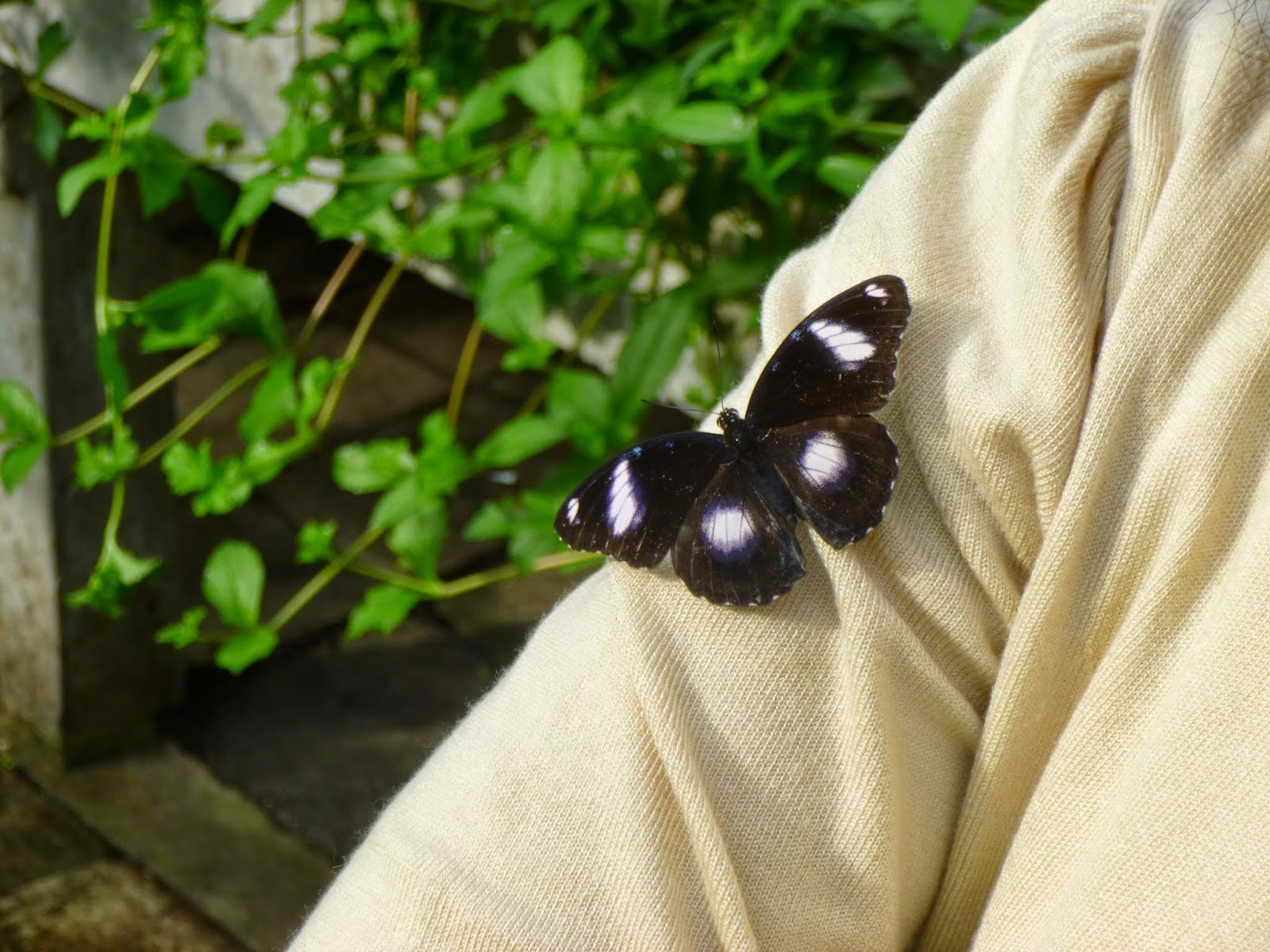
| Another Owl Butterfly |

 |
| Zebra Longwing butterfly, I believe |


 |
| This was a rather interesting tree. First, as you can see, it's been grafted and the graft is quite obvious since the very bottom of the trunk looks dramatically different from the rest of the tree. I don't remember the identity of the rootstock, but the scion (the top part of the plant) is apparently a species called Manna Ash or Plume Ash (Fraxinus ornus). I'd never seen this kind of tree before and outside of its handsome ornamental characteristics, I was interested to read that the tree apparently produces a sugary sap (known as Manna) that can be used as a gentle laxative! |
 | ||
This is a robust clump of Kalimeris pinnatifida, also known as Double Japanese Aster. Highly recommended by Allan Armitage at University of Georgia. I hope to try this in my garden at some point. Clearly it seems to have a flopping problem, at least when grown in a somewhat shady spot. (Maybe it's more upright with more sunshine?) Regardless, the foliage certainly looks much better than that of the New England Aster.
|

 |
| Finally, I bring you a Plant Behind Bars! Yep, it's a caged Wollemi Pine. Don't worry - the plant is not dangerous to people! Rather, it's people that might be dangerous to the plant, and since this is a very rare and endangered species -- once thought to be extinct -- the Hortus Botanicus is determined to protect it. It was quite a neat experience to see this so-called living fossil, a link to a faraway era. |


