Showing posts with label Ribes odoratum. Show all posts

Sunday, February 18, 2018

2018 -- Let's get this party started with some clove currant!


Hello and a belated happy 2018 to all you cheerful chipmunks out there!  🐹

Sorry for the radio silence recently. The garden was relatively dormant. The weather was chilly and/or windy and/or rainy. And I had a busted camera that kept me from documenting the winter landscape.

(Don't worry... you didn't miss much.)

So now I'm back with a new and improved camera in hand.

So come along for the ride. I've got a feeling this will be the Best Year Ever for the Garden of Aaron.

To kick things off...

New spring foliage on clove currant (Ribes aureum)
You've gotta love clove currant (Ribes aureum) leafing out in mid-February! This is reliably the first deciduous plant to leaf out in my garden. And are these copper-tinged new leaves beauties or what!

More new foliage on clove currant (Ribes aureum)
Another shot of these stunning new clove currant leaves. 

Stay tuned... in a couple of weeks, clove currant will probably look like this.

Instagram

Follow Aaron Dalton on Feedio

Monday, April 25, 2016

Class of 2016 -- Ribes aureum, Ribes odoratum, clove currant, golden currant

This clove currant (Ribes aureum) grows on a clay hillside to the east of an eastern red cedar (Juniperus virginiana). It gets a couple of hours of early morning sun, but is then in shade for the rest of the day. All clove currant photos in this post were taken on 4/22/2016.

I really like clove currant's soft, toothed foliage. I planted both of my clove currants last autumn and was pleasantly surprised to find out that they held onto their leaves into December and started leafing out very early in the spring (February). It just goes to show that not all 'deciduous' shrubs have the same visual impact in the landscape. Something like Vitex agnus-castus (chaste tree) or crape myrtle (Lagerstroemia spp.) could be bare for 5 months of the year, whereas clove currant could have foliage for all but 2 months of the calendar here in Tennessee.

Here's a close-up on the clove currant leaves. Sorry for the flash effect, but it was the only way I could capture any detail on the small insect (bee?) that I noticed resting on one of the leaves.


Why I'm growing Ribes aureum in my garden...

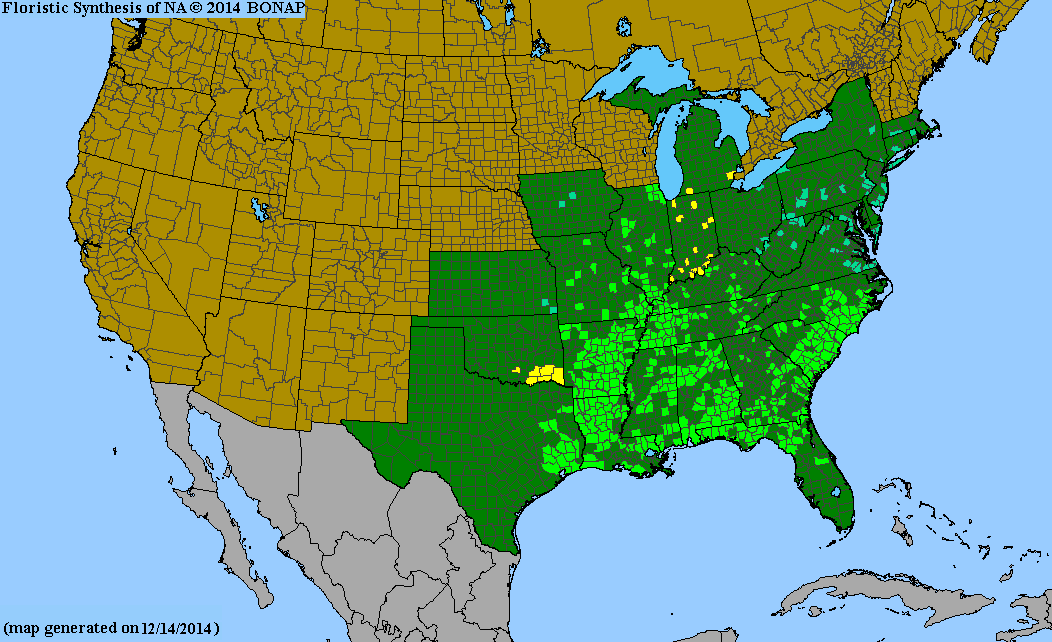
1) Although it is native mainly to western North America, there are fairly significant populations not too far west of here in Arkansas and Missouri, plus waif populations in Tennessee and other parts of the Eastern U.S.

2) The British Beekeepers Association reports that clove currant flowers provide nectar and pollen to bees.

3) UC Davis says that the flowers also attract butterflies and beneficial insects.

4) Missouri Botanical Garden recommends it as one of the best shrubs for heavy clay soils.

5) Pacific Horticulture claims that golden currant fruits are excellent for desserts and jellies. Clove currants are dioecious (meaning cross-pollination must occur between male and female plants in order for the females to produce fruit). Although there are female cultivars like 'Crandall', the straight species plants are generally sold unsexed. I bought two shrubs, but I don't know whether I have two males, two females or one of each. If I get lucky and cross-pollination does occur successfully, then the female shrub should produce fruit. 

Do you grow clove currant? If so, what has been your experience with this plant?

Note: Commenter HKCL mentions below that currant growing is banned or restricted in certain states, such as New Jersey. I could not find an official list of such restrictions in the U.S., so here is a link to a recent unofficial list.

Instagram

Monday, March 30, 2015

Cheekwood Botanical Garden in Spring - Flowering Quince, Cornelian Cherry, Hyacinths, Tulips, Winter Honeysuckle and More!

Chaenomeles x superba (C. japonica x speciosa) 'Jet Trail', flowering quince


'Jet Trail' quince looks like a good bee plant. I've never tried it, but I've read that ornamental quince (Chaenomeles spp.) produces a very hard fruit that can be used to perfume a room or even cooked to make jam.

The foliage emerges early (mid-March) on Heptacodium miconioides (seven-son flower), a Chinese tree that reportedly has fragrant late-summer flowers that attract bees and butterflies.

Beautiful peeling bark on the Heptacodium miconioides adds a lot of character and texture to the garden.

I confess I haven't had the courage to do much with bulbs (other than daffodils). I'm nervous that winter rains and heavy clay soil would be a death sentence for most bulbs. But since my wife was enamored with this hyacinth display, I guess I'll be digging holes and popping in hyacinth bulbs next autumn. Perhaps if I plant them on a hill they'll be OK?

There was something about these thick, twisting wisteria vines curled around a metal arbor that reminded me of the Elvish kingdom in Lord of the Rings. (FYI, Asian wisteria vines (Wisteria sinensis and Wisteria floribunda) are considered invasive in Eastern U.S. forests. And as you can see here, they can get massive over time. If you live in the Eastern U.S. and must have a wisteria, perhaps consider the American wisteria - W. frutescens - which is native primarily from Texas to Florida and Missouri to Kentucky.)

What a nice moss-covered rock. Gardeners in shady moist regions awash in moss would probably find this photo laughable, but in my moss-deprived garden, this would be a handsome sight. I have a few small patches of moss (including one shown in my last post) and am trying to encourage them to proliferate.

Cornus mas (cornelian cherry) flowers

Ribes odoratum (clove currant) leafed out nicely already in mid-March. Could the foliage withstand temperatures in the 20s? I'll have to make a return trip to find out... Primarily native to Western and Central North America from California to Arkansas and Washington to North Dakota, I think clove currant is supposed to be the only currant capable of surviving (or perhaps thriving?) in the heat and humidity of the Southeast.
There were bees (honeybees, I think) all over this blooming Lonicera fragrantissima (winter honeysuckle). Although some other exotic bush honeysuckles are considered highly invasive, winter honeysuckle apparently is much less of a problem from an invasiveness standpoint. For example, it has the lowest level rating (Alert) from the Tennessee Exotic Pest Plant Council (TNEPPC). By contrast, the TNEPPC considers Japanese honeysucke - L. japonica - to be a Severe Threat to native plant communities. Given this relatively well-behaved reputation and its clear appeal for bees, I may have to consider adding L. frangrantissima to my garden. As the common name suggests, the flowers have a marvelous scent that can be detected from some distance away when the shrub is in full bloom.

Cheekwood has a remarkable tulip festival in the Spring. We visited too early to see most of the tulips, but these precocious 'Rosy Delight' bulbs were putting on a good show! :)