Showing posts with label berries. Show all posts

Monday, October 19, 2015

Cultivars vs. Straight Species -- Viburnum Dentatum / Arrowwood Viburnum


So where do you stand on the whole cultivar vs. species issue?

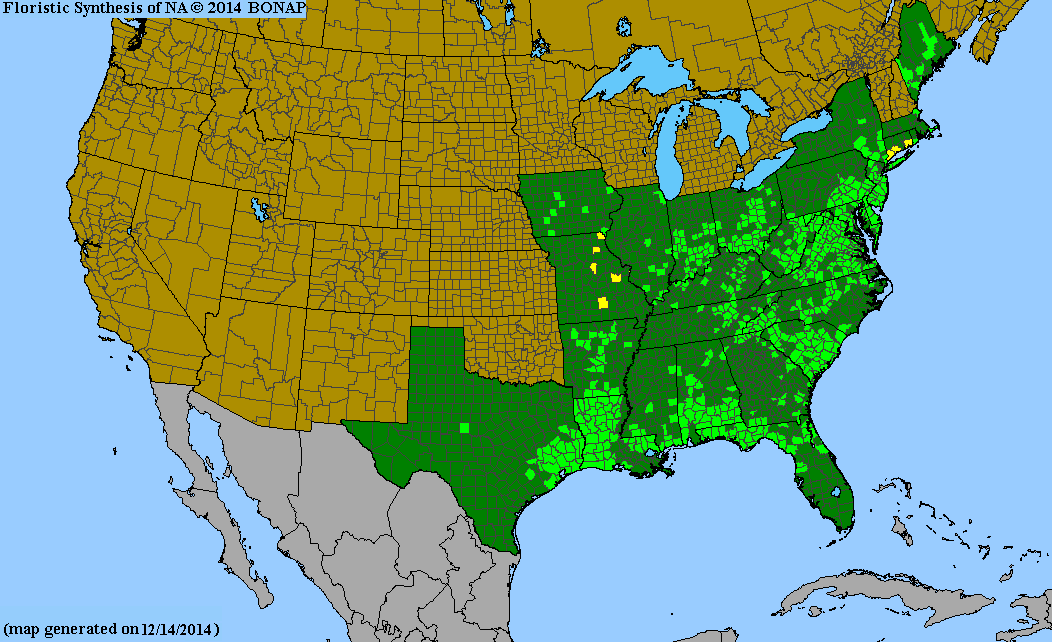
Here at Garden of Aaron, I grow three types of Viburnum dentatum (arrowwood viburnum), which is native throughout much of the Southeast, Midwest and Mid-Atlantic and up into New England.

Here is how the straight species looked in early October:

Here is the form of a Viburnum dentatum (straight species), growing in full sun and awful solid clay 'soil' (1st year in the garden)

Here's a close-up of the foliage, which I'd say still looks pretty darn fresh for early October!


Here is how the 'Pearl Bleu' cultivar looked at the same time:


Here's V. dentatum 'Pearl Bleu' -  as you can see, much of the foliage has folded in half and quite a few leaves have burnt edges.


And here is the 'Chicago Lustre®' cultivar, also on the same day:

By contrast, the foliage on the 'Chicago Lustre' cultivar of V. dentatum looks fresh, lush, healthy and deep green. 

Remember, these are all the same species - just different cultivars - growing in very similar conditions.

In fact, here's a side-by-side shot to show you that 'Pearl Bleu' and 'Chicago Lustre' are growing literally side-by-side. They're both on the northwest side of the house, which gets mostly shade all morning, but bakes in a surprising amount of sun on summer afternoons. In fact, I'd say 'Chicago Lustre' may actually get more of the afternoon sun and perhaps provides a bit of shade to its 'Pearl Bleu' companion.

'Pearl Bleu' on the left, 'Chicago Lustre' on the right. Both shrubs were planted at the same time. Both actually died back to the roots (after I stored them in the garage over the winter and shamefully neglected them), but 'Chicago Lustre' has clearly roared back more vigorously than 'Pearl Bleu'...


Interestngly, the straight species produced more fruit this year than either of the cultivars (although the berries on Chicago Lustre appeared to be larger and more plump than those on the species). All the Viburnum dentatum berries on the species plant and 'Chicago Lustre' have already been devoured by the birds. (I suspect that a mockingbird and a blue jay divided the ones on the species plant.)

I'm planning to add a few more V. dentatum cultivars to the garden this autumn (from Classic Viburnums nursery, which has an amazing selection of the genus), so perhaps I can report back in a year to give a comprehensive overview of the relative strengths of the different cultivars vs. the species.

Oh and then there's this little seedling that popped up on the corner of the house right near where 'Chicago Lustre' and 'Pearl Bleu' could have canoodled. I've transplanted it to someplace where it will have a bit more room to spread its wings...

I'm fairly sure that this is a Viburnum dentatum seedling. It seems to have taken the transplantation well. You'll notice that the foliage is lighter-green and has more of a matte finish, but otherwise seems just as clean and healthy as the 'Chicago Lustre' foliage. 


How about in your garden?

Do you like growing straight wild species plants or do you seek out cultivars?

Personally, in some cases I favor the straight species and in other cases I see the merits of cultivars.

For instance, I chose to grow the 'Miss Huff' cultivar of Lantana camara because it is supposed to have better cold hardiness than the species and I was worried that the straight species would not survive here in Tennessee. (Actually, I'm not sure one can even find a straight species Lantana camara at nurseries. The only ones I've seen for sale are different cultivars.)

With Viburnum dentatum, the jury is still out for me. I'd say that the species has done much better so far than 'Pearl Bleu', but I quite like the 'Chicago Lustre' cultivar.

In other cases - for instance with Echinacea purpurea (purple coneflower) - I only grow the straight species. For one thing, I've read that the species is tougher and has greater longevity than the cultivars.

The cultivars of many flowering plants are bred to have bigger, fancier, 'double' flowers. But if you garden to help the bees and other pollinators like I do, you're probably better off choosing a plant with simpler, single flowers. As GardenersWorld.com says: "Most double flowers are of little use [to bees], as they're too elaborate. Some are bred without male and female parts, while others have so many petals that bees can't get to the nectar and pollen. So single dahlias are popular with many bees, while doubles are usually ignored."


Instagram
Follow Aaron Dalton on Feedio

Thursday, July 30, 2015

Zombies in the Garden


Anise-scented sage (Salvia guaranitica) - it's....back from the DEAD!!


I think zombies get a bad rap.

Well, garden zombies that is!

I'm talking about those plants that you try to kill. You get so frustrated with their underperformance (or in some cases their exuberance) that you rip them from the ground, tear them limb from limb, cut off their heads and put a metaphorical stake through their roots/hearts.

I guess weeds would often qualify as zombie plants, but here I'm talking about a couple of gentler souls that I tried to evict from the garden, but which have won my grudging respect and admiration from the way they miraculously reappeared.


Salvia guaranitica (anise-scented sage) is native to South America (Brazil, Argentina and Uruguay). I planted it for its stunning dark blue flowers and its reported ability to attract and support butterflies and hummingbirds.

But it was very pouty and wilty last year, so I got fed up and shovel-pruned it.

....or so I thought!

But a month or two ago, I saw some familiar-looking foliage popping up in the same spot where S. guaranitica lived last year. Yep, it was back! And strangely, it seems a bit heartier and stronger than before, blooming through the past few weeks of miserably hot, humid weather without even a whimper.

I mean, once you've pulled a Lazarus, I guess everything else is a piece of cake!

(I will note that S. guaranitica is often only rated as hardy to USDA zone 8, whereas I garden on the zone 6/7 border, so we're talking about a plant that defies death in multiple ways!)

The other dearly-not-so-departed plant to make a surprise return to the garden stage is Callicarpa americana, American beautyberry.

You can't keep a good beautyberry down...


I have to admit I was feeling a bit guilty about ripping American beautyberry from the garden last winter, but again it had been a chronic underperformer. It just about croaked when I planted it in full sun originally, and even after I moved it to a partial shade spot in the front border, it seemed awfully delicate and wishy-washy.

But it is a Southeastern native and it does reportedly provide good food for the birds (with its bright purple berries) so I'm glad to find this zombie back in the garden.

And as with the S. guaranitica, beautyberry actually seems much stronger and healthier this time around!  (I suppose with the beautyberry, there's a possibility that I'm actually seeing a seedling rather than the original plant, in which case it could make sense that the seedling is better adapted to its environment than a transplant...)

Have you ever had any (desirable) plants in your garden come back from the dead? And did you welcome these 'zombies' when they showed up?

(Hey, at least they're not asking for brains!!) ;-)

PS - Want to stay up-to-date on garden reincarnations and other miraculous happenings? Don't forget to sign up for an email subscription so you never miss a beat!

Tuesday, June 17, 2014

A New Taste: Serviceberry

Amelanchier x grandiflora "Autumn Brilliance"
Photo taken at Atlanta Botanical Garden, May 2014

One of the things you start discovering when you dive into gardening and horticulture is just how few of the world's edible plants (i.e. plants people can eat) have been widely commercialized.

As a result, even if you've reached the ripe old age of 30-something (as I have), you can still have a brand new taste sensation.

In my case, it happened last month when I was visiting the Atlanta Botanical Garden and came across the marvelous serviceberry tree (Amelanchier x grandiflora "Autumn Brilliance") in the edible part of that garden.

Perhaps to the annoyance of the birds who were hopping from branch to branch gorging themselves on the fruit, my wife and I each snuck a few berries. They were very tasty!

Serviceberries (Amelanchier x grandiflora "Autumn Brilliance")
Close up on Serviceberries
Photo taken at Atlanta Botanical Garden, May 2014


I've been talking to some horticultural experts recently at botanic gardens around the country and several have recommended the serviceberry for both its aesthetic and edible qualities.

If you're looking to add some home-grown fruit to your garden with a versatile small tree that reportedly often has very nice fall foliage, Serviceberry could be just the ticket.

Robin amid serviceberry foliage
Look closely.
Can you spy the robin amid the Serviceberry foliage?
Serviceberries can feed the birds, while perhaps giving you some berries for your own table.
Photo taken at Atlanta Botanical Garden, May 2014

Friday, June 6, 2014

Atlanta Trip Report #3 - Mandarin Oriental English Garden


Garden pool at Mandarin Oriental, Atlanta
Beautiful formal pool in the middle of the English Garden at the Mandarin Oriental Atlanta.
Love the flagstone hardscape surrounding the pool. Very chic.

Despite being situated in the middle of Buckhead, one of the fanciest neighborhoods in the midst of urban Atlanta, where real estate values are probably stratospheric, the Mandarin Oriental Atlanta hotel has set aside a blissful bit of greenery - an English Garden where you can reboot and escape the stresses of the city.

The Mandarin graciously offered to host me on my trip to Atlanta last month. Which meant I had some quality time to get up close and personal with the garden. Here's what I found:

I saw some of the biggest, most beautiful Oakleaf Hydrangeas of my life in the Atlanta area -- and several of them were right in the Mandarin Oriental's garden. Check out those loooooooong flower panicles!

Blue spruce surrounded by hostas at the Mandarin Oriental garden
Here's a bold color combination - a metallic blue spruce surrounded by chartreuse hostas. Zowie!
(Incidentally, I've heard that blue spruces don't do very well in the Southeast, but they're available at local Tennessee nurseries and this one seemed to be doing fine in Atlanta. Any other Southeast gardeners care to chime in about their experiences with blue spruces?)

Remember my foliage posts (1 and 2) from last month? Here's more evidence that you can have a wild color palette even without flowers by combining blue spruce, purple Japanese maple, green hedges and a mix of yellow and variegated grassy groundcovers

Here's the same planting bed -- I just backed up a little to capture the wild Russian Sage (Perovskia atriplicifolia) sprawling nearby. I liked the fact that not everything in this garden was trimmed to within an inch of its life. Now if only I could figure out why the Mandarin Oriental's Russian Sage is thriving while I had to cut mine to the ground for rejuvenation...
Rosemary hedge at Mandarin Oriental Atlanta garden
This Rosemary 'hedge' alongside the pool looked robust and healthy. Last year, the Mandarin Oriental Atlanta apparently had an entire herb section its garden. After a redesign, that herb garden is gone, but the chefs are planning to grow a few of their more frequently used garnishes in the garden this summer.

Of course, I didn't spend all my time in the garden. My wife and I had the chance to sample breakfast at the Mandarin Oriental's Cafe. I love the fact that the Mandarin's restaurant emphasizes fresh, local and organic cuisine.

This spicy cajun shrimp and grits dish used local North Georgia grits from Nora Mill. The grits themselves may  have been the creamiest I'd ever eaten. (Apparently the chef uses "a little" butter.)

Can't beat fresh-squeezed OJ - one of the best glasses I've had since I visited Valencia, Spain

The berries used to top the skillet french toast apparently are local and/or organic. Oh and the restaurant uses organic eggs too. So yeah, there's a whole lots of tasty organic stuff going down.
I should mention that you don't need to stay overnight at the Mandarin Oriental Atlanta to visit the garden. If you're having breakfast, lunch or dinner at the Cafe, feel free to spend some time in the garden before or after.

If you stop by to hear Friday night jazz at the Taipan lounge (8 p.m. to midnight), you can clear your head with a romantic stroll in the moonlit garden. (Presuming the moon happens to be shining that night, of course. Not even the Mandarin can make the moon appear on demand.) 

Here's a word to the wise -- if you do want to listen to jazz in the lounge, make sure to request reservations. It's a hot ticket and most seats were sold out early in the evening, although the room does clear out somewhat as the evening wears on if you want to stop by later on.

There's one other way to experience the Mandarin Oriental Atlanta's garden. The hotel will be throwing a summer garden party that is tentatively scheduled for July 3rd. There's no entry fee for this shindig, so if you're in the neighborhood, feel free to enjoy the ambiance, some live music and some creative libations prepared by a "guest mixologist" at the cash bar.