Showing posts with label aggressive. Show all posts

Monday, October 2, 2017

Strawberries Must Go!

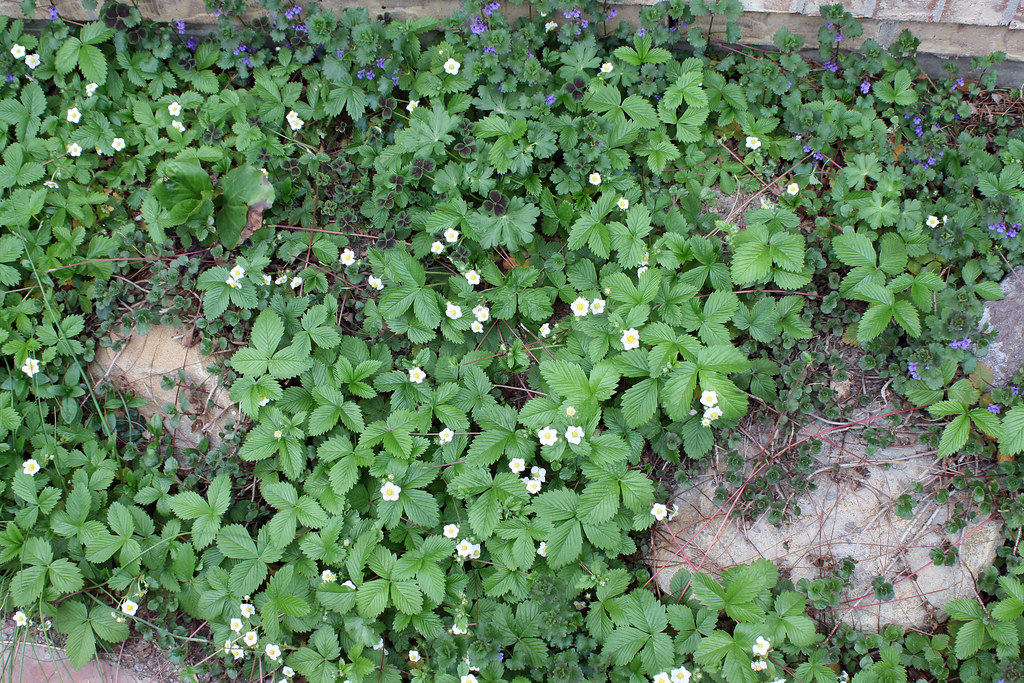
Wild strawberry (Fragaria virginiana) doing what it does best - covering ground.
Photo by Patrick Standish


I thought that I had it all figured out.

But that's what gardening is good at -- Just when you're feeling cocky, it pulls the rug out and shows you who's boss.

At first, I thought wild strawberry (Fragaria virginiana) would be the answer to my prayers. I've been searching for a tough groundcover (ideally native) that would cover all the bare dirt in my beds, block weeds and provide a beautiful green backdrop for all the other perennials, shrubs and trees in the garden.

Wild strawberry definitely excels in the fast groundcover category - like 10-feet-in-every-direction-in-a-single-season fast.
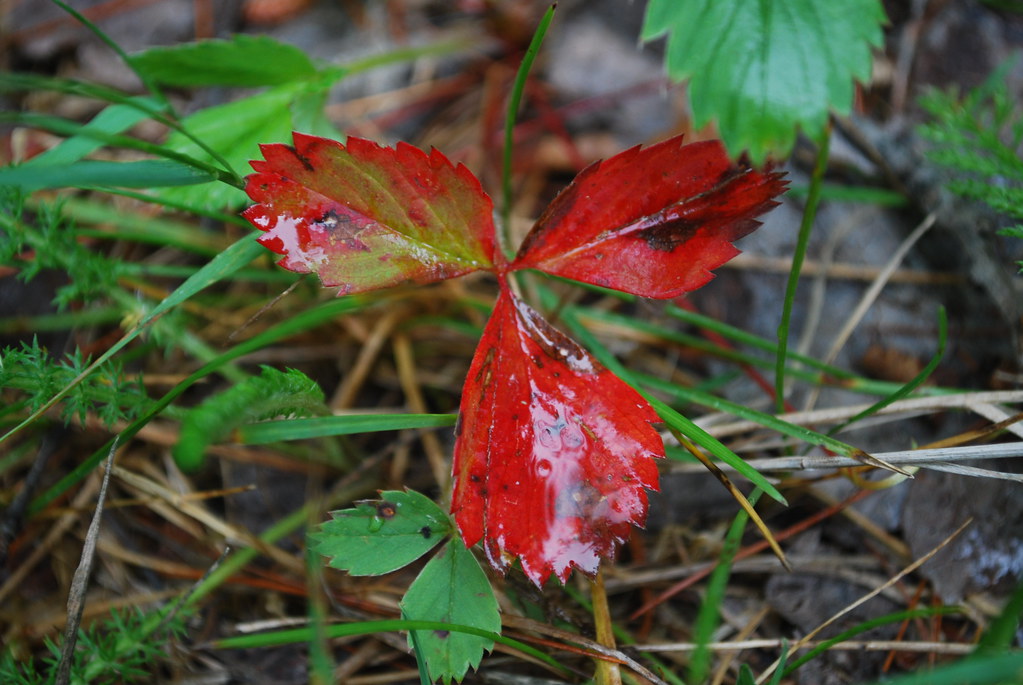
I will admit that wild strawberry foliage can display some excellent, vibrant colors in fall and winter. Photo by Joshua Mayer


Of course, I should have known better.

Just like canopy trees planted next to a house foundation don't stop growing when they hit 10-feet tall, a rampant groundcover doesn't stop expanding when it hits the end of a bed.

In the case of a plant like wild strawberry that throws out long above-ground stolons, it just starts gunning for the lawn or sprawling onto the patio, the sidewalk, the driveway, etc.

Once I realized it would be a daily (hourly?) chore to keep it in bounds, I decided to remove it. Since then, I've spent hours and hours trying to evict wild strawberry from the garden.

I know it's a native here (though I don't remember ever seeing it in the wild). And it's probably a lovely plant in the right circumstances, but I just couldn't keep up with it here.
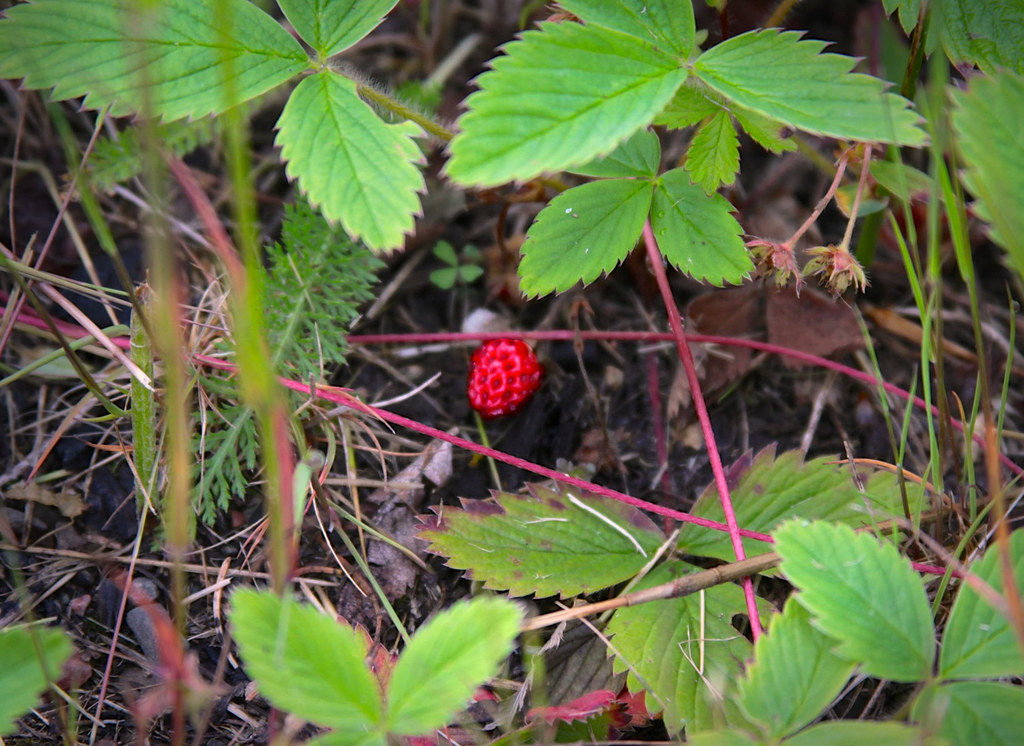
The wild strawberry fruit is tiny (compared to the typical commercialized hybrid berry that you find at a grocery store, farmers market or pick-your-own farm). Notice all the wiry, red stolons that connect the strawberry plantlets. Photo by espie (on and off)

For those who are wondering, it also didn't yield much fruit. A chipmunk (or chipmunks) got most of the fruit it did produce. And contrary to the rhapsodies you find on the Internet, I did not find the taste of wild strawberry fruit particularly impressive. In fact, I'd say that market hybrid strawberries are much sweeter and juicier. But I might have picked my wild strawberry too soon. I was pretty sure that if I waited another day or two, a critter would beat me to the punch and I wouldn't get to taste it at all.

So where does this leave me in terms of groundcovers?

I'm still trialing a few spreaders:

Erigeron pulchellus (rose petty)
- Epimedium x perralchicum 'Frohnleiten'
Packera obovata (golden groundsel)
Asarum canadense (wild ginger)
and
- Coelestinum conoclinium (blue mistflower).

I'm also thinking about certain reseeding, clumping plants as groundcovers in their own right. Plants like
- Agastache foeniculum
Baptisia australis
- Gaillardia x grandiflora 
and
- Platycodon grandiflorus)

And a couple of woodies:

Cephalotaxus harringtonia 'Prostrata'
and
Juniperus virginiana 'Grey Owl'


I know some readers might feel that I'm too picky, that I want it all. Can't I just give up this wild goose chase and blanket my beds in wood chips, compost or pine straw like everyone else?

Nope. Not yet. I haven't given up hope quite yet.


Instagram

Follow Aaron Dalton on Feedio

Monday, May 1, 2017

Blue Mistflower - Love It or Fear It?


Blue mistflower (Conoclinium coelestinium). Last year, this started as just a tiny quart-size plant. This year, it's on the march!


As with other fast-spreading yet herbaceous perennials (e.g., mountain mint), I'm not quite sure about the best way to use blue mistflower (Conoclinium coelestinum) in my garden.

On the bright side, as I wrote last November, it has a nice long autumn bloom season with flowers that attract pollinators.

On the other hand, as Tammy and Jason both pointed out last year, blue mistflower likes moisture. Although it's planted in heavy clay that gets sodden in winter and early spring, the area also bakes in summer. Of the three clumps I had growing last year, it looks like only one clump (the healthiest and strongest) came back this year.

That surviving clump has expanded dramatically - from a 3.5-inch pot to probably close to 4 square feet in about 18 months. I recognize that I kvetched in a recent post about some groundcovers - Epimediums and partridge berry -  spreading too slowly.

How can I turn around and complain about a groundcover spreading too fast? Aren't groundcovers supposed to cover ground.

Sure they are.

But as with many things in life, I think there is an ideal happy medium here. I don't want a 'groundcover' that pokes along, only extending its coverage by a couple of inches per year.

But I also don't necessarily want a groundcover that races across the property, smothering small buildings in a single season.

I'm much more leery of aggressive plants if they're exotic. I don't want to be responsible for unleashing havoc on the local ecosystem. It's one of the reasons why I gave plants like blue star creeper, creeping raspberry, sweet woodruff and Ajuga the heave-ho.

(Well, I'm trying to evict Ajuga from the garden. It's putting up a heck of a fight to stay.)

I'm much more willing to tolerate aggressive plants if they're native and/or easy to remove. For example, wild strawberry (Fragaria virginiana) spreads pretty darn fast, but (a) it seems to spread only via above-ground stolons (so I can at least keep track of its spread versus those plants that extend their territory via underground rhizomes), and (b) it seems very easy (so far) to uproot any clumps that grow where they are not wanted.

When the blue mistflower gets a little taller, I plan to go out after a rain and see how hard it is to pull out some stems along the edges of the clump. Basically, I want to see how much of a struggle it will be to keep this in bounds.

(Update - I went and tried this and the blue mistflower stems at the edge of the clump seemed quite easy to pull. That makes me feel a bit more confident that I could keep blue mistflower from overwhelming other nearby plants...)

If I do let it stay and it romps through the back garden, I envision a lot of late winter or early spring maintenance.

It's not such a big deal chopping down stems on a few clumps of rose mallow (Hibiscus moscheutos), but I think it's another matter entirely to find a way to deal with 100 square feet of a tough-stemmed herbaceous and rhizomatous perennial.

For anyone who has a large stand of blue mistflower or any other aggressive perennial (e.g., one of the rhizomatous goldenrods, a spreading Monarda or a mountain mint), how do you handle winter clean up of large swaths of dead stems. Do you cut back by hand with a bypass pruner or shears? Do you use a mower?

Blue mistflower leaves, up close and personal


Then there's the issue of blue mistflower being deciduous/herbaceous. It dies back in winter and didn't make an appearance this year until late March / early April. If it covers a lot of ground in spring, summer and fall, that means a lot of bare ground from late autumn to early spring. I worry about weeds getting a toehold in that bare dirt.

That's why I've gravitated toward low-growing evergreens ('Biokovo' geranium, wild strawberry, golden groundsel, Robin's plantain, etc.) in my search for ideal groundcovers.

Anyway, blue mistflower is still in the garden for now. If you grow this plant - or something similar in habit - I'd love to hear how you integrate it into your garden to enjoy its assets without having it become a maintenance nightmare.

Instagram
Follow Aaron Dalton on Feedio

Friday, April 21, 2017

No One to Blame but Myself - Geranium sanguineum and Ajuga genevensis

Geranium sanguineum looks innocent, but it's a bloody nuisance to remove
Geranium sanguineum looks so innocent, but don't be fooled. I've tried ripping out this plant about five times and it keeps growing back!

I have weeds aplenty.

Some blow into my garden (dandelions, for instance), while others (looking at you, wild grape and oak seedlings) presumably are gifts from birds or squirrels.

That's OK. It's part of the gardening life. As I cover more ground with plants I do want in the garden, I anticipate gradually being able to displace some of those I don't want in the garden.

Meanwhile, I pull. And use the CobraHead.

But what really burns my biscuits are the plants that I add to the garden and then decide were awful, terrible, no-good mistakes that must be evicted.

Sometimes, I shovel-prune plants (looking at you, gardenia and Carolina allspice) because they have died. That's discouraging, but at least those mistakes don't come back to haunt me.

Other times, I have to work a bit harder to rip out overly aggressive / invasive plants (e.g., lemon balm, creeping raspberry, blue star creeper, sweet woodruff) that wear out their welcome, but at least those guys have the decency to leave for good when asked. (And when I say "asked," I mean ripped out of the ground.)

I had a tough time kicking out hardy blue plumbago. It kept trying to make a sly comeback with a stem or two here and there, but I think I've finally gotten rid of it.

Still, none of those compare to the challenge I've had removing Geranium sanguineum and Ajuga from my sticky clay soil.

This is a good time to note that there can be massive differences between the way different species from the same genus behave in the garden. What I'm trying to say is - Just because G. sanguineum has been a bully in my garden, don't tar all the other cranesbill geraniums with the same brush.

'Rozanne' hybrid geranium is a perfectly well-behaved herbaceous perennial that flowers for months. In my experience, it doesn't quite have the heat tolerance or drought tolerance to thrive in a tough-love garden setting in Tennessee, but it's still a very nice plant.

And 'Biokovo' cranesbill geranium (G. x cantabrigiense) is one of my favorite geraniums and one of the top groundcovers I've found for Tennessee. It's basically evergreen here, developing nice red tints to the foliage in winter, has nice flowers that attract bumble bees and expands at a manageable pace. If it goes someplace unwanted, I've found it easy as pie to lift up and remove or relocate a chunk.

Then there's G. sanguineum - bloody geranium. I suppose it's called 'bloody geranium' because of its bright red roots, but it deserves the name for being a bloody nuisance. OK, I'll give it props for being fairly tough and semi-evergreen, but it's quite aggressive. Once it's established, it starts spreading far and wide via deep (relative to the size of the above-ground plant) and thick roots.

Even small blood geranium clumps put down deep roots before they start spreading laterally.

Try to remove the plant and those roots tend to snap (at least when you're pulling them from sticky, heavy clay - sand or loam might be a different story). Leave any bits of roots in the soil and the plant will reemerge to laugh at you behind your back. There are places where I've dug wide holes 10 inches deep trying to get all the root fragments and the plant still pops up after I've backfilled or jumps up somewhere nearby. (I think it also spreads a bit by seeding, though fortunately the seedlings show up near the parent plant and the self-seeding has not been rampant.)

Meanwhile, I'm loathe to plant anything else where I've tried to evict the bloody geranium, because I worry that the geranium will pop up again and I'll have to dig up the whole area, damaging the new plant.

So right now, I have a number of holes and bare spots in the garden where I'm just waiting for the bloody geranium to re-emerge so I can dig up another missed root. I suspect this will continue for months. At least.


Ajuga genevensis returns after a weeding attempt
Ajuga genevensis after I tried ripping it out last winter. Clearly, I failed the first time around.


Ajuga genevensis is in the same category. Well, except that the roots don't go as deep and I haven't tried ripping out (yet) as many times as the bloody geranium.

Still, from the picture above, you can see that it hasn't been impressed by my eviction efforts. I thought I'd torn out a rather large, thick patch of A. genevensis last winter, but clearly all I did was prune it.

Once I had praised A. genevensis for being less aggressive (and more evergreen in Tennessee) than the typical Ajuga (A. reptans) that you usually find at plant nurseries. It's true that A. reptans spreads a bit faster and less predictably, but I've found all the Ajugas are challenging to remove through hand pulling.

I hope my experiences save some other gardeners time, effort and hair-pulling.

Meanwhile, I continue to evaluate groundcover alternatives, focusing on natives. As I mentioned in a recent post, I think that effort is bearing fruit.

I'll keep observing and plan to post an update either at the end of this year or next spring with an overview of the best groundcover candidates so far.

How about in your garden? Have you planted anything aggressive that you later regretted? If so, did you succeed in evicting it or have you given up and simply found a way to live with it?


Instagram

Follow Aaron Dalton on Feedio