Showing posts with label blue mistflower. Show all posts

Monday, May 1, 2017

Blue Mistflower - Love It or Fear It?


Blue mistflower (Conoclinium coelestinium). Last year, this started as just a tiny quart-size plant. This year, it's on the march!


As with other fast-spreading yet herbaceous perennials (e.g., mountain mint), I'm not quite sure about the best way to use blue mistflower (Conoclinium coelestinum) in my garden.

On the bright side, as I wrote last November, it has a nice long autumn bloom season with flowers that attract pollinators.

On the other hand, as Tammy and Jason both pointed out last year, blue mistflower likes moisture. Although it's planted in heavy clay that gets sodden in winter and early spring, the area also bakes in summer. Of the three clumps I had growing last year, it looks like only one clump (the healthiest and strongest) came back this year.

That surviving clump has expanded dramatically - from a 3.5-inch pot to probably close to 4 square feet in about 18 months. I recognize that I kvetched in a recent post about some groundcovers - Epimediums and partridge berry -  spreading too slowly.

How can I turn around and complain about a groundcover spreading too fast? Aren't groundcovers supposed to cover ground.

Sure they are.

But as with many things in life, I think there is an ideal happy medium here. I don't want a 'groundcover' that pokes along, only extending its coverage by a couple of inches per year.

But I also don't necessarily want a groundcover that races across the property, smothering small buildings in a single season.

I'm much more leery of aggressive plants if they're exotic. I don't want to be responsible for unleashing havoc on the local ecosystem. It's one of the reasons why I gave plants like blue star creeper, creeping raspberry, sweet woodruff and Ajuga the heave-ho.

(Well, I'm trying to evict Ajuga from the garden. It's putting up a heck of a fight to stay.)

I'm much more willing to tolerate aggressive plants if they're native and/or easy to remove. For example, wild strawberry (Fragaria virginiana) spreads pretty darn fast, but (a) it seems to spread only via above-ground stolons (so I can at least keep track of its spread versus those plants that extend their territory via underground rhizomes), and (b) it seems very easy (so far) to uproot any clumps that grow where they are not wanted.

When the blue mistflower gets a little taller, I plan to go out after a rain and see how hard it is to pull out some stems along the edges of the clump. Basically, I want to see how much of a struggle it will be to keep this in bounds.

(Update - I went and tried this and the blue mistflower stems at the edge of the clump seemed quite easy to pull. That makes me feel a bit more confident that I could keep blue mistflower from overwhelming other nearby plants...)

If I do let it stay and it romps through the back garden, I envision a lot of late winter or early spring maintenance.

It's not such a big deal chopping down stems on a few clumps of rose mallow (Hibiscus moscheutos), but I think it's another matter entirely to find a way to deal with 100 square feet of a tough-stemmed herbaceous and rhizomatous perennial.

For anyone who has a large stand of blue mistflower or any other aggressive perennial (e.g., one of the rhizomatous goldenrods, a spreading Monarda or a mountain mint), how do you handle winter clean up of large swaths of dead stems. Do you cut back by hand with a bypass pruner or shears? Do you use a mower?

Blue mistflower leaves, up close and personal


Then there's the issue of blue mistflower being deciduous/herbaceous. It dies back in winter and didn't make an appearance this year until late March / early April. If it covers a lot of ground in spring, summer and fall, that means a lot of bare ground from late autumn to early spring. I worry about weeds getting a toehold in that bare dirt.

That's why I've gravitated toward low-growing evergreens ('Biokovo' geranium, wild strawberry, golden groundsel, Robin's plantain, etc.) in my search for ideal groundcovers.

Anyway, blue mistflower is still in the garden for now. If you grow this plant - or something similar in habit - I'd love to hear how you integrate it into your garden to enjoy its assets without having it become a maintenance nightmare.

Instagram
Follow Aaron Dalton on Feedio

Wednesday, November 9, 2016

Hello, November! :)


No rain in 2 months? If you're Salvia greggii (autumn sage), apparently you don't care.

We're going through a dry spell.

A no-rain-in-two-months kinda dry spell.

I recognize that's no big deal in some parts of the country (e.g., California, Arizona, heck even Pacific Northwest in the summertime), but it's quite unusual in the Southeast.

Still, I guess I'd rather have a drought now than in the Spring. At least this time of year, plants are getting ready to go dormant for winter anyway so many of them just call it quits and shut down a little sooner in the case of a drought.

(At least, I'm hoping that's the case. Clearly I won't know whether there's any more serious damage until the shrubs leaf out and the perennials emerge from dormancy - or not - next spring.)

Nonetheless, with only minimal amounts of supplemental irrigation, some plants in the garden continue to put on a fantastic show, attracting and supporting beautiful wildlife...


Balloon flower (Platycodon grandiflorus)  

More balloon flowers still to come! They're budding and getting ready to bloom as we head toward mid-November! 


Bee on the blanket flower (Gaillardia x grandiflora). This is a volunteer blanket flower. I like how this photo shows the multiple stages the flower goes through. On the bottom right, you have a bud just starting to open. After the flower blooms, the petals fall off to reveal a yellow puffball. Eventually, you have the smaller silver starbursts that fade to tan. It's hard to think of a flower that looks prettier at every stage of its life!


"This flower ain't big enough for the two of us."
"Um...yes it is."

Blue mistflower (Conoclinium coelestinum), a native that's been blooming for months and attracting small clouds of skipper butterflies on warm days. (This was a cool, breezy morning. No butterflies in sight.)

Unknown Camellia sasanqua and honeybee. This plant and a few Russian sages are the favorite plants for honeybees in my autumn garden.

Aronia arbutifolia (red chokeberry). The berries are pretty, but birds don't seem interested in them. And having tried them, I can tell you there's a reason they're called chokeberry - their astringency is off the charts. I may actually be removing this plant from the front foundation once these berries have fallen off. The foundation planting is a little overcrowded and I'd rather give more space to the adjacent oakleaf hydrangea (Hydrangea quercifolia). 

A few pretty fruits on the 'Sugar Tyme' crabapple. I think this crab gets ravaged by cedar-apple rust fungus spread from all the nearby eastern redcedars that I planted (Juniperus virginiana). It's a pity. Maybe it would do better on decent soil with irrigation, but it's surviving (and sending up suckers) on heavy clay in hot baking sun all day.


Senna marilandica (wild senna) seedpods. Lots of seedpods on this plant. I harvested many of the seeds, but have left these to dry on the plant (and hopefully provide some volunteers).

Tomatoes in November?! Well, we have had record warmth recently... This is an unnamed volunteer cherry tomato that sprung up next to the house. I didn't harvest many fruits from it this year, but the chipmunk(s) got some.

The autumn drought has meant that leaf colors have been muted for the most part, but this Viburnum ashei is putting on a good show. Love the reds!


Wish you a beautiful month and a happy, hopeful, peaceful holiday season ahead...


Instagram

Follow Aaron Dalton on Feedio

Monday, January 4, 2016

Class of 2016 -- Conoclinium coelestinum, blue mistflower


Happy New Year!

I hope you all will have a wonderful, exciting (yet peaceful) and happy 2016!

This year, many of my blog posts will be for the purpose of introducing new plants that I'm adding to the Garden of Aaron.

Some of these plants were actually added to the garden a few months ago, but since 2016 will be their first growing season, I'll be introducing them throughout this year.

My plant is to introduce one new plant each Monday morning.

As the year progresses, the introductions probably will come to include some details about how the plants have performed their first year in the garden.

Without further delay, here's the first introduction!

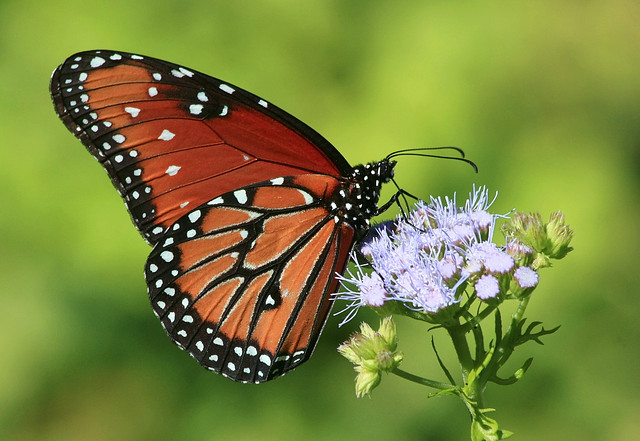
Butterfly visiting blue mistflower, Conoclinium coelestinum (photo via TexasEagle)

Why I'm growing Conoclinium coelestinum in my garden...

1) It's native to Tennessee and much of the Eastern U.S.

2) Gail at clay and limestone gave it an incredibly enthusiastic review, praising its ability to support butterflies, bees and birds.

3) I purchased some cut stems of blue mistflower from Laura Bigbee-Fott at a Nashville farmers market last summer and was impressed by the way that the flowers lasted up to 2 weeks in a vase.

4) It is supposed to be drought tolerant, capable of growing in full sun or partial shade, and resistant to damage from both deer and rabbits.

5) Some gardeners say it can spread too aggressively, which gave me pause. But I have a lot of open space to fill in a couple of garden beds in the backyard, so I figure I won't mind if this native wildflower naturalizes itself back there -- especially given its wildlife-friendly qualities.


Do you grow blue mistflower? If so, what has been your experience with this plant?

Instagram