Tuesday, September 15, 2015

Ah, to Bee in Paris!

This is the beehive that sits on a balcony on the 7th floor of the Hyatt Paris Madeleine. The hotel conceptualized and created a mascot called Maddie the Bee to try to make bees seem less intimidating to children. As you can see, Maddie is very French -- she is even wearing a beret. (Photo courtesy of Hyatt Paris Madeleine)

Ah, Paris.

City of Love.

City of Light.

City of honeybees on 7th floor hotel balconies.

Well, perhaps the last description is not so well-known, but it is accurate, at least in the case of the Hyatt Paris Madeleine, a charming boutique hotel with its very own honeybee hive right in the heart of Paris.

Whenever I travel, I always try to stay someplace that demonstrates some commitment to the environment.

The Hyatt Paris Madeleine recognizes that honeybees are in trouble and so it has installed and maintains this hive to show support for the bees.

I also like the fact that the hotel hosts an event where local elementary schoolchildren can watch a beekeeper harvest the honey and ask any questions they may have about bees or beekeeping.

The beekeeper at the Hyatt Paris Madeleine makes a point during the honey harvest. (Photo courtesy of Hyatt Paris Madeleine)


Laura, who works in communications at the Hyatt, very kindly gave me a tour of the beehive area. Although she assured me that these are sweet-natured bees, I got to suit up in the white pullover and helmet that beekeepers wear. (Sorry I forgot to ask for a blogger-as-beekeeper photo.) Then we stepped gingerly out on the small balcony and I shot this video of the bees buzzing in and out of their hive.


(The suit seemed unnecessary. The bees did not seem at all perturbed by presence. In fact, they ignored me entirely.)

Later on, I got a chance to sample some of the latest crop of honey and was very impressed. I have to say that it's among the most floral and 'perfumed' honeys I've ever tasted. I'd even go so far as to call it a 'romantic' honey -- the bees have managed to imbue it with the spirit of Paris!

A jar of the 2015 honey crop from the hive Hyatt Paris Madeleine. This little information card in all the rooms not only gives guests a chance to save water and detergent (by refraining from having their sheets laundered every day), it also makes sure they learn about the hotel's beekeeping program and hopefully sparks a conversation on the rationale and importance of such an initiative.


Laura mentioned that the chef in the Hyatt's on-site restaurants, Cafe M and Chinoiserie, incorporates the hotel's honey each year into a special dish/dishes. Last year, the honey showed up in a poached peach desert alongside lime blossoms and red currants. This year, the chef incorporated the honey into a sorbet (shown below).

This seasonal sorbet incorporated honey from the Hyatt Paris Madeleine's own beehives.

Beyond the bees and the honey, the Hyatt Paris Madeleine is still a pretty sweet hotel. The rooms are modern and spacious (for Paris). There's even a little spa in the basement with steam room (they call it a 'hammam') and dry sauna, plus a small relaxation room for chilling out with ambient music.

And I got a kick out of learning that the glass ceiling in the hotel atrium was designed by the workshops of Gustave Eiffel.

This is a view from the lobby looking toward the atrium. You can glimpse the glass roof designed by Mr. Eiffel's studio. (Photo courtesy of Hyatt Paris Madeleine)


You may have heard of Mr. Eiffel. He's well-known for a certain eponymous tower (visible from certain rooms at the Hyatt)...

Mr. Eiffel is actually better known for his tower (seen here in the distance from a room at the Hyatt Paris Madeleine) than for the hotel's atrium. (Photo courtesy of Hyatt Paris Madeleine)

From a practical standpoint, I should note that the Hyatt Paris Madeleine is very well-situated. It's near to several Metro stations (especially the Madeleine and Saint-Augustin stops) and I had no trouble walking from the hotel to the Tuileries garden, the Louvre, the Musee d'Orsay or the Opera Garnier.


Disclosure: Hyatt Paris Madeleine arranged for a press visit so that I could gather material for this review. That said, the opinions expressed here are my own.

Friday, September 11, 2015

Cutest. Caterpillar. Ever.

My, what big eye spots you have, Papilio troilus!


Remember a little while ago when I posted about a mystery seedling that had popped up next to my house?

I thought it looked a little like a sassafras (Sassafras albidum), but I couldn't be sure because the leaves were simple/entire, whereas sassafras usually has lobed, mitten-shape leaves.

One wise gardener (shout out to Laurrie!) who commented on my original post thought the mystery plant could be a spicebush (Lindera benzoin), which did seem like a reasonable possibility.

Well, I happened to go outside one day about a week ago and spot this large, adorable caterpillar resting on a leaf.

"Ah ha!," I thought. "This is a spicebush swallowtail caterpillar. Which means, this must be a spicebush."

(Yeah, Sherlock Holmes ain't got nothing on me.)

Except, of course, that I was wrong. When I looked more deeply on the WWW, I found that the spicebush swallowtail caterpillar munches not just on spicebush leaves, but also feeds on other species including sassafras!!

So, I was back to square one in terms of not knowing the identity of my seedling, except that when I kept a close eye on it, I noticed that it had started producing lobed mitten-shaped leaves.

Here you can see all three types of sassafras leaves - three-lobed, mitten-shaped and entire/simple (no lobes). Mystery solved!


Yep, mystery (truly) solved -- I'm ready to call it as Sassafras albidum.  (So that means Laura Bigbee-Fott was right with her plant ID. Thanks Laura!)

Which means, I will need to transplant it, because having a tree that can grow 30 to 40 feet tall growing 6 inches from your house is Not a Good Idea.

Will it survive transplantation? I don't know, but I've got nothing to lose by trying and a nice native tree to gain for the landscape if it works out.

PS - I'm a little worried about sassfras' reported tendency to sucker, but I think I'll take that risk and try keeping it anyway. It's supposed to be a beautiful tree and I'd love to see more of those caterpillars and the beautiful swallowtail butterflies they become.

Spicebush swallowtail caterpillar all grown up (photo by Elizabeth Nicodemus)


What other amazing discoveries could I make in the garden? Find out with a free email subscription to Garden of Aaron.

Thursday, September 10, 2015

Trip Report - Giverny, France - Back to Monet's Garden (3 of 3)

Welcome to the final installment of an August visit to Claude Monet's garden in Giverny, France.

(In case you missed, the first two posts, you can find them here and here.)

Without further ado...


Some type of Begonia, I believe...

(Update - Holly's Folly has suggested this could be B. grandis)

Lovely use of Alchemilla mollis (lady's mantle) as edging in an herbaceous border.


I believe this is some sort of milkweed mixed in with some kind of marigold. (Very specific, I know.)

Update -- Holly's Folly has suggested this (and the next photo) are Asclepias tuberosa 'Hello Yellow'


New Update: Giverny gardener Enrico has kindly informed me that this is actually Asclepias curassavica 'Silky Gold'

It's a beautiful plant -- but please note that there are some potential concerns in warmer parts of the U.S. around the effect this non-native milkweed may have monarch butterflies and their migration. I think Monarch Butterfly Garden provides a good overview of the issue.

A close-up shot of the Asclepias curassavica 'Silky Gold'

I believe this is some kind of Datura, a poisonous genus with the incongruously pretty common name if 'Angel's trumpets'

Update - Holly's Folly has suggested that this flower - and the next two - could be Brugmansia species...


New Update: Gardener Enrico has kindly informed me that the flower in this photo and the one below is Datura metel ‘Oeschberg Violet’. Thanks for the info, Enrico!

Datura metel ‘Oeschberg Violet’, side view

A different kind of Datura

The view of the garden in Giverny from an upper room in Monet's house

Finally, a view of the lily pond. I tried to capture the horizon-less feeling from Monet's famous series of waterlily paintings at the Orangerie museum in Paris. This photo (and the paintings) also make me think of the Japanese art of ukiyo-e, often translated into English as 'pictures of the floating world'

Thank you for joining me on this tour of Giverny. I'll be publishing more posts in the coming weeks based on some recent travels in England and France. If you'd like to be among the first to hear of these posts, you can sign up for a free email subscription here.


Monday, September 7, 2015

Trip Report - Giverny, France - Back to Monet's Garden (2 of 3)

Step back with me into Claude Monet's garden in Giverny, France as we build on last week's post and continue our ramble through the garden...


This is Enrico from Italy. He is one of the gardeners who is lucky enough to call Giverny his 'office'. Enrico was very kind to chat with me for a bit about his work at the garden, whether the garden looked similar in Monet's day (it didn't) and which plants from Giverny might work in my own Tennessee garden. He suggested that I consider Caryopteris x clandonensis (which happens to be blooming in my garden right now) and Oenothera speciosa (probably a bit too wild, from what I've read, but I'm strongly considering a different Oenothera - O. fruticosa - for my garden). Enrico also told me that approximately 70 percent (!) of the flowers in the Giverny garden are annuals, which gives you an idea of the immense amount of work that Enrico and his fellow gardeners do in overhauling the garden each winter and refreshing it anew for each spring, summer and autumn season. Thank you, Enrico!

Tithonia rotundifolia, Mexican sunflower. This is actually another  plant that Enrico recommended. I love Mexican sunflower, but my one attempt to grow it from seed ended in failure.

I believe this is amaranth.

Some type of Lavatera perhaps?

Grape-leaf anemone (and bee), if I'm not mistaken, with perhaps Phlox paniculata in the background?

Update: Gardener Enrico has kindly informed me that this is actually Dahlia 'Jet'. Thanks for the information, Enrico. I'm kind of a dunce sometimes when it comes to confusing dahlia and anemone flowers...


Loads more dahlias, I believe. Gorgeous flowers, although I believe they take some work in my zone (6/7) in terms of lifting the bulbs and overwintering them. Perhaps I'll try someday...

Update: Enrico has confirmed that these are, in fact, dahlias! The cultivar name is 'Othello'.

Love this use of lamb's ear (Stachys byzantina) as an herbaceous border. I may try to replicate it. Although I wonder how much work it takes to keep the border from spreading into the path...?


Nasturtiums! According to Enrico, this is one part of the garden that is historically accurate. Apparently Monet was a big fan of Nasturtiums. Personally, I love Nasturtiums, both their cheery flowers and their interesting rounded foliage. I didn't have much success trying to grow them in Tennessee though. I think it was just too hot here (although I may have tried to grow them in 2012, which was an unusually hot summer). Anyway, they clearly are very happy growing in Giverny. Enrico said they need to cut back these Nasturtiums pretty regularly to keep them from overwhelming the entire path!

Goldenrod (Solidago spp.).

Update: Enrico has told me these are Solidago canadensis. Although S. canadensis would be a native plant in the Midwest, Mid-Atlantic and New England regions of the U.S., I believe it is considered invasive through much of Europe.

PS - Note that even in regions where it is native, some gardeners find S. canadensis too aggressive to grow as part of a mixed perennial garden bed, although they tolerate or even appreciate it in wilder parts of their property...There are many other goldenrod species which have a reputation as being able to 'play nice' with other plants. I'm growing a couple of those kinder, gentler species myself - S. sphacelata 'Golden Fleece' and S. caesia (wreath goldenrod). I plan to add a few more species (but not S. canadensis) to the garden next spring.

Don't miss the final installment of this romp through Monet's garden at Giverny. Sign up today for a free email subscription and you'll be among the first to know about new garden photos from France, England and (of course) Tennessee! :-)

Thursday, September 3, 2015

Trip Report - Giverny, France - Back to Monet's Garden (1 of 3)


A few years ago, before I knew much about gardening (not that I'm saying I know everything now), I had the chance to visit Claude Monet's garden in Giverny, France and was gobsmacked by its floriferous beauty.

So on a trip to Europe last month, I jumped at the chance to return to the Giverny garden once more and share some of its beauty with you on this blog.

(Incidentally, although Monet is best known for his painting, he supposedly said, "My garden is my most beautiful masterpiece." Although, you know, he said it French, so it sounded even better...)

For the last couple of decades of his life, I think Monet focused mainly on painting his garden. Some of his most famous paintings are of garden scenes, including his famous series of waterlily paintings on display at the Orangerie museum in Paris

Here are some pics from the August garden at Giverny...

(I took lots of photos. Since I don't want to overwhelm anyone, I'll separate the photos into batches and upload them as three separate blog posts over the next week or so. This is post #1...)


The famous lily pond glittering in the early morning sunlight...

I thought the contrast between the soft pink of the (foxglove?) flowers and the spiky (holly?) leaves in the background was eye-catching...


Grape-leaf anemone? Anemones seem to be a favorite plant in parks and gardens in London and Paris these days.

Dinosaur-sized leaves!


I believe this is glossy abelia (Abelia x grandiflora).

Anyone know what these could be? Dahlias? Peonies? They are outside my realm of expertise...

Not sure about the identity of the star-shaped dark red flower. But I love the contrast with its ruffled pink gladiolus neighbor!

Update: Enrico, a kind gardener at Giverny, has informed me that the red flower is actually Dahlia 'Honka Rouge'. Thanks for the info, Enrico!

Down the garden path... The main part of the Giverny garden is interlaced with these paths leading toward Monet's house, visible here in the background. The paths are not for visitors, but for the gardeners who weave in and out of the lush plantings making magic with trowel, rake and pruners.


Don't want to miss the second and third installments of this Giverny visit? Be sure to sign up for the free email newsletter!

Monday, August 24, 2015

The Tallest and Skinniest Bluebird Ever?


Symphotrichum laeve 'Bluebird' (smooth aster) in the middle here between a DeGroot's Spire arborvitae and an unhappy looking inherited azalea. In the foreground, you can see a small clump of false heather (Cuphea hyssopifolia), which I understand is used as an evergreen shrub in the Deep South, but will almost certainly behave like an annual here.


This is my first year growing Symphyotrichum laeve, commonly known as 'smooth aster'.

The cultivar I'm growing (which I think is more often found in the trade than the straight species) is called 'Bluebird'.

The only other aster I've grown has been Symphyotrichum oblongifolium 'October Skies' (aromatic aster), which has a very bushy growth habit.

I naively assumed that Bluebird might grow the same way. So imagine my surprise when this single, unbranched stem shot up about 5 feet in the air!

It's recently shown some inclinations of branching near the top - and another stem has emerged from the ground at the base of the plant - so I'm thinking perhaps a clump will develop after all.

For now, it looks a bit funny all by its lonesome growing next to a DeGroot's Spire arborvitae, but I have to respect its toughness and tenacity. When gale force winds toppled a couple of purple coneflowers (Echinacea purpurea) and sent a top-heavy cucumber-leaf sunflower (Helianthus debilis subsp. cucumerifolius) toppling to earth, the Bluebird swayed and bent a little, but ultimately stayed upright (though perhaps looking a bit more...sinuous than before).

I can't wait to see what the flowers will look like! :-)

PS - If you don't want to miss the flowers either, sign up for a free email subscription and you'll get all the updates on Bluebird and everything else in the Garden of Aaron straight to your inbox!

Thursday, August 20, 2015

Oh, Sassafras?


I found this tree sapling growing in one of my foundation plantings right alongside the corner of my house.

What do you think -- Could this be a sassafras (Sassafras albidum) seedling?

If so, do you think there's any chance that I could transplant it successfully elsewhere in the yard? I understand it gets to be a pretty big tree in time, so I don't want it growing right next to my foundation, but I don't know if it withstands transplantation or if it's not even worth the effort to try.

Or am I misidentifying this seedling completely?


Monday, August 17, 2015

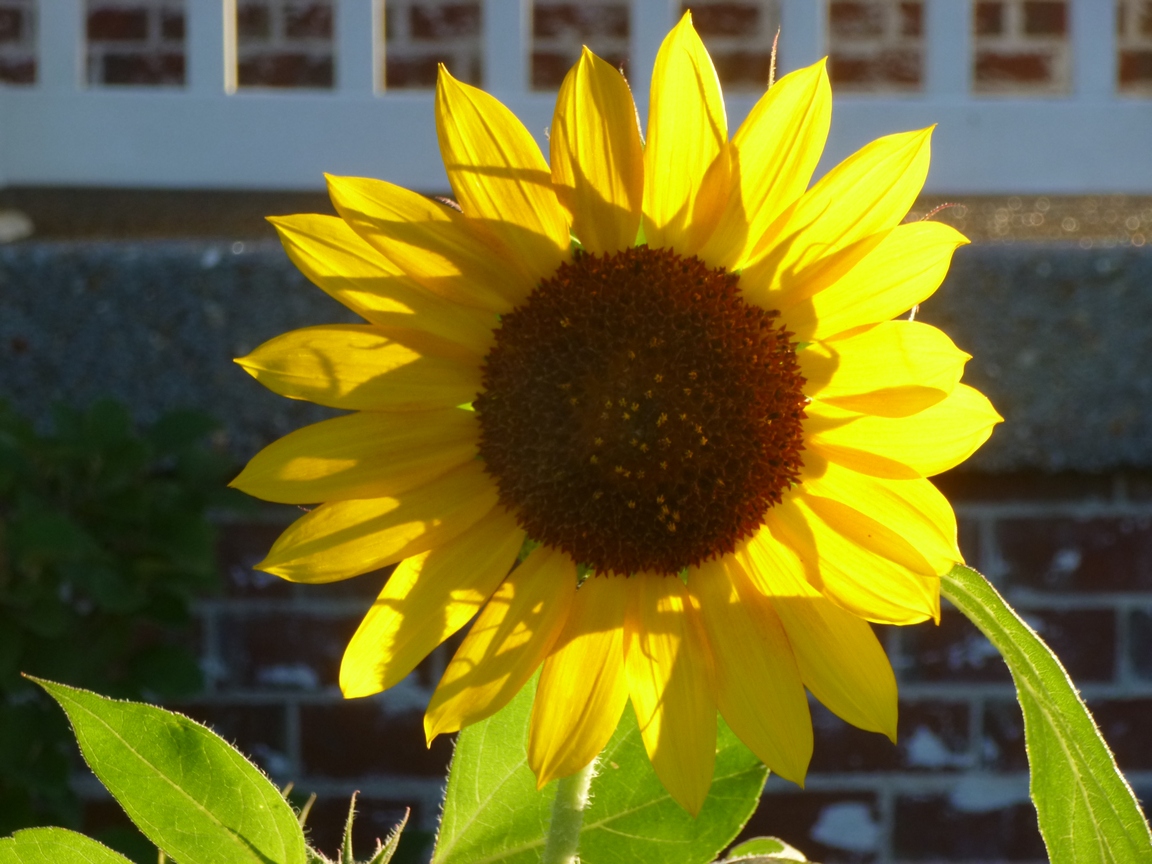
Sunny Sunflower


No question how the sunflower (Helianthus annuus) got its name :-)

In the late afternoon / early evening (just about an hour before the sun goes down), the light shines at just the right angle to illuminate this sunflower from behind.

As the sun shines through the sunflower, for a brief moment the sunflower transmits some of the glory of its namesake.

Thursday, August 13, 2015

The Brave Rabbit


Why hello there, Mr./Ms. Bunny. Don't mind me. You just keep munching away.


There's this little bunny rabbit in my garden that likes to hop around the perennial borders munching on this and that.

I encounter it frequently in my walks and I think it has become so accustomed to my presence that it rarely bothers to hop away even when I come within a few feet of it.

It's so quiet and well-camouflaged that my biggest concern is that I'll accidentally step on it someday! 


I'm sure there are still a few blades of tender green grass worth nibbling among the otherwise parched lawn.


Have a good evening!
 

Do you have any 'wildlife' in your garden that have become acclimated to your presence?

PS - Get all the latest Garden of Aaron tidbits straight to your inbox with a free email subscription :)

Monday, August 10, 2015

Lotsa Balloons!


Probably not 99 balloons here, but still quite a few...

The balloon flowers (Platycodon grandiflorus) are reblooming!

In my experience, balloon flowers bloom for months (pretty much all of June and July this year, I think) and if you deadhead them consistently, they'll bloom well into autumn.

Now that's a long bloom season!

Deadheading is not my favorite garden activity, but I think I'm willing to make an exception for balloon flowers because they are otherwise such cheery, tough, carefree, long-lived plants.
(Also, it's not such a chore to deadhead balloon flower compared to deadheading some other plants. The flowers bloom on tall spikes, so you can cut off an entire spike rather than trying to snip an individual spent flowerhead.)

And while I rarely saw any pollinators visiting the balloon flowers in prior years, I've seen quite a few pollinators of all shapes and sizes visiting the balloon flowers this year now that the original clumps have gotten larger and the balloon flowers have even self-sowed a bit here and there.

Besides, who doesn't love balloons? :)

PS - Sign up for a free email subscription to make sure you don't miss out on balloons or any other charming flowers!