Showing posts with label Coral Honeysuckle. Show all posts

Monday, October 20, 2014

Energizer Flowers in the October Garden of Aaron - Balloon Flower, Rozanne Geranium, October Skies Aster, Chaste Tree and more!

I'm probably revealing my age here, but do you remember the Energizer battery commercials from years past with a battery-powered bunny drummer that kept going and going and going?

That's just the sort of plant I admire in the garden, one that flowers for months and months without much (or any) external intervention.

I actually went away for a few weeks in September and left my garden to its own devices. We had a warm September here in Tennessee -- meaning plenty of days with temps in the 80s and practically no rain whatsoever (0.25 inches for the whole month).

And while the grass got some water from the sprinkler, the garden had to fend for itself without any irrigation. Here's how things looked when I got home:

Red berries on the Aronia arbutifolia, Red Chokeberry

Bunches of black berries on the Aronia melanocarpa, Black Chokeberry.
In prior years, these had some nice fall color. More recently, they seem to get defoliated (perhaps by lacebugs) every year, which doesn't seem to damage the plant much, but certainly eliminates any autumn color.

Autumn Fern (a.k.a. Japanese Shield Fern), Dryopteris erythrosora, I installed two of these in April in a partial shade setting. They seemed to struggle at first, but have since settled in nicely. Yep, it turns out there are ferns such as this that are remarkably drought tolerant once established. In fact, UGA recommends it as a groundcover for Georgia, which tells you it can take the heat (though it's also cold hardy to USDA zone 5). No flowers of course, but the new fronds have a beautiful copper color.

This is Platycodon grandiflora, the Balloon Flower. It had a nice long flowering period in the early summer, after which it formed seeds. Last year, I let the seeds mature and fall to the ground, which resulted in some self-sowing. This year, I trimmed back the plant by about one-third, which prompted it to rebloom vigorously. I've also noticed some bees visiting the flowers this year, which is nice.

Baptisia australis, Blue False Indigo, this has pretty flowers in the spring, but it certainly doesn't fall into the Energizer flower category (the flowers only last a couple of weeks at most), But it's a trouble-free tough native perennial with lovely foliage that stays attractive all year. It is also apparently a host plant for the Clouded Sulphur butterfly, which I have seen in my garden this year for the first time. I just planted some new Baptisias from Prairie Nursery, so hopefully I'll have more Baptisia foliage next year upon which the Clouded Sulphurs can dine.

I planted three small Spicy Globe basil plants in the spring. I hae to say this was not necessarily my favorite basil from a taste perspective. But they formed nice bushy plants (perhaps 8 inches high by 12 inches wide) that were covered with flowers for months and months. As you may be able to see in the left middle section of the photo, the flowers do a great job of attracting bees. So if you're looking to attract pollinators to your garden, a few basil plants could work wonders. And unlike some herbs, they seem to grow perfectly well (at least in Tennessee) in partial shade. Since these got so much attention from pollinators and since I never cut them back, I'm very curious to see whether they will self sow next year.

The Camellia sasanqua by the front porch has started blooming. You can't see it here, but the flowers attract a steady stream of honeybee visitors.

Even though I did not do any deadheading or pruning, the young Vitex agnus-castus (Chaste Tree) began reblooming in early September and was still going strong in early October. These flower spikes almost always have large bees hanging on them from dawn to dusk. They also attract some butterflies, as you can see from the small tawny skipper butterfly in the upper section of this photo.

More big bees on Chaste Tree flower spike

Practically all the cosmos have fallen over, but they usually are tough enough to keep blooming even while lying prone on the ground. And as you can see here, the (slightly out-of-focus) small bees will keep visiting regardless.

You may not be able to tell from this photo, but this (self-sown) cosmos plant has actually fallen across the path, but it is still blooming its heart out. No deadheading required for weeks and weeks (sometimes months and months) of blooms!

I'm not a huge fan of daylilies, but I do have some in my garden that I inherited and more that I added before I decided I didn't like them much. One thing I truly dislike is staring at the dead, dying and damaged daylily foliage after the plants flower. So after doing some research online, I read it's possible to cut the daylilies to the ground and have them resprout fresh foliage (aquilegia will do the same). So I gave it a try and - voila! - it worked! This clean foliage is much nicer to look at from late summer into autumn.

Another clump of daylilies that was cut back to the ground in mid-summer and has since resprouted vigorously with clean light green foliage.

A feather found in the grass. Perhaps from a hawk?

I tried to remove the Ajuga reptans from part of the front border. Clearly I did not get it all. Meanwhile, I had planted an Athyrium nipponicum, Japanese Painted Fern. Again, this is a fern that some sources will list as being drought tolerant (in partial to full shade) once established. This particular fern is called "Ghost" and it's actually a hybrid between the Japanese fern and a native American fern called Athyrium filix-femina. The name seems appropriate, since I thought it was a goner when something (rabbits?) ate it to the ground twice over the summer. Nonetheless, it has popped back to life each time! Clearly tougher than it looks...

My three Hidcote lavender plants (Lavandula angustifolia, also called Lavandula officinalis) have all grown nicely this year, although they haven't flowered much. I fear I may have cited them in too much shade, or perhaps they are just getting settled. The big challenge with growing in Lavender in Tennessee (as I understand it) is not so much the cold - these are after all supposed to be hardy to zone 5. No, the real challenge is our heavy clay soil and winter rains. Lavender apparently cannot tolerate wet winter soils. That said, Hidcote is supposed to be one of the tougher lavenders, so I'll hope these guys can defy the odds and survive until springtime.

At first, I thought my lavender plants would not flower at all this year, but sometime in September they did produce a few tall flower spikes. Since this is my first year growing lavender, I'm not sure when I'm supposed to harvest it for dried flowers / potpourri. 


One of my favorite plants just keeps on giving. Lonicera sempervirens, the native Coral Honeysuckle, produces non-stop orange-red hummingbird-attracting flowers from very early spring to autumn. The flower production has slowed dramatically now, but all those hummingbird (and butterfly) visits have clearly produced results, as the plant is now covered in berries at various stages of ripening. This photo shows all three stages of berries ripening from green to light orange to bright orange-red. I haven't noticed any birds feeding on the berries yet, but American Beauties says that bluebirds, waxwings and many other birds will eat the fruit. 

There are some Aronia berries in this photo, but the intended focus is the lush mass of Melissa officinalis, a.k.a. Lemon Balm, that grew from three tiny sprigs that I planted in April. As you can see, the Lemon Balm has formed a thick weed-suppressing groundcover. And the foliage is darn pretty. The leaves have a nice lemony scent, and I've tried them in a salad and as "lemonade", but alas I could not detect much of a lemon taste. Lemon Balm did not flower this year, but it's supposed to have late spring or early summer flowers that are a big hit with the bees, so I'm hoping it will put on a nice flowering show next year if it feels suitably happy and established. Of course, the real question is how far it will spread and whether I will someday regret having planted it. Only time will tell...

You can see where October Skies aster (Aster oblongifolius) gets its name. These plants are absolutely covered with sky-blue flowers in September and October. And the flowers are visited by clouds of little bees and wasps. It's a delightful plant that has been trouble-free so far for me this year. The dense foliage also does a great job of suppressing weeds. This was my first year growing asters, so I'm excited to see how they perform next year (presuming of course that they survive the winter without any problems).

Just another photo to show how floriferous all three October Skies asters have been. Charming, lovely plants. Unlike some other asters (I'm looking at you, New England asters), that can grow tall and gangly with defoliated lower stems, the October Skies aster stays dense and bushy. And at least this year, it probably topped out at about 12 inches high with perhaps a 14-18 inches spread. Definitely a lovely foreground plant.

Finally, a definite contender in the Energizer bunny category, this is Rozanne Cranesbill Geranium which has flowered for at least four months (early June through early-to-mid October) and will probably keep going until a hard frost with no deadheading or pruning required. (It accepts pruning if it rambles out of bounds, but no pruning is necessary to stimulate flowering.) What's more, I think the foliage quality actually improved on Rozanne throughout the summer and into autumn. One of the first plants I added to my garden, Rozanne has survived a couple of transplants and given me so much joy over the years. I think anyone who can grow Rozanne (hardy to zone 5), should give her a try.

Monday, August 25, 2014

Shots from the August Garden #1 - Ajuga, Dead and Dying Viburnums, Aronia Berries, October Skies Aster, Coral Honeysuckle, Hyssop and Zagreb Coreopsis


These photos were taken in early-to-mid August in my Middle Tennessee garden. Hope you enjoy!

Ajuga genevensis, personally I find this much more attractive than the typical A. reptans. It's also much harder to find. This is in partial shade (morning shade, afternoon sun) and you can see that it's lush, happy and healthy with very minimal supplemental water. I have a patch growing pretty well in full sun too, but I think it's happier in partial shade.
 
I don't shy away from admitting my mistakes here at Garden of Aaron. I had the "brilliant" (not really) idea to pay a landscaper to install three substantial Alleghany Viburnums along the back of my property for privacy purposes. They were supposed to grow 10-12 feet tall and wide with broad evergreen leaves. Unfortunately, two died almost immediately (including this one). Not sure what went wrong? It's a tough spot - full hot sun, heavy clay that has some of the worst drainage in the yard. In any case, V x rhytidophylloides (whew - what a mouthful!) is a hybrid of two exotics (the Eurasian V. lantana and the Chinese V. rhytidophyllum) that reportedly became invasive in Virginia when two different cultivars were grown close together. Guess I should stick with the native viburnums, which probably are better suited for this climate and soil anyway...

Here's the one surviving Alleghany Viburnum. Not a pretty picture. What was I thinking? I know I've seen some good looking dense evergreen viburnums around town in inhospitable locations (i.e. highway offramps). Perhaps they're using a different species? Or perhaps they started with smaller plants that had an easier time adjusting to transplantation. Or perhaps they used container grown shrubs (I think these were balled and burlapped and I'm of the opinion that container grown typically works much better.) Whatever the case, I have some big regrets about using these viburnums in the landscape and plan to rip them all out this autumn and replace with something completely different.

Close up on Aronia melanocarpa berries. I have two kinds of Black Aronia berries - these are larger ones and I think they're the Viking variety that was bred for commercial uses (juice production?) in Europe. I also have an Autumn Magic A. melanocarpa, which going by the name, I'd guess was selected mainly for its autumn leaf color. In some ways, these are great plants. They seem very tough through heat and drought, they don't have any problems with our winter (they're hardy to zones 3-4) and as you can see they berry profusely. You don't even have to fight the birds for the berries. So what's the problem. They're bitter. Really, really bitter / astringent. These Viking ones actually aren't so terrible compared to the smaller and far more astringent Autumn Magic variety (presuming I've got my plants ID'd properly). But "not so terrible" is not exactly a ringing endorsement. Truth be told, I wish I'd planted something else. And even though they can take the heat here in Middle Tennessee, I think it stresses them out, which perhaps makes them more susceptible to the insects (I'm guessing lace bugs) that disfigure their leaves something awful and make them drop prematurely. Some folks on Gardenweb seem to think that hot weather makes the berries more astringent. That seems to dovetail with my own experience, so I think folks in more northern climates (like Michigan or the Pacific Northwest) might have better luck with aronia. That said, I'm not planning to rip mine out just yet. For one thing, I have too many other more pressing landscape concerns -- like replacing those danged viburnums shown above. But I don't think I'd recommend Aronia for the Southeast, at least not from an edible perspective. It is true, however, that I have not yet tried adding Aronia berries to the fresh fruit smoothies I make. If I try it and it's not too awful, I may yet change my tune.

"October Skies" Aster. Looking healthy and loaded with buds. Love the way that it's spread to form a tall, beautiful weed-suppressing groundcover.
Hyssop officinalis. I planted three of these earlier this year in the hopes I could trim them into a low informal hedge. That's still a work in progress, but they've grown very well in a hot full sun area next to the driveway. And as you can see, the bees like the blue flowers -- and so do I!

Coral Honeysuckle (native Lonicera sempervirens) still blooming strong on the front porch railing. The hummingbirds seem to love it. As you can see, they manage to fertilize the flowers, which leads to berry production, shown here as a green cluster right below the flowers . They'll ripen to red and then probably be picked off by other birds to be eaten and spread as nature intended).
Another shot of Coral Honeysuckle. Blooms from early spring right through summer and into autumn. One of my favorite plants! Yes, it's a little rampant, but you can cut it back hard at pretty much anytime and it will bounce back.

One more view of the Coral Honeysuckle flowers. I tried to duck down and get a pic from the hummingbird's point of view on its approach. Sure looks enticing...

Coreopsis verticillata "Zagreb". I've got two of these plants growing underneath a crape myrtle. They're probably getting a little too much shade and I might try transplanting them this autumn. That said, they're still blooming nicely and have probably increased in size by 3-4 times since I planted them early this spring. They bloom for months without deadheading and seem to attract some tiny critters (originally I just saw ants, more recently I've seen some small bees visiting the flowers too).

I didn't want to overwhelm with a cavalcade of photos. So I split up the bounty into multiple posts. Stay tuned for installment #2!

Wednesday, February 26, 2014

Ripe for Discussion: Vines on Walls?


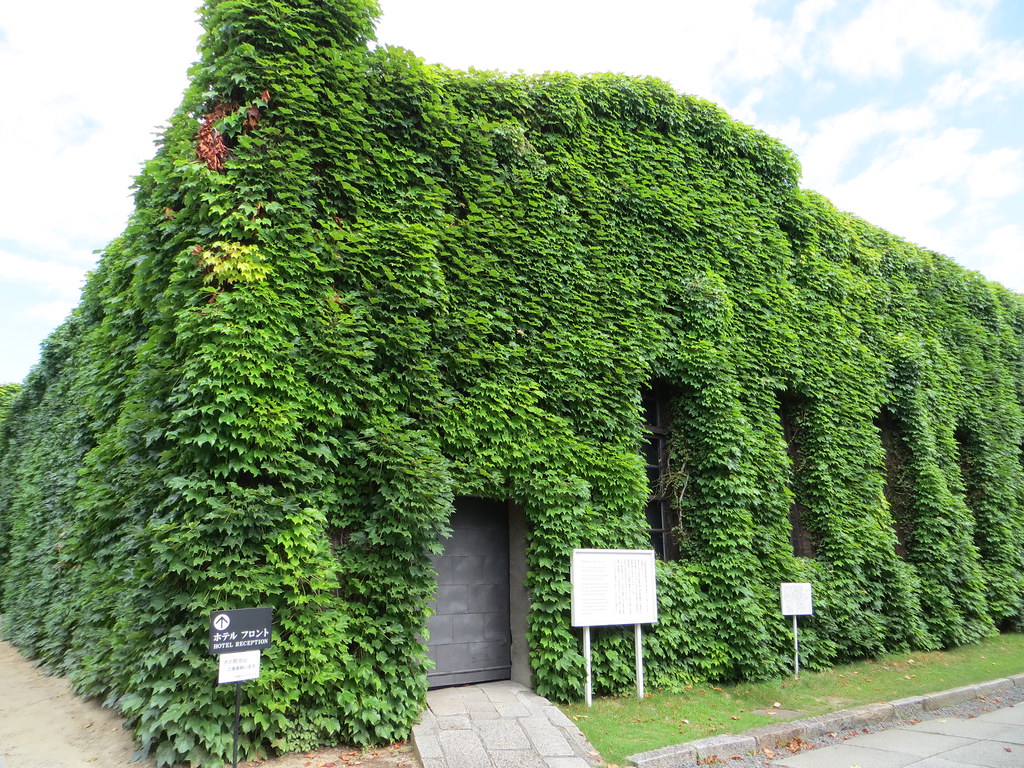
Ivy covers a structure in Kurashiki, Japan. Photo by Joel Abroad.
There may be a building under there somewhere....
Ivy covers a structure in Kurashiki, Japan.
Photo by Joel Abroad

I recently came across this study (published nearly four years ago, but new to me) from Oxford University in the UK saying that ivy could benefit walls by protecting them from temperature extremes and pollution.

I'd say there are at least two important caveats to this study:

1) The authors seem comfortable claiming ivy helps protect intact walls, but they note that ivy might exacerbate problems in walls that already have cracks or holes.

2) The ivy study seems to have focused only on five sites in England, so it's not clear whether the findings apply in much hotter/colder/drier/wetter settings. (Although really, is there any place wetter than England? Probably not this winter.)

What do other Internet sources say?

Today's Homeowner pretty much agrees with the Oxford study, saying ivy can protect "solid, well-constructed masonry walls" but basically warning against using ivy as a climber anywhere else -- dry-stacked walls, old brick homes, wooden walls or fences, siding, stucco, painted surfaces, etc.

The consensus on one home improvement forum (StackExchange) seems to be that ivy on walls is bad news. The only dissenters were the ones who cited the Oxford study.

And then there's the whole issue of invasiveness, at least here in the States (since the commonly used English Ivy, Hedera helix, seems to have been introduced here from Europe and western Asia).

As I understand it, ivy grown as a groundcover can be annoying in terms of running rampant over anything else in a garden bed, but it only really becomes invasive when it is allowed to climb, flower and produce seeds that are then dispersed by birds into forest settings. Seems like wall-grown ivy would be a constant source of menace in terms of introducing ivy seeds into the environment.

*****

But even if you swear off English Ivy, what about using other vines - perhaps native vines - to cloak your walls? For example, what about letting the native Crossvine (Bignonia capreolata) clamber up your wall? Does the idea intrigue you or you terrified that tendrils will creep into your attic one dark and stormy night?

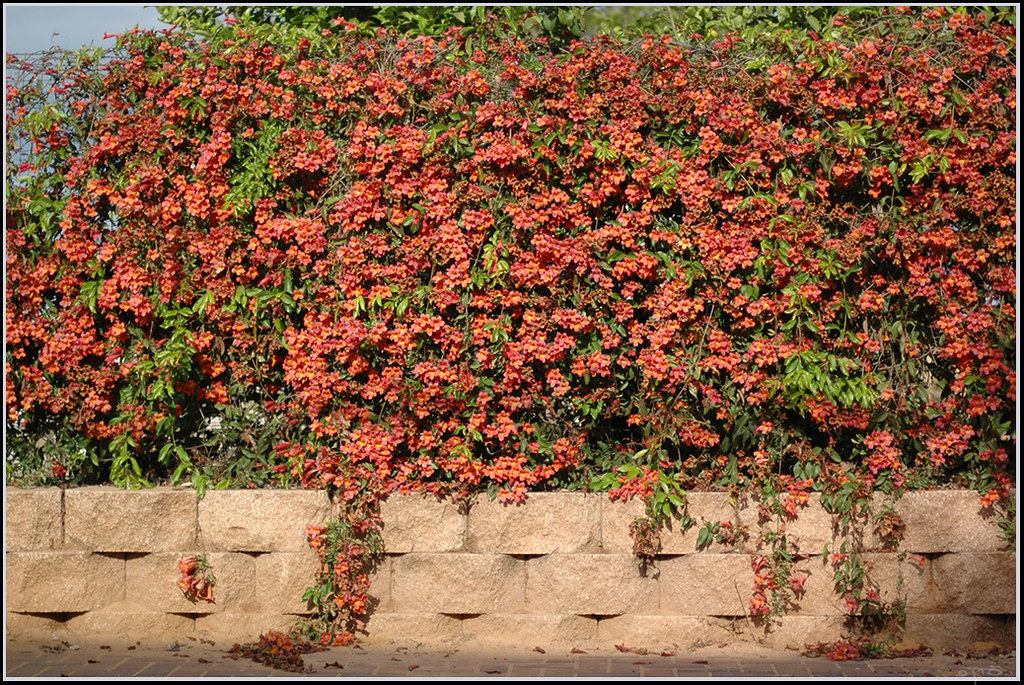
Bignonia capreolata, Crossvine, "Tangerine Beauty" variety. Photo by Eran Finkle
Bignonia capreolata, Crossvine, "Tangerine Beauty" variety (may be a bit easier to tame than the species)
Photo by Eran Finkle
Or what about Virginia Creeper (Parthenocissus quinquefolia), also native to North America, but sounds far more rampant than Crossvine. The Lady Bird Johnson Wildflower Center says that Virginia Creeper climbs with adhesive disks rather than penetrating rootlets and thus does not cause as much damage to buildings as some other vines.

Have you -- or would you -- grow a vine on a wall of your house or other structure (garage, shed, etc.)? 

Or do you think that's just asking for trouble?

One other idea -- what about getting the aesthetic and protective benefits of a vine without the potentially destructive drawbacks? Old-House Online suggests building a trellis along a wall for a twining climber like wisteria or grapevine.

I like the concept, although I object to the wisteria suggestion. Japanese Wisteria and Chinese Wisteria are exotic invasives, and I believe even our native wisteria -- American Wisteria, W. frutescens -- would want to grow too big and heavy for a wall trellis. Plus wisterias have poisonous seeds, which I would argue mitigates against using wisteria in a residential setting.

But perhaps other twining vines -- e.g.,  Coral HoneysuckleArmand Clematis or the Hops vine (Humulus lupulus) -- would do the trick?

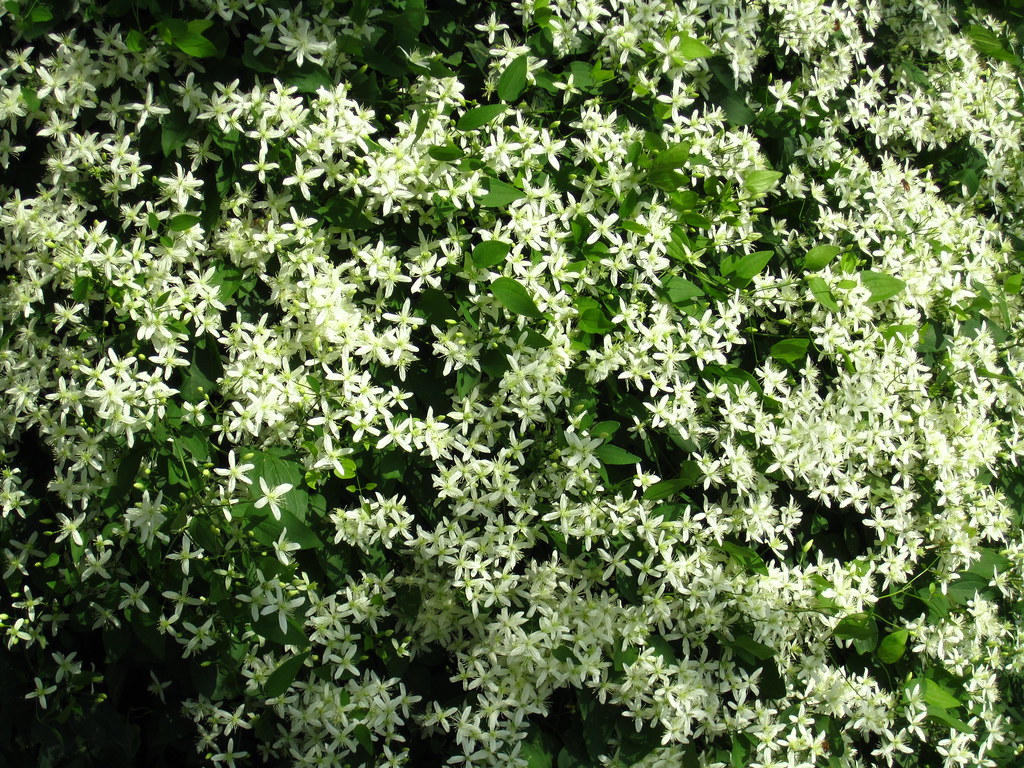
Clematis armandii in bloom. Photo by Ali Eminov
Clematis armandii in bloom
Photo by Ali Eminov

Update: Here's how Mr. Smarty Plants of the Lady Bird Johnson Wildflower Center sees the pros and cons of growing vines on walls.

Monday, November 4, 2013

Feeling Guilty about Coral Honeysuckle


Alas, Poor Honeysuckle, it's only crime was to grow too well and too bushy...

I had a dream in days gone by of native coral honeysuckles twining their way up the metal railings on either side of my porch stems, blooming with their orange-and-yellow trumpets all summer long, attracting hummingbirds and softening the hard lines of the metal and brick.

Amazingly, my dream came to fruition.

And yet, once I saw the coral honeysuckle in place, I realized I had made a mistake.

The honeysuckle was so happy and so exuberant that it practically hid the railing entirely and sent up bushy tendrils in every which direction from the top railing.

It was out of control.

And I was worried. Worried that I had created a potential hazard for anyone using the front porch. After all, the railings are there for a reason - to help people go up and down without tripping or slipping.

But if they can't find or grasp the railing, then the railing is pretty well useless.

I didn't want anyone to get hurt and I didn't want to worry about the liability issues either.

So one day in August, I went out with scissors and started trying to snip the honeysuckle vine off the railings.

The vine broke my scissors! (The tendrils get woody and tough after a while.)

So I went to get my loppers. Overkill? Sure, but it did the trick.

I toyed with the idea of ripping out the whole plant, but I felt guilty curtailing the growth of a couple of vines that were only being all-too-successful at fulfilling the goals I had set for them.

So I left the stubs with a couple of flowers and some maturing berries.

Here you can see the pruned remnants of the formerly mighty vine - now transformed into a truncated bush - encamped at the foot of the stairs.


Provided the vines survive, I'm still undecided as to whether I should leave them to ramble through the front foundation beds or take them out entirely. I'm not at all sure that they'd be willing to play nice with other perennials, at least not without a lot of watchful pruning and shaping.

But I do like the fact that the vine frequently attracted a visiting hummingbird -- who seems to have become accustomed to our property and now drinks from other flowers like the zinnias and even has sampled the Russian Sage.

What would you do with these Coral Honeysuckle vines?

And have you ever had to remove or relocate any overperformers in your garden?