Showing posts with label Camellia sasanqua. Show all posts

Wednesday, November 9, 2016

Hello, November! :)


No rain in 2 months? If you're Salvia greggii (autumn sage), apparently you don't care.

We're going through a dry spell.

A no-rain-in-two-months kinda dry spell.

I recognize that's no big deal in some parts of the country (e.g., California, Arizona, heck even Pacific Northwest in the summertime), but it's quite unusual in the Southeast.

Still, I guess I'd rather have a drought now than in the Spring. At least this time of year, plants are getting ready to go dormant for winter anyway so many of them just call it quits and shut down a little sooner in the case of a drought.

(At least, I'm hoping that's the case. Clearly I won't know whether there's any more serious damage until the shrubs leaf out and the perennials emerge from dormancy - or not - next spring.)

Nonetheless, with only minimal amounts of supplemental irrigation, some plants in the garden continue to put on a fantastic show, attracting and supporting beautiful wildlife...


Balloon flower (Platycodon grandiflorus)  

More balloon flowers still to come! They're budding and getting ready to bloom as we head toward mid-November! 


Bee on the blanket flower (Gaillardia x grandiflora). This is a volunteer blanket flower. I like how this photo shows the multiple stages the flower goes through. On the bottom right, you have a bud just starting to open. After the flower blooms, the petals fall off to reveal a yellow puffball. Eventually, you have the smaller silver starbursts that fade to tan. It's hard to think of a flower that looks prettier at every stage of its life!


"This flower ain't big enough for the two of us."
"Um...yes it is."

Blue mistflower (Conoclinium coelestinum), a native that's been blooming for months and attracting small clouds of skipper butterflies on warm days. (This was a cool, breezy morning. No butterflies in sight.)

Unknown Camellia sasanqua and honeybee. This plant and a few Russian sages are the favorite plants for honeybees in my autumn garden.

Aronia arbutifolia (red chokeberry). The berries are pretty, but birds don't seem interested in them. And having tried them, I can tell you there's a reason they're called chokeberry - their astringency is off the charts. I may actually be removing this plant from the front foundation once these berries have fallen off. The foundation planting is a little overcrowded and I'd rather give more space to the adjacent oakleaf hydrangea (Hydrangea quercifolia). 

A few pretty fruits on the 'Sugar Tyme' crabapple. I think this crab gets ravaged by cedar-apple rust fungus spread from all the nearby eastern redcedars that I planted (Juniperus virginiana). It's a pity. Maybe it would do better on decent soil with irrigation, but it's surviving (and sending up suckers) on heavy clay in hot baking sun all day.


Senna marilandica (wild senna) seedpods. Lots of seedpods on this plant. I harvested many of the seeds, but have left these to dry on the plant (and hopefully provide some volunteers).

Tomatoes in November?! Well, we have had record warmth recently... This is an unnamed volunteer cherry tomato that sprung up next to the house. I didn't harvest many fruits from it this year, but the chipmunk(s) got some.

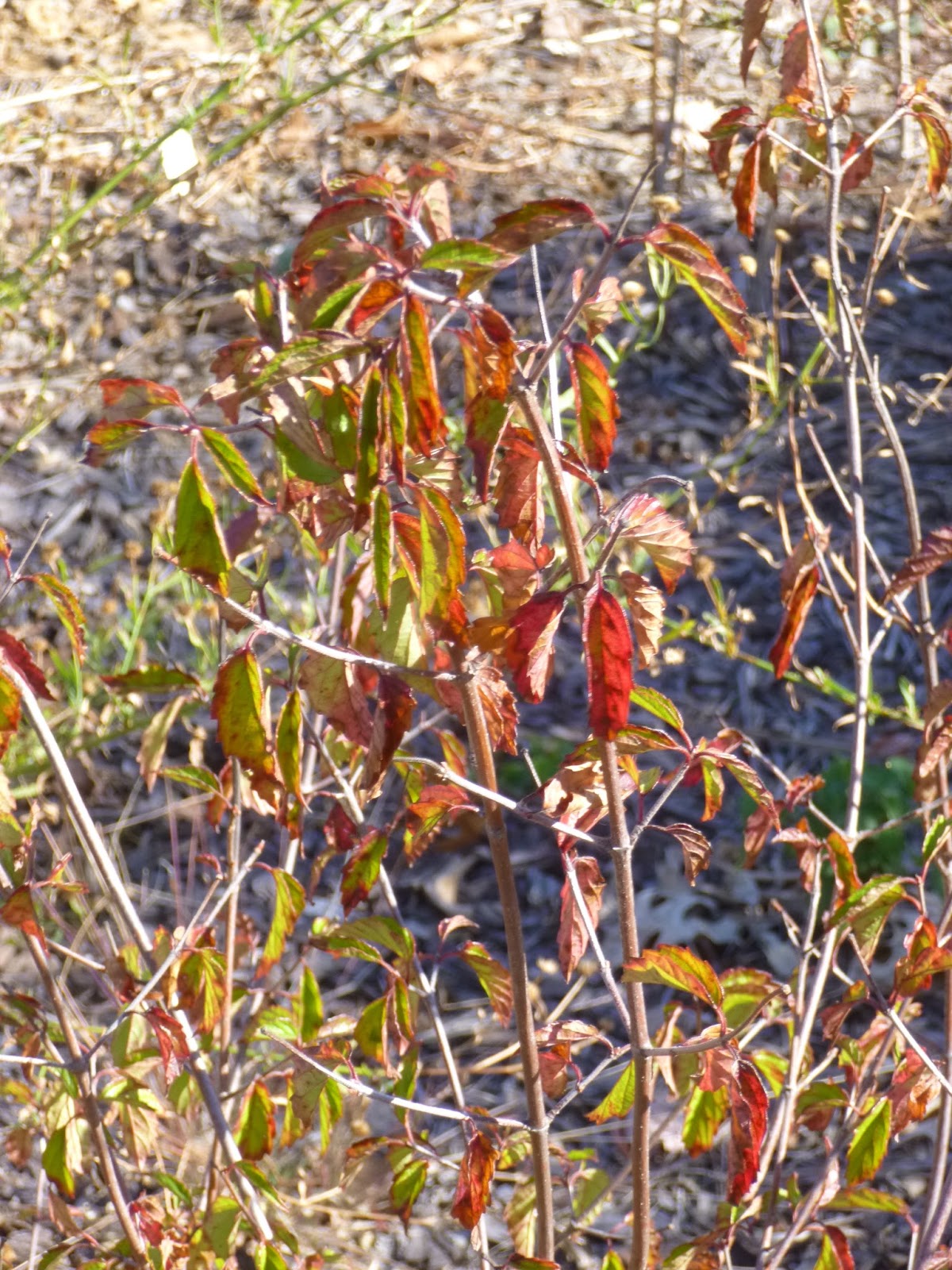
The autumn drought has meant that leaf colors have been muted for the most part, but this Viburnum ashei is putting on a good show. Love the reds!


Wish you a beautiful month and a happy, hopeful, peaceful holiday season ahead...


Instagram

Follow Aaron Dalton on Feedio

Monday, December 14, 2015

The Flowers of December - Camellia and Hellebores


It's been an unusually warm 'winter' so far, but I think these plants might all be in flower this time of year even in a normal winter...

Pollinator on Camellia sasanqua flower
Camellia sasanqua with (I believe) some sort of wasp...

Pollinators on hellebore flower
This hellebore has attracted some sort of pollinator (I'm guessing it might be a fly, based on the large eyes) and a ladybug. Note the persistent greenish bracts at the bottom of the picture that provide the illusion of flowers over many weeks.
 
Helleborus buds in December
OK, this other hellebore has not quite bloomed, but the pink buds and glaucus foliage are so pretty through I thought it deserved to be included in this post. I'll try to post an update in the weeks ahead when these buds open into flowers...


Instagram

Follow Aaron Dalton on Feedio

Wednesday, November 18, 2015

Last of the Bloomers

I think it's almost "lights out" for the flowers in the Garden of Aaron this year.

Temperatures are forecast to drop in the coming days (40s for high on Sunday, lows in the 20s), but up to this point, unusually warm autumn weather to date has allowed some brave bloomers to strut their stuff right into Thanksgiving territory.

Mexican sage, Salvia leucantha, has bloomed for months from summer to late autumn. In recent weeks, it became a magnet for bees and other pollinators.

Sweet alyssum (Lobularia maritima), also a long bloomer, very popular with mini pollinators (hoverflies, etc.)

Most of the hardy geraniums stopped blooming long ago, but 'Rozanne' hybrid geranium carries on with a few last flowers. Unfortunately, Rozanne doesn't have the same winter presence as some of my other favorite cranesbill geraniums. Where Geranium sanguineum and Geranium cantabrigiense seem more or less evergreen here in zone 6/7, 'Rozanne' has acted behaved like a true herbaceous perennial, dying back to the ground each year. 


This unknown Camellia sasanqua has had a great year. As you can see, if you pick a camellia with open, single flowers, you'll give the bees a banquet!

A few of the flowers on this group of reblooming azaleas have been blasted by frost, but the shrubs are still putting on a magnificent show!
OK, no flowers here, but the fall foliage on this Virginia creeper (Parthenocissus quinquefolia) certainly shines on its own.


No flowers here, but I love the pop of the red chokeberries (Aronia arbutifolia) against the variegated aucuba (Aucuba japonica) in the background.


Thanks for reading and commenting this past year.

I'll continue to post in the weeks and months ahead, though most likely at a more lugubrious pace than during the growing months, but I do look forward to sharing information with you on plants I've added to the garden this fall, seeds I'll be winter-sowing and so forth.

Best wishes to you all (in the Northern hemisphere) for a warm and cozy winter season. And to you in the Southern hemisphere... Happy Spring :)


Instagram

Follow Aaron Dalton on Feedio

Monday, October 20, 2014

Energizer Flowers in the October Garden of Aaron - Balloon Flower, Rozanne Geranium, October Skies Aster, Chaste Tree and more!

I'm probably revealing my age here, but do you remember the Energizer battery commercials from years past with a battery-powered bunny drummer that kept going and going and going?

That's just the sort of plant I admire in the garden, one that flowers for months and months without much (or any) external intervention.

I actually went away for a few weeks in September and left my garden to its own devices. We had a warm September here in Tennessee -- meaning plenty of days with temps in the 80s and practically no rain whatsoever (0.25 inches for the whole month).

And while the grass got some water from the sprinkler, the garden had to fend for itself without any irrigation. Here's how things looked when I got home:

Red berries on the Aronia arbutifolia, Red Chokeberry

Bunches of black berries on the Aronia melanocarpa, Black Chokeberry.
In prior years, these had some nice fall color. More recently, they seem to get defoliated (perhaps by lacebugs) every year, which doesn't seem to damage the plant much, but certainly eliminates any autumn color.

Autumn Fern (a.k.a. Japanese Shield Fern), Dryopteris erythrosora, I installed two of these in April in a partial shade setting. They seemed to struggle at first, but have since settled in nicely. Yep, it turns out there are ferns such as this that are remarkably drought tolerant once established. In fact, UGA recommends it as a groundcover for Georgia, which tells you it can take the heat (though it's also cold hardy to USDA zone 5). No flowers of course, but the new fronds have a beautiful copper color.

This is Platycodon grandiflora, the Balloon Flower. It had a nice long flowering period in the early summer, after which it formed seeds. Last year, I let the seeds mature and fall to the ground, which resulted in some self-sowing. This year, I trimmed back the plant by about one-third, which prompted it to rebloom vigorously. I've also noticed some bees visiting the flowers this year, which is nice.

Baptisia australis, Blue False Indigo, this has pretty flowers in the spring, but it certainly doesn't fall into the Energizer flower category (the flowers only last a couple of weeks at most), But it's a trouble-free tough native perennial with lovely foliage that stays attractive all year. It is also apparently a host plant for the Clouded Sulphur butterfly, which I have seen in my garden this year for the first time. I just planted some new Baptisias from Prairie Nursery, so hopefully I'll have more Baptisia foliage next year upon which the Clouded Sulphurs can dine.

I planted three small Spicy Globe basil plants in the spring. I hae to say this was not necessarily my favorite basil from a taste perspective. But they formed nice bushy plants (perhaps 8 inches high by 12 inches wide) that were covered with flowers for months and months. As you may be able to see in the left middle section of the photo, the flowers do a great job of attracting bees. So if you're looking to attract pollinators to your garden, a few basil plants could work wonders. And unlike some herbs, they seem to grow perfectly well (at least in Tennessee) in partial shade. Since these got so much attention from pollinators and since I never cut them back, I'm very curious to see whether they will self sow next year.

The Camellia sasanqua by the front porch has started blooming. You can't see it here, but the flowers attract a steady stream of honeybee visitors.

Even though I did not do any deadheading or pruning, the young Vitex agnus-castus (Chaste Tree) began reblooming in early September and was still going strong in early October. These flower spikes almost always have large bees hanging on them from dawn to dusk. They also attract some butterflies, as you can see from the small tawny skipper butterfly in the upper section of this photo.

More big bees on Chaste Tree flower spike

Practically all the cosmos have fallen over, but they usually are tough enough to keep blooming even while lying prone on the ground. And as you can see here, the (slightly out-of-focus) small bees will keep visiting regardless.

You may not be able to tell from this photo, but this (self-sown) cosmos plant has actually fallen across the path, but it is still blooming its heart out. No deadheading required for weeks and weeks (sometimes months and months) of blooms!

I'm not a huge fan of daylilies, but I do have some in my garden that I inherited and more that I added before I decided I didn't like them much. One thing I truly dislike is staring at the dead, dying and damaged daylily foliage after the plants flower. So after doing some research online, I read it's possible to cut the daylilies to the ground and have them resprout fresh foliage (aquilegia will do the same). So I gave it a try and - voila! - it worked! This clean foliage is much nicer to look at from late summer into autumn.

Another clump of daylilies that was cut back to the ground in mid-summer and has since resprouted vigorously with clean light green foliage.

A feather found in the grass. Perhaps from a hawk?

I tried to remove the Ajuga reptans from part of the front border. Clearly I did not get it all. Meanwhile, I had planted an Athyrium nipponicum, Japanese Painted Fern. Again, this is a fern that some sources will list as being drought tolerant (in partial to full shade) once established. This particular fern is called "Ghost" and it's actually a hybrid between the Japanese fern and a native American fern called Athyrium filix-femina. The name seems appropriate, since I thought it was a goner when something (rabbits?) ate it to the ground twice over the summer. Nonetheless, it has popped back to life each time! Clearly tougher than it looks...

My three Hidcote lavender plants (Lavandula angustifolia, also called Lavandula officinalis) have all grown nicely this year, although they haven't flowered much. I fear I may have cited them in too much shade, or perhaps they are just getting settled. The big challenge with growing in Lavender in Tennessee (as I understand it) is not so much the cold - these are after all supposed to be hardy to zone 5. No, the real challenge is our heavy clay soil and winter rains. Lavender apparently cannot tolerate wet winter soils. That said, Hidcote is supposed to be one of the tougher lavenders, so I'll hope these guys can defy the odds and survive until springtime.

At first, I thought my lavender plants would not flower at all this year, but sometime in September they did produce a few tall flower spikes. Since this is my first year growing lavender, I'm not sure when I'm supposed to harvest it for dried flowers / potpourri. 


One of my favorite plants just keeps on giving. Lonicera sempervirens, the native Coral Honeysuckle, produces non-stop orange-red hummingbird-attracting flowers from very early spring to autumn. The flower production has slowed dramatically now, but all those hummingbird (and butterfly) visits have clearly produced results, as the plant is now covered in berries at various stages of ripening. This photo shows all three stages of berries ripening from green to light orange to bright orange-red. I haven't noticed any birds feeding on the berries yet, but American Beauties says that bluebirds, waxwings and many other birds will eat the fruit. 

There are some Aronia berries in this photo, but the intended focus is the lush mass of Melissa officinalis, a.k.a. Lemon Balm, that grew from three tiny sprigs that I planted in April. As you can see, the Lemon Balm has formed a thick weed-suppressing groundcover. And the foliage is darn pretty. The leaves have a nice lemony scent, and I've tried them in a salad and as "lemonade", but alas I could not detect much of a lemon taste. Lemon Balm did not flower this year, but it's supposed to have late spring or early summer flowers that are a big hit with the bees, so I'm hoping it will put on a nice flowering show next year if it feels suitably happy and established. Of course, the real question is how far it will spread and whether I will someday regret having planted it. Only time will tell...

You can see where October Skies aster (Aster oblongifolius) gets its name. These plants are absolutely covered with sky-blue flowers in September and October. And the flowers are visited by clouds of little bees and wasps. It's a delightful plant that has been trouble-free so far for me this year. The dense foliage also does a great job of suppressing weeds. This was my first year growing asters, so I'm excited to see how they perform next year (presuming of course that they survive the winter without any problems).

Just another photo to show how floriferous all three October Skies asters have been. Charming, lovely plants. Unlike some other asters (I'm looking at you, New England asters), that can grow tall and gangly with defoliated lower stems, the October Skies aster stays dense and bushy. And at least this year, it probably topped out at about 12 inches high with perhaps a 14-18 inches spread. Definitely a lovely foreground plant.

Finally, a definite contender in the Energizer bunny category, this is Rozanne Cranesbill Geranium which has flowered for at least four months (early June through early-to-mid October) and will probably keep going until a hard frost with no deadheading or pruning required. (It accepts pruning if it rambles out of bounds, but no pruning is necessary to stimulate flowering.) What's more, I think the foliage quality actually improved on Rozanne throughout the summer and into autumn. One of the first plants I added to my garden, Rozanne has survived a couple of transplants and given me so much joy over the years. I think anyone who can grow Rozanne (hardy to zone 5), should give her a try.