Showing posts with label Aronia melanocarpa. Show all posts

Monday, August 25, 2014

Shots from the August Garden #1 - Ajuga, Dead and Dying Viburnums, Aronia Berries, October Skies Aster, Coral Honeysuckle, Hyssop and Zagreb Coreopsis


These photos were taken in early-to-mid August in my Middle Tennessee garden. Hope you enjoy!

Ajuga genevensis, personally I find this much more attractive than the typical A. reptans. It's also much harder to find. This is in partial shade (morning shade, afternoon sun) and you can see that it's lush, happy and healthy with very minimal supplemental water. I have a patch growing pretty well in full sun too, but I think it's happier in partial shade.
 
I don't shy away from admitting my mistakes here at Garden of Aaron. I had the "brilliant" (not really) idea to pay a landscaper to install three substantial Alleghany Viburnums along the back of my property for privacy purposes. They were supposed to grow 10-12 feet tall and wide with broad evergreen leaves. Unfortunately, two died almost immediately (including this one). Not sure what went wrong? It's a tough spot - full hot sun, heavy clay that has some of the worst drainage in the yard. In any case, V x rhytidophylloides (whew - what a mouthful!) is a hybrid of two exotics (the Eurasian V. lantana and the Chinese V. rhytidophyllum) that reportedly became invasive in Virginia when two different cultivars were grown close together. Guess I should stick with the native viburnums, which probably are better suited for this climate and soil anyway...

Here's the one surviving Alleghany Viburnum. Not a pretty picture. What was I thinking? I know I've seen some good looking dense evergreen viburnums around town in inhospitable locations (i.e. highway offramps). Perhaps they're using a different species? Or perhaps they started with smaller plants that had an easier time adjusting to transplantation. Or perhaps they used container grown shrubs (I think these were balled and burlapped and I'm of the opinion that container grown typically works much better.) Whatever the case, I have some big regrets about using these viburnums in the landscape and plan to rip them all out this autumn and replace with something completely different.

Close up on Aronia melanocarpa berries. I have two kinds of Black Aronia berries - these are larger ones and I think they're the Viking variety that was bred for commercial uses (juice production?) in Europe. I also have an Autumn Magic A. melanocarpa, which going by the name, I'd guess was selected mainly for its autumn leaf color. In some ways, these are great plants. They seem very tough through heat and drought, they don't have any problems with our winter (they're hardy to zones 3-4) and as you can see they berry profusely. You don't even have to fight the birds for the berries. So what's the problem. They're bitter. Really, really bitter / astringent. These Viking ones actually aren't so terrible compared to the smaller and far more astringent Autumn Magic variety (presuming I've got my plants ID'd properly). But "not so terrible" is not exactly a ringing endorsement. Truth be told, I wish I'd planted something else. And even though they can take the heat here in Middle Tennessee, I think it stresses them out, which perhaps makes them more susceptible to the insects (I'm guessing lace bugs) that disfigure their leaves something awful and make them drop prematurely. Some folks on Gardenweb seem to think that hot weather makes the berries more astringent. That seems to dovetail with my own experience, so I think folks in more northern climates (like Michigan or the Pacific Northwest) might have better luck with aronia. That said, I'm not planning to rip mine out just yet. For one thing, I have too many other more pressing landscape concerns -- like replacing those danged viburnums shown above. But I don't think I'd recommend Aronia for the Southeast, at least not from an edible perspective. It is true, however, that I have not yet tried adding Aronia berries to the fresh fruit smoothies I make. If I try it and it's not too awful, I may yet change my tune.

"October Skies" Aster. Looking healthy and loaded with buds. Love the way that it's spread to form a tall, beautiful weed-suppressing groundcover.
Hyssop officinalis. I planted three of these earlier this year in the hopes I could trim them into a low informal hedge. That's still a work in progress, but they've grown very well in a hot full sun area next to the driveway. And as you can see, the bees like the blue flowers -- and so do I!

Coral Honeysuckle (native Lonicera sempervirens) still blooming strong on the front porch railing. The hummingbirds seem to love it. As you can see, they manage to fertilize the flowers, which leads to berry production, shown here as a green cluster right below the flowers . They'll ripen to red and then probably be picked off by other birds to be eaten and spread as nature intended).
Another shot of Coral Honeysuckle. Blooms from early spring right through summer and into autumn. One of my favorite plants! Yes, it's a little rampant, but you can cut it back hard at pretty much anytime and it will bounce back.

One more view of the Coral Honeysuckle flowers. I tried to duck down and get a pic from the hummingbird's point of view on its approach. Sure looks enticing...

Coreopsis verticillata "Zagreb". I've got two of these plants growing underneath a crape myrtle. They're probably getting a little too much shade and I might try transplanting them this autumn. That said, they're still blooming nicely and have probably increased in size by 3-4 times since I planted them early this spring. They bloom for months without deadheading and seem to attract some tiny critters (originally I just saw ants, more recently I've seen some small bees visiting the flowers too).

I didn't want to overwhelm with a cavalcade of photos. So I split up the bounty into multiple posts. Stay tuned for installment #2!

Friday, May 2, 2014

Some Things Get Better with Age....Others Not So Much

I've been feeling more than the usual aches and pains recently in the garden.

Blame it on the fact that my wife and I planted four trees, several large shrubs and dozens of perennials over the past few weeks.

After all the heavy digging, it was ironic when I somehow strained a back muscle planting a tiny 4-inch Salvia greggii.

Don't worry -- the pain isn't too bad (as long as I don't bend over). ;-)

So I've been thinking about how age is reflected in the garden. I don't know about you, but when I plant a perennial, a shrub or a tree (most anything but an annual), I have high hopes that the plant will get better and stronger with time.

Sometimes, this wish comes true. Perennial Lemon Queen Sunflower looks about five-times bigger, bushier and stronger than it did last year.

Perennial "Lemon Queen" Sunflower doing its best impression of a shrub
only a month after emerging from dormancy


All the aronias have been going from strength to strength in the past couple of years -- more flowers, more berries, more healthy foliage, taller plants.

But then there are other plants that seem to have a tougher time of it with each passing year. (I can sympathize!!)

I'm talking about plants like Gaura lindheimeri. I've seesawed back and forth in the past on whether I love this plant (gorgeous pink flowers over a long bloom season) or whether I'm ready to shovel-prune it (mass of ugly dead stems in the spring that seem to take forever to green up).

Gaura lindheimeri in late April. Not looking promising.

This year, I think Gaura is trying to save me the trouble of making up my mind. All of the gauras are a little later than usual in making their spring comeback. When I didn't see any growth at all, I started hacking down through the dead stems and found that many of them were rotted and could pretty much twist away in my hands. Not a good sign.

It looks like what they say about Gaura needing good drainage really is true. And my heavy clay soil just isn't cutting it.

(I know that when some perennials start dying out in the middle, it's time to try to divide them, but I've heard that gaura is taprooted and therefore does not take well to division. Has anyone successfully divided a gaura before?)

That said, when I ripped away all the dead foliage, at least I discovered what looks like a bit of healthy foliage on the outskirts of the plant. Maybe I'll get at least one more good year out of the gaura? And I think there are a couple of seedling plants nearby.

A tiny bit of healthy foliage offers hope that a piece of Gaura may have survived to bloom another day

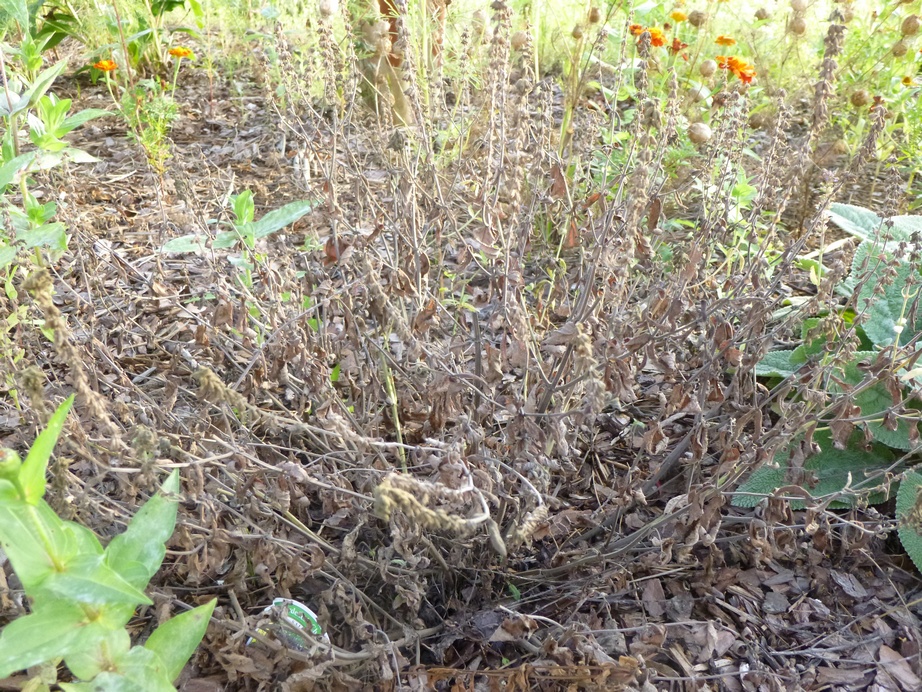
That's more than can be said for Russian Sage. Initially one of our favorite plants due to its silvery foliage and pretty blue flowers that attract bees, Russian Sage has gone downhill year by year. The experts say to cut Russian Sage back in the spring when it starts leafing out, but the plants aren't regrowing any leaves on the old wood, they seem to be sending up new shoots from the base. That creates a bit of an issue with new foliage emerging from a mound of dead wood.

New foliage (surrounded by dead wood) growing from the base of Russian Sage 

Worse than that, much of the new foliage starts wilting and browning within a few days of unfurling. This happened in earlier years too, but the whole process seems to be happening even faster this year. I suspect poor drainage may be the culprit here too.

New Russian Sage foliage wilting just days after appearing. Not a pretty sight.


I tried cutting away as much dead foliage as I could and leaving the healthiest looking new stems, but I suspect that these Russian Sages may all go to the great compost pile in the sky before the year is out.

Leaving the best Russian Foliage intact in the hopes it will serve as the core of a healthy plant this year


What's the lesson here? I guess for me it's a reminder not to rush to judgment. For better and worse, I'm often quick to praise a plant to the skies or heap scorn upon it.

Patience....Patience.

Sometimes a plant that soars in the spring will flame out before the year is done. Other times (frequently?) it can take a plant several years to settle into a new home, prove its mettle and show its true colors.

Which plants in your garden get stronger year by year? And which ones have petered out over time?

Tuesday, April 29, 2014

April Showers Bring Lots of Flowers

Clematis "Crystal Fountain", purchased from Brushwood Nursery in 2012, growing very happily at the base of a Natchez Crape Myrtle
Clematis "Crystal Fountain", purchased from Brushwood Nursery in 2012. I seem to have failed at training this clematis into a crape myrtle, but nonetheless it is growing very happily at the base of that tree.

OK, it's not quite May yet (ergo I can't call these "May flowers"), but the recent torrential downpours we've been receiving in Middle Tennessee and throughout the South seem to be unleashing pent up Spring energy. Suddenly numerous flowers dot the garden landscape with a brilliant backdrop of lush green foliage.

Here are some of the late April highlights at Garden of Aaron:

Side view of flower spikes on Ajuga genevensis (partial shade setting)

Overhead view of flower spikes on Ajuga genevensis (full sun setting)

Aquilegia vulgaris "Winky Rose", purchased from Bluestone Perennials in 2011

This is the first year I have an Aquilegia vulgaris "Winky Rose" self-sown seedling!

Aronia melanocarpa, still full of flowers and pushing new growth

Unknown pink azalea flower
The pink azaleas in the front of the house have begun to flower. They were here when we moved in, so I don't know the variety. Below the fresh new green leaves you can see quite a bit of damage on the older leaves, but this variety fared much better than another variety (possibly Encore?) that I shovel-pruned.


Baptisia australis (Blue False Indigo) flower spikes
This is the second year in the garden for Baptisia australis (Blue False Indigo) and the first year it has produced flower spikes. Very exciting! I didn't really plan it, but the flowers appear around the same and blend nicely with the blue Ajuga genevensis flowers growing (just out of the picture) nearby.

Lonicera sempervirens (Coral Honeysuckle) flowers, close-up

Lonicera sempervirens, Coral Honeysuckle, growing at the foot of the front porch steps
Lonicera sempervirens (Coral Honeysuckle) growing at the foot of the front porch stairs. I hard-pruned this last winter so nearly all of what you're seeing here is new growth!

Dianthus gratianopolitanus "Firewitch". Remember how I included Firewitch on last year's list of failed plant relationships? Well, going against the advice of Taylor Swift, Firewitch and I are getting back together!

Epimedium x perralchicum "Frohnleiten", beautiful new foliage

Gaillardia x grandiflora "Sunset Cutie"
Gaillardia x grandiflora "Sunset Cutie", new addition from Mary's Greenhouse. Looking a little bedraggled, but bravely blooming nonetheless.

Chrysogonum virginianum, Golden Star, Green and Gold, "Allen Bush" flowers
Chrysogonum virginianum, Golden Star, Green and Gold, "Allen Bush" variety. Hardy to zone 5 and described as semi-evergreen, the foliage on this plant still burned badly without any snow cover during this past harsh winter, but it has recovered nicely and makes a charming (though diminutive) plant. 

Flower buds on Spigelia marilandica, Indian Pink
Another new addition to the garden from Mary's Greenhouse, these are the buds on Spigelia marilandica, Indian Pink, a Tennessee native whose flowers reportedly attract hummingbirds!

Fresh new Liatris spicata (Blazing Star, Gayfeather) foliage emerges

Beautiful new foliage on a Cercis canadensis (Redbud) tree.
(This is another plant that I was too quick to jilt. We're getting back together too.)

Cercis canadensis, Redbud seed pod
When the Redbud has finished its floral show, pollinated flowers may produce these beautiful seed pods

New foliage emerges on Rose of Sharon alongside frost-killed leaves
Two weeks after its newly emerging leaves were destroyed by a late freeze, Rose of Sharon is giving it another shot and pushing out fresh new foliage.

New leaves on Vitex agnus-castus, Chaste Tree
The new Vitex agnus-castus (Chaste Tree) leaves were also killed by the mid-April cold snap, but the plant has produced a second round of new foliage.


Flower spikes on Salvia nemorosa, Woodland Sage
Salvia nemorosa, either "May Night" or "Blue Hill". I'm tempted to get back together with Woodland Sage, but then I remember how it looked last August...

Helianthus "Lemon Queen" perennial sunflower foliage
This miniature forest of foliage is a second-year Helianthus "Lemon Queen" perennial sunflower. The foliage in the lower right corner of the photo is Phlox paniculata "David"

Tiarella cordifolia "Pink Skyrockets" flower spikes
Yep, here's another relationship I might have ended too soon. Tiarella cordifolia "Pink Skyrockets" seems to have weathered the winter with ease and is looking good in the late April garden.

Thursday, April 3, 2014

Sparkly, Shiny and New!

Alchemilla mollis (Lady's Mantle) leaves sparkle with raindrops on the morning after a heavy storm

Shiny leaves appear on Aronia melanocarpa (Black Chokeberry)

Fresh new fuzzy foliage unfurls on an Alleghany Viburnum (Viburnum x rhytidophylloides)
Fresh new fuzzy foliage unfurls on an Alleghany Viburnum (Viburnum x rhytidophylloides) 

Monday, August 5, 2013

All Summer Long -- The Flower Parade Continues into August


Zinnia elegans, just one of a wide variety of self-sown volunteer zinnias in my garden in a dazzling variety of colors and shapes. Gardening books suggest deadheading zinnias for more blooms, but I rarely deadhead mine (since the goldfinches like to eat the seeds) and I still tend to get blooms for months! Zinnias are heat-tolerant and somewhat drought-tolerant, in my experience.


The foliage on one of the aquilegia plants was looking very tired, so I cut it all the way back down to the ground. From my experience in prior years, fresh new foliage -- seen here -- will soon emerge and make the plant look good as new. 

One of the two Black Chokeberries (Aronia melanocarpa) that I planted in spring 2012. This one is doing great, has probably tripled in size so far this year and is still pushing new growth. It gets morning sun and afternoon shade.

This is the other Aronia melanocarpa, also doing pretty well. It's bushier with more suckers pushing up, but it has not grown as tall. And if you look closely, you'll notice light dots on many of the upper leaves. I believe those are injuries caused by lace bugs. I typically don't spray any of my plants and this is no exception (although I did wash off the undersides of some of the worst affected leaves with a garden hose). I want to see if the Aronia can fight off the lace bugs -- hopefully with the assistance of some beneficial insects drawn in by the pests themselves and flowers like Sweet Alyssum that I've planted nearby. From what I've read, lace bugs don't usually cause the plant any severe damage, so I'm hopefully the Aronia will survive this indignity and emerge even stronger next year. 

Yes, like every other homeowner south of the Mason-Dixon, I have several crape myrtles. My favorites are the ones with white flowers like Natchez. I tend to find most of the other colors a bit too jarring and garish in the landscape. Plus in my experience, the white-flowered ones seem to attract the most bees! Anyway, like several of the other crape cultivars, Natchez has gorgeous exfoliating bark. I love both the older grey bark that's sloughing off and the ultra-smooth glowing new brown bark underneath.
 
Close up on Natchez Crape Myrtle blossoms

Cucumber-leaf sunflower (grown from seed), blooming its heart out for weeks and weeks!

OK, it can't all be pretty. This is/was a Salvia nemorosa (either May Night or Blue Hill...I planted them next to each other and never could remember which was which). Both plants bloomed too early to attract many bees. I trimmed them back as suggested to stimulate a rebloom. Instead, I seem to have stimulated their early demise.

And...here's the other Salvia nemorosa. It's not totally dead yet. Just mostly dead.

Sunflower, taller than me (ergo taller than 6-feet)

Gaillardia pulchella "Arizona Apricot", attracts small bees, keeps blooming for months even without deadheading, even the spent flowerheads are attractive fuzzy balls. Technically perennial to zone 3, but it is not supposed to do well on heavy soils (like our clay), so I'm not counting on it to come back next year. But it is supposed to self sow, so hopefully I'll have some gaillardia regardless. And just in case, I'll probably try growing some from seed too. (This one was grown from a transplanted seedling purchased I believe at the Perennial Plant Society of Middle Tennessee plant sale.)

Not too many flowers here, but the foliage of this perennial geranium (x cantabrigiense "Biokovo") is looking great with barely any supplemental water all year in its first year in the ground.
 
Rozanne perennial geraniums are having their Best Year Ever. There are three Rozanne plants all mixed and rambling together. They too flower for weeks and weeks, especially when given afternoon shade. You can see that the plant is even pumping out fresh new (lighter green) foliage in August!

Yet another perennial geranium - Geranium sanguineum "New Hampshire". This one is throwing off a few flowers and lots of fresh green foliage. Beautiful!
Love the sky blue flowers on the Hardy Blue Plumbago (HBP). But why is it turning red so early in the year? That can't be a good sign... This one is in the sun and it's looking reddest (also doesn't seem to have grown at all from last year), but one of the two HBPs in partial shade is also reddening a bit. Hmmmm.... Has anyone else experienced this?

Lovely lemony flowers on the perennial sunflower Helianthus microcephalus (Small-headed Sunflower), "Lemon Queen" variety purchased just this spring at Gardens in the Wood of Grassy Creek. As with many of my other Gardens in the Wood purchases, this one has done great. This healthy, bushy plant is probably between 4-5 feet tall now. There are about a dozen flowers already open and many more buds. I'm guessing that within a week or two, this plant be covered with dozens of flowers. The bees and other beneficial insects are already happily visiting the flowers. I imagine the whole plant will be buzzing with activity very soon!


Don't be too grossed out, but what you're looking at here is a stem of the Lemon Queen perennial sunflower pictured above. You're probably wondering what the heck is that white foam at the stem junction? I was wondering too, so I looked it up and near as I can tell, it's probably the excretions of an insect called (for obvious reason) the Spittlebug or Froghopper. The insect sucks some sap from the plant and uses some of that sap to produce the foam to camouflage itself and protect it from predators. What do you think? Gross? Amazing? Clever? All of the above? Anyway, apparently spittlebugs usually don't hurt the plants on which they feed, so I've opted to pursue my usual policy of benign neglect, although I did use a hose to wash off some of the spittle one time to give predatory insects or birds a chance to do their thing.


Another sunflower? Not quite. This is a False Sunflower, Heliopsis helianthoides "Summer Sun" variety. Like many of the other flowers featured here, Heliopsis has been blooming for many weeks. Amazingly, the one slightly faded flower in the bottom left of the photo was the very first flower that opened and it's still looking pretty good! I haven't seen the Heliopsis attract as many bees or butterflies as the true sunflowers, but perhaps it's just getting overlooked right now? Although gardening guides say the plant can get up to 5-feet tall, it's probably only around 12-inches at the moment. It is a native perennial (hardy to zone 3), so perhaps it will get bigger next year? I think some Garden of Aaron readers have commented that Heliopsis self sows readily, so perhaps the bees will take more notice next year if I have a whole patch of Heliopsis plants for them to visit...

This is New York Ironweed (Vernonia noveboracensis). The foliage looks nice and I love the purple color of the flowers, but I have to admit I've been a little disappointed so far. The flowers are small, they don't seem to last that long, the spent flowers are not particularly attractive and worst of all, I don't think I've seen any bees or butterflies visiting the Ironweed yet. I've no intention of pulling the plant, but I am a little bummed that it has not attracted more pollinators yet. Again, as with the Heliopsis, maybe the problem is that I only planted a single Ironweed?

Similar issue here with the dwarf Joe-Pye Weed (Eupatorium dubium "Baby Joe"). I recently saw my first small bee on this plant, but I have not seen a single butterfly visit it yet, despite the fact that it is advertised as a butterfly magnet. I do have to admit that both the foliage and the pink flowerheads are very pretty though.

Another sunflower (Helianthus annus) bloom. I've got a lot of them in a variety of sizes and shapes. That's what happens when you plant a variety pack of sunflower seeds!
The older foliage on the Vitex agnus-castus is still looking great, but I'm excited to see the plant is having a flush of beautiful light green foliage. For some reason, I find these new leaves incredibly cute. I'm hoping the new leaves means that a second flush of flowers might be on the way. The bees - especially the bumble bees - went nuts over the earlier Vitex blooms, so I'm sure they'd appreciate a second round! 


Speaking of those earlier Vitex blooms, you can see the spent flowerheads here with their seeds forming. And camouflaged among the seeds is quite an interesting insect. Does anyone know what this? I imagine that it's predatory and is hiding among the seedheads waiting for an unsuspecting prey insect to alight?

Here's a mixed patch of Cosmos and Zinnias. As you can see, I love the casual and informal look of different colors all mixing cheerfully together.  

Let's finish up with the irrepressible purple coneflowers. Some of the petals are looking tattered, but these plants have been blooming for months, giving joy to countless bumblebees like the one on the right side of this photo. If you want to find a bumblee in my garden on a hot summer day, the best place to look would be on a sunflower or a coneflower.

I hope you enjoyed this little tour. I'll try to do another photo safari through the garden toward the end of September. Will the garden still be filled with flowers in another 6-8 weeks? Or will pathogens and pests get the upper hand? (Right after I took some of these photos, I noticed that powdery mildew is starting to run rampant through the zinnias.) 

Tune in next time - Same Bat Time, Same Bat Channel :)