Showing posts with label Dogwood. Show all posts

Sunday, April 13, 2014

Tulip Extravaganza! (And Dogwoods too)

This morning we visited Cheekwood Botanical Gardens in Nashville.

Cheekwood has been going all out with tulips the last couple of years. Last year, they claimed 50,000 bulbs. This year, they upped the ante and doubled the count to a neat 100,000!

Here are some highlights from our visit - plenty of tulips, but also some dogwoods and ...

Yellow tulip with violas


River of orange tulips
River of orange 

Blowzy pink and purple tulips

Pink and lavender tulips surround a gazebo
What a lovely spot for a rendezvous...


White, pink and purple tulips mixed with blue and yellow violas
So many colors -- somehow they all work beautifully together!

White tulips mixed with purple fringed tulips
Who doesn't love a fringed purple tulip?

River of white and purple tulips flows beneath still bare mature crape myrtle trees
These majestic mature crape myrtle trees may still be bare, but their exfoliated trunks serve as the perfect vertical contrast to this flowing river of white and purple tulips

A patch of cheerful yellow tulips
What a sunny, cheerful sight!

Yellow and orange formal tulips surround a billowy informal yellow variety
Here's an unusual "deconstructed" yellow tulip surrounded by some complementary more formal peers


And it wasn't all about the tulips at Cheekwood. The garden has an impressive collection of dogwoods, many of which were in bloom. Our favorite was Cherokee Chief:

Cornus florida "Cherokee Chief" Dogwood

Cornus florida "Xanthocarpa" full of white flowers
Cornus florida "Xanthocarpa"


Cornus florida "Xanthocarpa" flowers against a blue April sky

Side-by-side pink and white flowering dogwood trees seem to enhance each other's beauty

Saturday, April 6, 2013

Signs of Life ... and Death?


With the shot of warm air that finally hit Middle Tennessee yesterday (and looks like it will stick around for a while), I had the urge to go out and stroll the garden, taking photos of comeback kid plants and those that have put on a disappearing act.

Here's what I found...

The pink camellia (not sure of the name since it was here when we moved in) is still going strong and covered in blooms. I only fertilize this plant once a year with an acidic natural fertilizer! Yesterday was the first day this year to see a bee working the camellia bush. Definitely a sign of spring!

I wasn't too impressed with Dianthus Firewitch last year. It just kind of sat there, but at least it didn't die in full sun, intense heat and drought. This year, it seems to be expanding. All of a sudden, just in the last couple of days, it is shooting outward in all directions. Love the foliage color. Curious to see whether this will be a long-lived perennial...

One of the two native coral honeysuckles flanking the front steps. LOTS of buds on the plant this year (its second year in the ground). Looks to be establishing nicely. Can't wait to see if a profusion of flowers will attract hummingbirds (as it is supposed to do). Last year, it had a sparse bloom and I didn't see any hummers...

Phlox paniculata 'David' - tall garden phlox. I planted three small plants back in 2011 (so two years ago). All three have come back and multiplied. From one initial stalk on this particular one, it looks like I have about a dozen stalks this year. Exciting!

I was worried that I had killed my Rozanne Geraniums by transplanting them twice last year - first from the full sun back of the house to the afternoon shade in the front. Then transplanted them again to bring these low plants closer to the front of the border where they would be more visible -- and also because I needed the space to put in an oakleaf hydrangea (see below). Anyway, I'm pretty sure these small leaves are the reemergence of one of the Rozanne Geraniums. I see another plant emerging nearby. So that's 2 out of 3 (at least). Not bad for plants that were manhandled roughly last year.

I forgot about this lily altogether until I saw it pushing up boldly in the front of the house! We put in three Stargazer Lilies when we moved in back in 2011. I remember the two in the back of the house in full sun, but the one in the front in afternoon shade has never done much. It looks really strong this year though so I have high hopes!

This is the oakleaf hydrangea I mentioned above. The new leaves are unfurling at the tips of the branches even as the old leaves still hang on. I'd say that our oakleaf hydrangea was semi-evergreen in its first winter, but the old leaves are still beautiful - colorful and almost like they are etched with frost. I think it's exciting to see the new and the old side-by-side, each beautiful in its own way. Look forward to watching this plant undergo its metamorphoses throughout the year.

And now for some not-so-great news. As you can see, the buffalo grass patch is still looking pitiful. Not a single sign of green on any of the tufts. They might be dead for all I know, or maybe just still dormant. Either way, I can't imagine planting a larger patch of buffalo grass here in Middle Tennessee. Even if it is low-growing and green in the summer, I can't imagine having the lawn look like this (or a version of this with the dormant grass more filled in) during 5-6 months from November to April.

Trying to find the bright side of the ridiculously awful buffalo grass, I will say that all the spaces between the dormant tufts provide room for self-sown annuals like this volunteer lettuce to pop up. I plan to eat this soon. It looks better in real life than in this top-down photo.


And alongside the lettuce amid the dormant buffalo grass, I also like to see these adorable violets. They popped up early despite the cold spring and have added a touch of color and movement at a time when almost everything else was dead, dormant, brown or grey. I know some people think of violets as weeds, but I like them in my garden :)

Here's a close-up on a dormant tuft of buffalo grass so you can see just how pitiful and scrawny it looks. Not surprisingly, I had to weed this patch heavily earlier in the winter...


Moving to the front of the house, there are no signs of life on this Clematis integrifolia. I did not really like the plant last year - the flowers were pretty but down-turned on a low plant so that I would have had to lie on the ground to really see them. That's my own aesthetic sensibility - just not much of a fan of down-turned flowers. I don't mind them on Aquilegia (Columbine) but I'm not particularly longing for a Hellebore either for the same reason. Anyway, I figure I'll give this Clematis another week or two to make an appearance or show some signs of life before shovel-pruning it. Or perhaps I'll just cut it way back and see if it ever makes a reappearance...

This is actually one of my biggest disappointments of the spring! You're probably thinking, "That doesn't look like much." You're right - that's the problem! This is one of the three Ceratostigma plumbaginoides (Hardy Blue Plumbago) in my garden. All three of them are just bare little sticks right now. I loved these tough plants last year - they were pretty slow-growing, but they slowly did expand over the course of the growing season and they had the prettiest blue flowers plus lovely red foliage in the autumn. But I have heard these are very late to leaf out in the spring and they seem to be sticking true to that description. It's a pity, because I was thinking to try to propagate these and divide them and buy more to get a large scale Hardy Blue Plumbago groundcover, but I'm not sure I want to do that if they're going to stay dormant this far into the spring. (And that's presuming they do make an appearance and didn't bite the bullet for some reason over the winter...)

This is Geranium maculatum, just purchased via mail order. I don't have a good feeling about this plant to be honest (or most of the other plants that arrived in the same order).  The plant is quite small and some of the leaves have died since I planted it. But Geraniums are kind of tough plants (see the Rozanne above that I transplanted twice last year and still survived) so I'm hoping this one will pull through. I put it near the Rozanne to have a nice mixed Geranium area. That's the idea anyway.

This is Hexastylis arifolia, an ornamental ginger native to the Southeast. It arrived in the same mail order package as the Geranium maculatum above. Again, I think it's looking really pitiful. Only one of the leaves is hanging strong and the rest of the stems have pretty much keeled over. I'll give it time to recover, but I don't think it's looking good. 

OK, let's finish on a high note with some upbeat images. As I mentioned in my last post, I'm loving the Veronica Georgia Blue so far. I added two to the garden last autumn and both stayed evergreen through the winter and are now blooming their pretty little heads off in March and April. They are most floriferous on sunny days. Just beautiful!! Love that shade of blue :)  (This one is in afternoon shade and seems to be spreading a bit wider than the one in full sun, but the one in full sun looks good too, just growing a little tighter.)
I don't have the tag for this anymore, but I believe this is a variegated variety of Agastache foeniculum, a.k.a. Anise Hyssop. I bought this plant late last autumn and it did not have much time to settle in before it went dormant for the winter, so I was a little worried about it, but it seems to be coming back nicely this spring. It is actually supposed to prefer full sun (I have it in an afternoon shade setting) but it's related to mint and mints like moist soil and the full sun areas on my property tend to bake and dry out in mid-summer. So even though it is supposedly drought tolerant, I placed it in afternoon shade. So I may not get as many flowers as I would if it were in full sun, but hopefully the plant will survive and thrive. If I ever get another one, I'll probably try it in full sun just to see what happens, but I'm trying to minimize supplemental irrigation in my garden and find plants that can survive just on rain water (with an occasional  assist in extreme droughts), and I'm not sure that Anise Hyssop would fit that bill in a full sun setting.
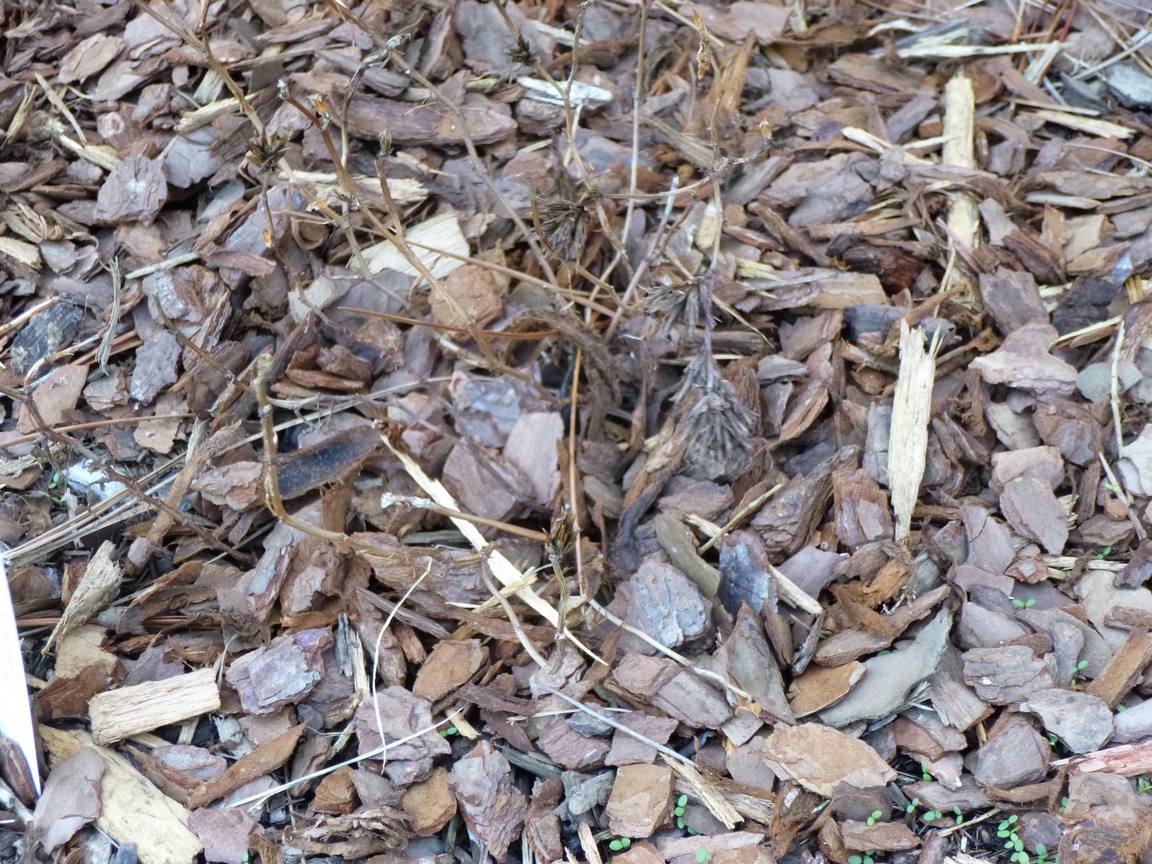
Here's another plant that I added late last year. It's hard to tell what's going on from this photo, but trust me when I say this is a top-down view of a dogwood that was sort mistreated by being partially buried alongside a brush pile last winter. Some branches were broken and/or perhaps nibbled by the mice who made their home in said brush pile. Nonetheless, the dogwood seems to have pulled through and is starting to leaf out! Exciting stuff!!
Here's another perennial with a reputation for breaking dormancy late in the year. But it's still up and growing before the Hardy Blue Plumbago. You're looking at the emerging stems of the balloon flower - Platycodon grandiflorus, Mariesii variety. Again, I added this late last year and it still flowered prettily in the autumn, but I was not sure if it had time to settle in before winter. Looks like it did just fine. I love the fleshy purple stems. I believe Platycodon is supposed to be long-lived and able to thrive with little human care. My kind of perennia! Plus the flowers are amazing.
Again, it's a little hard to tell from this photo (given the difficulty my camera has with focusing sometimes), but this is Aronia arbutifolia Brilliantissima variety. All three of my aronias struggled with the heat and drought last year, but they all pulled through and are leafing out nicely. The two A. melanocarpas on the other side of the front steps are a bit smaller, but this A. arbutifolia has lots of leaves and seems to be covered with buds. I'll be amazed if it blooms when it is this small (only about 12-18 inches tall) but it looks like it might just do that! Wow.

Finally, to finish with a favorite, this is the impossibly fresh and clean green foliage of Sweet Woodruff. One of three patches that I have in the garden (another one smaller than this and one that's much bigger). This came from Gardens in the Wood of Grassy Creek (GITWOGC) last autumn and it looks just beautiful. Based on my experiences so far, I can say that GITWOGC is the only mail order nursery that impressed me with the size and health of its plants and their vigor. I placed another order from Dottie at GITWOGC this spring and am looking forward to receiving my plants next week. (Normally, I think she would ship earlier, but North Carolina's spring has been as cold as ours here in Tennessee.) Some folks say that Sweet Woodruff is invasive. I'm sure I'll regret saying this later, but right now I'm hoping it will invade a lot of the bare ground in my landscape beds! ;)