Showing posts with label lily. Show all posts

Saturday, April 6, 2013

Signs of Life ... and Death?


With the shot of warm air that finally hit Middle Tennessee yesterday (and looks like it will stick around for a while), I had the urge to go out and stroll the garden, taking photos of comeback kid plants and those that have put on a disappearing act.

Here's what I found...

The pink camellia (not sure of the name since it was here when we moved in) is still going strong and covered in blooms. I only fertilize this plant once a year with an acidic natural fertilizer! Yesterday was the first day this year to see a bee working the camellia bush. Definitely a sign of spring!

I wasn't too impressed with Dianthus Firewitch last year. It just kind of sat there, but at least it didn't die in full sun, intense heat and drought. This year, it seems to be expanding. All of a sudden, just in the last couple of days, it is shooting outward in all directions. Love the foliage color. Curious to see whether this will be a long-lived perennial...

One of the two native coral honeysuckles flanking the front steps. LOTS of buds on the plant this year (its second year in the ground). Looks to be establishing nicely. Can't wait to see if a profusion of flowers will attract hummingbirds (as it is supposed to do). Last year, it had a sparse bloom and I didn't see any hummers...

Phlox paniculata 'David' - tall garden phlox. I planted three small plants back in 2011 (so two years ago). All three have come back and multiplied. From one initial stalk on this particular one, it looks like I have about a dozen stalks this year. Exciting!

I was worried that I had killed my Rozanne Geraniums by transplanting them twice last year - first from the full sun back of the house to the afternoon shade in the front. Then transplanted them again to bring these low plants closer to the front of the border where they would be more visible -- and also because I needed the space to put in an oakleaf hydrangea (see below). Anyway, I'm pretty sure these small leaves are the reemergence of one of the Rozanne Geraniums. I see another plant emerging nearby. So that's 2 out of 3 (at least). Not bad for plants that were manhandled roughly last year.

I forgot about this lily altogether until I saw it pushing up boldly in the front of the house! We put in three Stargazer Lilies when we moved in back in 2011. I remember the two in the back of the house in full sun, but the one in the front in afternoon shade has never done much. It looks really strong this year though so I have high hopes!

This is the oakleaf hydrangea I mentioned above. The new leaves are unfurling at the tips of the branches even as the old leaves still hang on. I'd say that our oakleaf hydrangea was semi-evergreen in its first winter, but the old leaves are still beautiful - colorful and almost like they are etched with frost. I think it's exciting to see the new and the old side-by-side, each beautiful in its own way. Look forward to watching this plant undergo its metamorphoses throughout the year.

And now for some not-so-great news. As you can see, the buffalo grass patch is still looking pitiful. Not a single sign of green on any of the tufts. They might be dead for all I know, or maybe just still dormant. Either way, I can't imagine planting a larger patch of buffalo grass here in Middle Tennessee. Even if it is low-growing and green in the summer, I can't imagine having the lawn look like this (or a version of this with the dormant grass more filled in) during 5-6 months from November to April.

Trying to find the bright side of the ridiculously awful buffalo grass, I will say that all the spaces between the dormant tufts provide room for self-sown annuals like this volunteer lettuce to pop up. I plan to eat this soon. It looks better in real life than in this top-down photo.


And alongside the lettuce amid the dormant buffalo grass, I also like to see these adorable violets. They popped up early despite the cold spring and have added a touch of color and movement at a time when almost everything else was dead, dormant, brown or grey. I know some people think of violets as weeds, but I like them in my garden :)

Here's a close-up on a dormant tuft of buffalo grass so you can see just how pitiful and scrawny it looks. Not surprisingly, I had to weed this patch heavily earlier in the winter...


Moving to the front of the house, there are no signs of life on this Clematis integrifolia. I did not really like the plant last year - the flowers were pretty but down-turned on a low plant so that I would have had to lie on the ground to really see them. That's my own aesthetic sensibility - just not much of a fan of down-turned flowers. I don't mind them on Aquilegia (Columbine) but I'm not particularly longing for a Hellebore either for the same reason. Anyway, I figure I'll give this Clematis another week or two to make an appearance or show some signs of life before shovel-pruning it. Or perhaps I'll just cut it way back and see if it ever makes a reappearance...

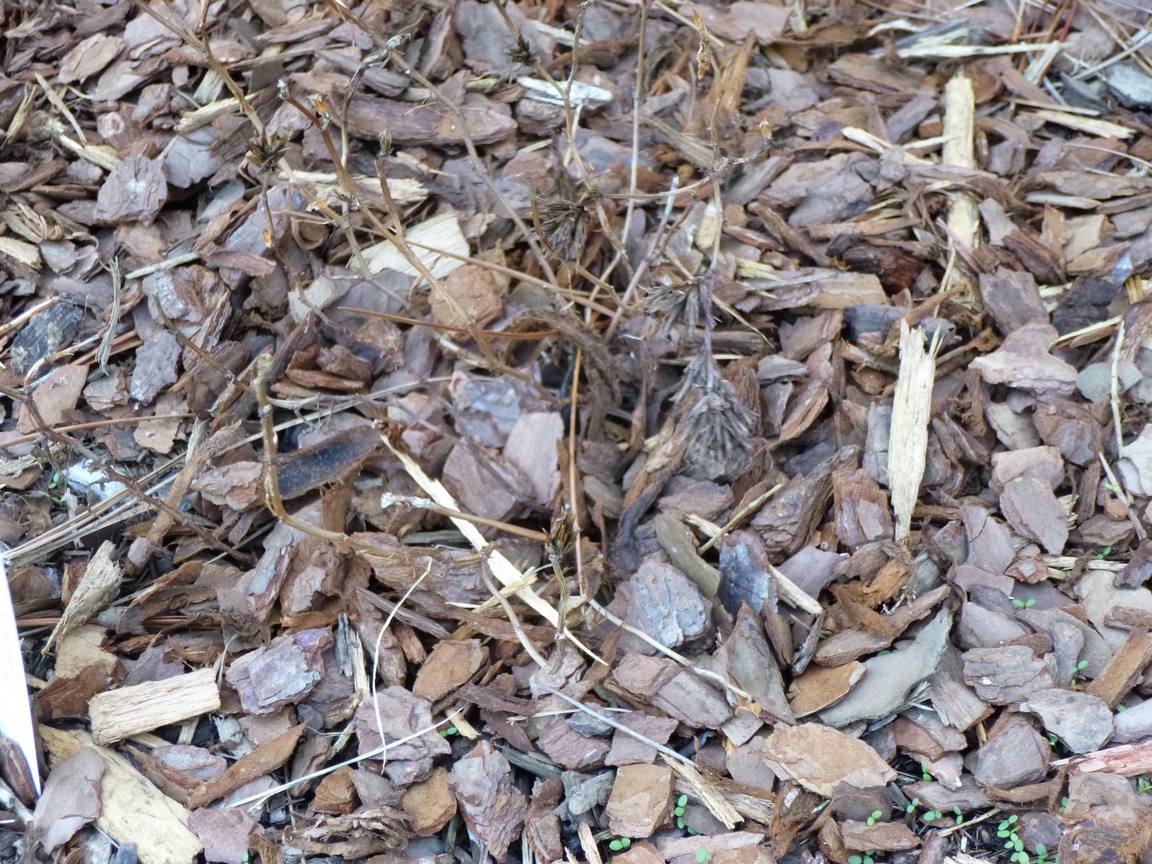
This is actually one of my biggest disappointments of the spring! You're probably thinking, "That doesn't look like much." You're right - that's the problem! This is one of the three Ceratostigma plumbaginoides (Hardy Blue Plumbago) in my garden. All three of them are just bare little sticks right now. I loved these tough plants last year - they were pretty slow-growing, but they slowly did expand over the course of the growing season and they had the prettiest blue flowers plus lovely red foliage in the autumn. But I have heard these are very late to leaf out in the spring and they seem to be sticking true to that description. It's a pity, because I was thinking to try to propagate these and divide them and buy more to get a large scale Hardy Blue Plumbago groundcover, but I'm not sure I want to do that if they're going to stay dormant this far into the spring. (And that's presuming they do make an appearance and didn't bite the bullet for some reason over the winter...)

This is Geranium maculatum, just purchased via mail order. I don't have a good feeling about this plant to be honest (or most of the other plants that arrived in the same order).  The plant is quite small and some of the leaves have died since I planted it. But Geraniums are kind of tough plants (see the Rozanne above that I transplanted twice last year and still survived) so I'm hoping this one will pull through. I put it near the Rozanne to have a nice mixed Geranium area. That's the idea anyway.

This is Hexastylis arifolia, an ornamental ginger native to the Southeast. It arrived in the same mail order package as the Geranium maculatum above. Again, I think it's looking really pitiful. Only one of the leaves is hanging strong and the rest of the stems have pretty much keeled over. I'll give it time to recover, but I don't think it's looking good. 

OK, let's finish on a high note with some upbeat images. As I mentioned in my last post, I'm loving the Veronica Georgia Blue so far. I added two to the garden last autumn and both stayed evergreen through the winter and are now blooming their pretty little heads off in March and April. They are most floriferous on sunny days. Just beautiful!! Love that shade of blue :)  (This one is in afternoon shade and seems to be spreading a bit wider than the one in full sun, but the one in full sun looks good too, just growing a little tighter.)
I don't have the tag for this anymore, but I believe this is a variegated variety of Agastache foeniculum, a.k.a. Anise Hyssop. I bought this plant late last autumn and it did not have much time to settle in before it went dormant for the winter, so I was a little worried about it, but it seems to be coming back nicely this spring. It is actually supposed to prefer full sun (I have it in an afternoon shade setting) but it's related to mint and mints like moist soil and the full sun areas on my property tend to bake and dry out in mid-summer. So even though it is supposedly drought tolerant, I placed it in afternoon shade. So I may not get as many flowers as I would if it were in full sun, but hopefully the plant will survive and thrive. If I ever get another one, I'll probably try it in full sun just to see what happens, but I'm trying to minimize supplemental irrigation in my garden and find plants that can survive just on rain water (with an occasional  assist in extreme droughts), and I'm not sure that Anise Hyssop would fit that bill in a full sun setting.
Here's another plant that I added late last year. It's hard to tell what's going on from this photo, but trust me when I say this is a top-down view of a dogwood that was sort mistreated by being partially buried alongside a brush pile last winter. Some branches were broken and/or perhaps nibbled by the mice who made their home in said brush pile. Nonetheless, the dogwood seems to have pulled through and is starting to leaf out! Exciting stuff!!
Here's another perennial with a reputation for breaking dormancy late in the year. But it's still up and growing before the Hardy Blue Plumbago. You're looking at the emerging stems of the balloon flower - Platycodon grandiflorus, Mariesii variety. Again, I added this late last year and it still flowered prettily in the autumn, but I was not sure if it had time to settle in before winter. Looks like it did just fine. I love the fleshy purple stems. I believe Platycodon is supposed to be long-lived and able to thrive with little human care. My kind of perennia! Plus the flowers are amazing.
Again, it's a little hard to tell from this photo (given the difficulty my camera has with focusing sometimes), but this is Aronia arbutifolia Brilliantissima variety. All three of my aronias struggled with the heat and drought last year, but they all pulled through and are leafing out nicely. The two A. melanocarpas on the other side of the front steps are a bit smaller, but this A. arbutifolia has lots of leaves and seems to be covered with buds. I'll be amazed if it blooms when it is this small (only about 12-18 inches tall) but it looks like it might just do that! Wow.

Finally, to finish with a favorite, this is the impossibly fresh and clean green foliage of Sweet Woodruff. One of three patches that I have in the garden (another one smaller than this and one that's much bigger). This came from Gardens in the Wood of Grassy Creek (GITWOGC) last autumn and it looks just beautiful. Based on my experiences so far, I can say that GITWOGC is the only mail order nursery that impressed me with the size and health of its plants and their vigor. I placed another order from Dottie at GITWOGC this spring and am looking forward to receiving my plants next week. (Normally, I think she would ship earlier, but North Carolina's spring has been as cold as ours here in Tennessee.) Some folks say that Sweet Woodruff is invasive. I'm sure I'll regret saying this later, but right now I'm hoping it will invade a lot of the bare ground in my landscape beds! ;)


Wednesday, July 4, 2012

104, 108, 106, 104, 99, 99

Those aren't lottery numbers, they're the high temperatures recorded in my neck of the woods over the past six days.

At Nashville airport, it actually hit 109 degrees (42.8 celsius) on June 29, setting an all-time high temperature record.

That's right, the highest temperature ever recorded in Nashville since modern record-keeping began back in 1871, over 140 years ago.

Oh and did I mention we have had basically no rain for over a month?

What does that do to a garden? It ain't pretty, folks. I'll spare you pics of the worst of the carnage today and just say that I'm fighting to keep most plants alive.

At the same time, I'm perversely interested to see what will survive. Especially in an age of scarce resources, I believe that coddle our gardens far too much. I think I want a garden that can prosper - or at least survive - with little intervention or assistance.

Is that too much to ask?

In any case, I have not been living up to that ideal, but I have taken feeble steps in that direction by refraining from watering every day and limiting my watering to every other day.

(The exception is the vegetable garden. It's not fair to ask vegetables that were bred to be edible, not drought-resistant, to survive on their own. It would be like throwing a toy poodle into the Amazon jungle. So the cucumbers, the beans and the stubbornly small okra seedlings get some daily water. The tomatoes though, which are well-established, only get a deep watering every other day.)

So how are some of the previous garden superstars doing in this infernal weather? Not so well...

Remember the Rozanne perennial geraniums covered in blooms back in early June? This is the same plant now:

Perennial geranium 'Rozanne', nary a bloom in sight

I had thought perennial geraniums like Rozanne were drought-tolerant, but as with my last post, I find that when I go back to look at the Bluestone Perennials plant description, I must have actually focused on heat tolerance rather than drought tolerance.

That's a big difference. Rozanne might do great in steamy tropical wet Florida -- or even in a normal Tennessee summer punctuated by regular downpours -- but it doesn't seem to have much tolerance when the rains fail.

In any case, I tried cutting back the dead growth on my three Rozannes. (I was guided in part by this article that suggests a big cutback can promote rebloom, though I'd be happy with just having them survive to bloom next year.) As a relatively novice gardener, I'm not sure if that was a good idea or not. Would more experienced gardeners like to chime in? Do you typically cut back drought-stressed perennials.

The trimmed Rozannes look better...for now. But we'll see how they fare through July and August...

Rozanne geranium after a major haircut

Since I was in a trimming mood, I also cut back two of the three gauras. Again, I was guided by an article that said: "If the plants are looking tired prune again in summer to encourage a further flush of flowers."

But what is the best way to trim a wild and sprawling gaura that has ceased flowering?

How do you tame a plant like a gaura? (Apologies to Sound of Music.)

I tried two methods of pruning with these two plants:

1) For the plant on the right, I grabbed bundles of the long floppy stems and cut them back close to where the leafy bottom part of the gaura begins, maybe 8-inches off the ground.

2) Cutting bundles of stems is hard work, so for the plant on the left, I tried to cut back even further. I mostly chopped this plant back to its woody stems. One cut to a woody stem severs all the floppy ones above it, so fewer total cuts are needed. But I'm a bit concerned that I may have cut back the plant too severely.

There were a lot of dead leaves at the base of both plants, particularly the one on the left. I'm not sure if this is typical (it's only my 2nd year growing gaura and I know they are supposed to be short-lived plants), but I suspect that it's at least partly the result of the heat and the drought.

Well, here is a photo showing one trimmed and one soon-to-be trimmed gaura:

Short-haired gaura vs. Long-haired guara :)

With the trimming done, I took a walk around and visited some other plants, like this heat-and-drought stressed lily. I can't remember the name of these lilies we planted last year, but all three of them did come back and they were looking pretty good until about two or three weeks ago when they started yellowing at the base. Not all the flowers have opened and the ones that did open weren't looking all that happy. So I cut some of the flowers and brought them inside where we could enjoy the beautiful fragrance. The ones that are inside in the a/c and sitting in a vase of water look much happier now!

Lily struggling in the heat.

A cool and comfortable lily blooming widely and fragrantly in the air-conditioned house

As we established in a post about 10 days ago, the zinnias are looking extremely drought-stricken. But I've been watering them faithfully every couple of days and most of them seem to be (barely) hanging in there. The ones that are left are visited regularly by gold finches and butterflies. Many of the butterflies are little brown skippers, but there are other beautiful visitors including this one:

Black and blue butterfly (swallowtail?) on zinnia

Same butterfly, same plant, different flower, different angle

Finally, let's take a walk around to the North side of the house. It's a bit cooler and shadier over here, which means that while several of the Natchez crape myrtles sitting in direct sun on the west side of the house have stopped flowering and are sulking with drooping leaves, the ones on the North side of the house are looking much fresher and just starting to cover themselves with flowers. It's a welcome sight from an aesthetic standpoint, and I'm guessing that the bees are happy as well.

Lavender crape myrtle blossoms

Smaller reddish-pink crape myrtle has grown a lot and has many more flowers this year compared to last year. I'm not sure if it will stay shrub-sized or grow into a small tree. This one is more susceptible to powdery mildew than either the Natchez or lavender crape myrtles, but so far it has fought off the mildew on its own to produce a multitude of flowers

Close up on reddish-pink crape myrtle flowers that harmonize nicely with the brick wall background


That's all for now. Weather.com is calling for a 95% chance of rain in the next six hours. Accuweather says 90% probability of rain. I hope they are right!

Conversation starter --- Do you pamper your garden with life-sustaining water in times of drought or do you practice tough love and create your own little Darwinian survival-of-the-toughest situation?

Monday, May 21, 2012

Down the Garden Path 2012 -- Nashville Garden Tour & Plant Sale

My wife and I had the pleasure of taking a Garden Tour this past weekend. The 13th Annual Down the Garden Path tour sold tickets to visit nine gardens as a fundraising effort for the Lupus Foundation of America, Mid-South Chapter.

All in all, it was a wonderful day. True, the heat and humidity were a little oppressive around noon, but a tremendous hail/lightning/thunder storm dropped the temperatures by 20 degrees in the early afternoon and made the rest of the tour much more comfortable.

Here are some of the photo highlights from our tour:

Lacecap Hydrangea (Hydrangea macrophylla normalis). I really liked the lacecap, but my wife liked the mophead ones better. Which do you like best?

Koi pond with water plants. Notice the heron statues behind the pond in the center of the photo. According to the owner of this garden, herons are territorial birds. Most of the time, if a heron flies over and looks down and sees what looks like another heron, it will bypass the garden, sparing the fish.
Close-up of the heron statues. Heron statues can ward off real live herons, which are solitary and territorial birds. The only problem is that the statues may actually attract  herons during mating season.

Lilies, after the rain

Hibiscus. Lots of people think that hibiscus is just a tropical flower, but hardy hibiscus (a.k.a. Rose of Sharon) plants are hardy perennials that can tough it out as far north as Zone 4!
Elegant fountain in shady woodland garden setting. This fountain was crushed by a falling tree that was uprooted in a storm, but the owner had the fountain rebuilt and restored to working order. I feel like fountains can have a cooling, soothing effect in any garden. 
Close-up on the big frog sitting next to the fountain.  Used with restraint, statuary can enhance a garden. Here it adds a touch of whimsy. 
We came around a bend in one garden and found ourselves facing this realistic deer statue. I loved the positioning and realism of the statue, although personally I think we have so many real, live, plant-destroying deer in Tennessee that I wouldn't erect a statue to one in my garden!
Next to this plant was a sign that read, "Ugly plant. Beautiful blooms only one night per year." This, my friends, is the Night-Blooming Cereus. Actually a type of spineless, climbing cactus, Cornell says a mature (4 or 5-year old) plant should bloom every two weeks from midsummer to autumn. The flowers are supposed to be extremely fragrant, but you had better be a night owl, because they don't reach full potency until after midnight. Not at all frost tolerant, it seems like Cereus would have to be grown in a pot in Tennessee and brought indoors over the winter. In frost-free parts of Florida, the plant can apparently climb as much as 40 feet.
Inviting bench swing with several types of clematis vines. Notice the adjacent meerkat statues.
Unknown pink flowers leaning against tall verbena. Wish that the gardener had been around to ask about the plant ID.
Rose Campion (Lychnis coronaria)
Unknown flower. Maybe a type of Monarda?
Hardy Gardenia. This plant had an incredible fragrance! We actually visited this garden twice, primarily to spend more time lingering and burying our noses in these flowers with their heavenly scent! 
Close-up on gardenia flower. Middle Tennessee is supposed to be right on the Northern edge of the hardy gardenia's range, but I may have to try growing one in a protected spot for a chance at inhaling that perfume again.