|
| The 'Grey Owl' cultivar of Juniperus virginiana (eastern redcedar) grows as a woody groundcover |
It seems to me that there are two basic ways to approach gardening - you can fight against Nature or you can try to form an alliance with Nature.
When it comes to preventing your garden beds from getting overgrown by weeds, the fighting approach calls for annual (or more frequent) applications of mulch, plus annual (or more frequent) applications of herbicide.
This fighting approach seems not only wasteful from an economic and resource standpoint, but also so much effort! And not one-time effort, but constant and unending work.
The alliance approach calls for using some other plant - a groundcover - that can block and suppress the weeds for you while you sit back on your porch and drink a Mai Tai (or an iced tea, for those of the teetotaler persuasion).
Of course, it's not quite as simple as all that.
Sometimes you
think you have an alliance with the groundcover, but the groundcover is actually secretly plotting world domination (or at least the domination of your garden beds).
Sometimes your ally proves too timid and weak to stand up to the onslaught of weeds or the indignities of heat, cold, wind, wet and drought that Nature throws its way.
After nearly 5 years of experiments, here are my thoughts on some of the groundcovers I have trialed in my USDA zone 6/7 clay soil Tennessee garden:
Woody groundcovers
 |
| Juniperus virginiana 'Grey Owl' loaded with 'berries' (actually berry-like cones) |
Juniperus virginiana, eastern redcedar - Both the straight species and many of the
J. virginiana cultivars are upright evergreen trees, but the
'Grey Owl' cultivar forms a lovely blue-grey spreading shrub.
After many years, 'Grey Owl' could grow into a large shrub - say 6 or 8 feet tall - at which point it would no longer fit a groundcover definition, though I'm interested to see whether judicious pruning could prevent or at least delay that transition from groundcover to mounding shrub.
The two 'Grey Owl' shrubs in my garden have been fantastic performers so far. They have lots of berry-like cones in the winter that are both ornamentally appealing and theoretically provide food for the birds.
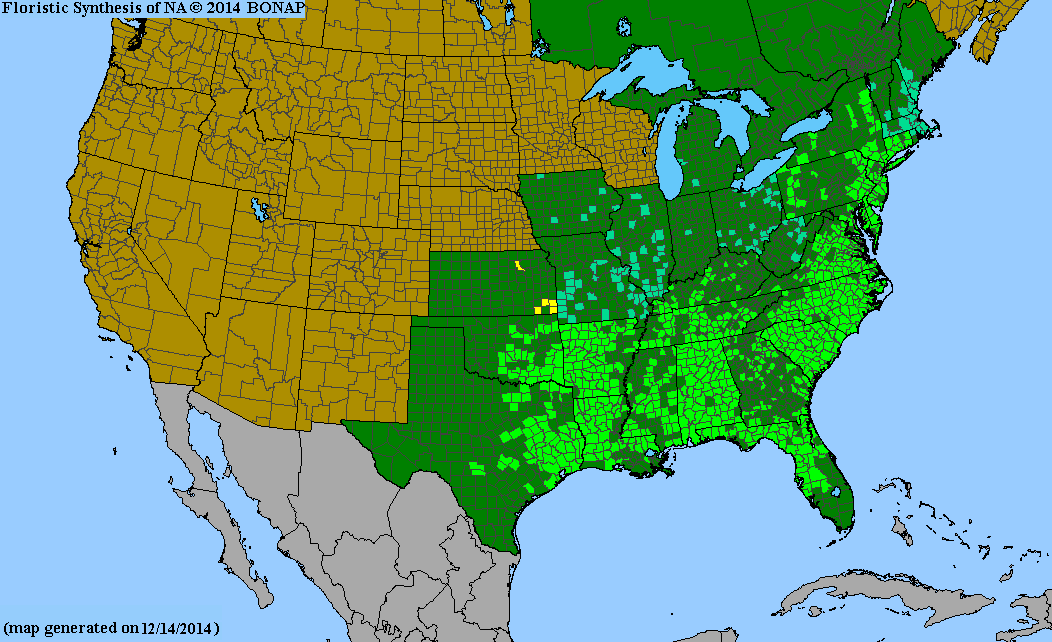
The species is
native throughout Eastern and Central North America and seems extremely adaptable and tough. Its only serious enemy in my garden has been the
bagworm, although actually this pest has not yet appeared on the 'Grey Owl' plants, but only on some of the upright eastern redcedars around my property. Hand-picking bagworms off a 15-foot tall upright juniper is impractical, but the task should be easier if the bagworms show up on a low-growing 'Grey Owl.' And since bagworms have only one generation per year, the task is not interminable. In any case, I plan to try to combat the bagworms next year with
Bt and asters, since I read someplace that asters attract beneficial insects that prey on the bagworms.
 |
| Rhus aromatica foliage, August 2015 |
Rhus aromatica, fragrant sumac - Again, the straight species of this plant is definitely
not a groundcover, but rather a vigorous shrub that reportedly can grow 8 to 10 feet tall with 5 years.
As with the 'Grey Owl' juniper, there is a fragrant sumac cultivar called 'Gro-Low' that is much more amenable to usage as a woody groundcover. Gro-Low tends to grow outward much more than upward, forming a spreading, sprawling shrub that could make a tall base layer underneath trees.
I have mixed feelings about fragrant sumac. It has interesting cone-shaped flowerbuds in winter. Its yellow springtime flowers seem
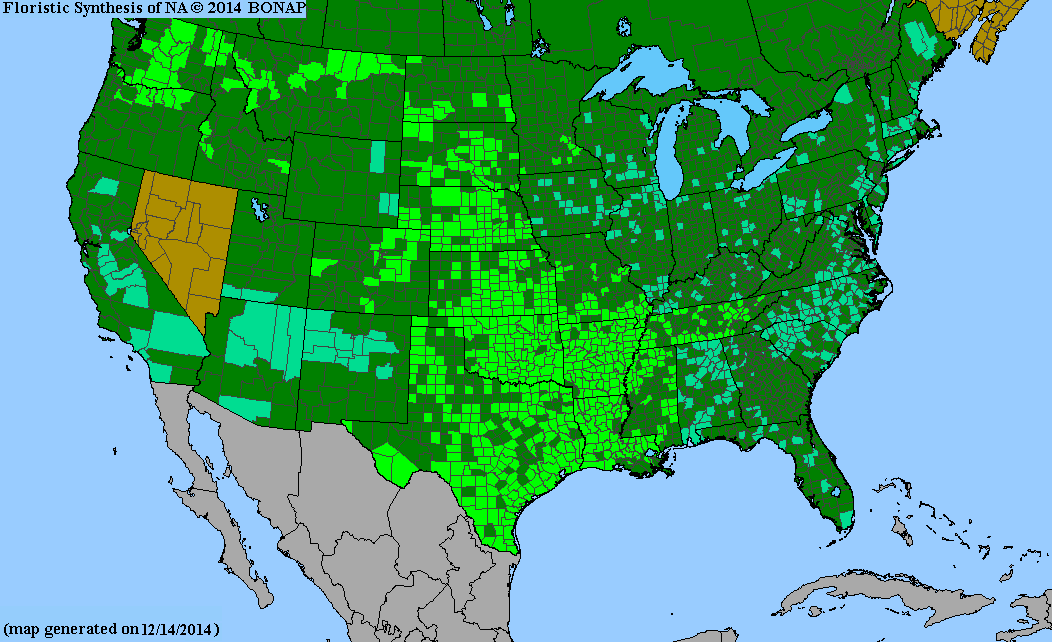
highly attractive to little pollinators. The species is a
native shrub. It has red berries that provide food for birds, interesting tripartite foliage and excellent fall color. What's not to like?
Well, for starters, it's a bit rough/messy looking. Nothing wrong with that per se, but let's just say it does not have a refined or formal look to it.
It also grows so vigorously that it can be a little tough to keep in bounds (although this could be a real asset if you have a lot of ground to cover).
I've also had some problems with certain branches dying off. I'm worried that it could be a fungal disease called verticillium wilt. Perhaps the problem is that it is growing on very heavy clay soil? I've read that it prefers sandy or loamy soils and can be short-lived on clay.
Also, since this is a deciduous shrub, you will be looking at bare branches and bare ground beneath those branches for around 5-6 months in Middle Tennessee. Although the shrub has a dense growth habit that does a good job of blocking weeds during the growing season, I have seen some weeds beneath the shrub now that the leaves have fallen and uprooting those weeds without damaging the shrub itself can be a little challenging.
 |
| Cephalotaxus harringtonia 'Prostrata', Japanese plum yew |
Cephalotaxus harringtonia, Japanese plum yew - This is a non-native alternative to to the 'Grey Owl' juniper. I believe the straight species of Japanese plum yew is a large, bushy plant, but the
'Prostrata' cultivar grows as a low, spreading shrub.
I've had some issues with Japanese plum yew. I had an upright ('Fastigiata') cultivar that totally failed to thrive and was soon removed (
something similar seemed to happen to a 'Fastigiata' specimen growing at our local botanic garden), but the two 'Prostrata' specimens in my garden have performed fairly well in a partial shade setting.
Groundcovers for the South says, "Plum yews are slow to establish and require careful attention for about two years. Once established, however, they are relatively drought tolerant and carefree."
Unlike junipers, plum yews reportedly respond well to shearing, and I've heard they can even spring back from rejuvenation pruning. Japanese plum yew is a dioecious species (meaning that plants are either male or female).
I don't know if 'Prostrata' is a male or female cultivar, but since it's the only cultivar I have at the moment, I don't anticipate getting fruit. The sources I have seen disagree on whether Japanese plum yew fruits are poisonous. (
The seeds, branches and leaves of true yews - Taxus spp. - reportedly are very poisonous.)
Groundcover vines
I've just begun to experiment with using vines as groundcovers.
 |
| Virginia creeper foliage in August 2015 |
 |
| Virginia creeper foliage in November 2015 |
In several places where
native Virginia creeper (Parthenocissus quinquefolia) has sprung up in the garden beds, I'm letting it grow to see if I can manage it as a deciduous groundcover. These are early days (I used to pull the Virginia creeper seedlings until this past year) so none of these vines have covered much ground yet, but I should have more information by next year. Although it is deciduous, the vine seems to catch blowing leaves in autumn, which gives me hope that these leaves would provide enough of a groundcover to prevent germination/growth of some weeds.
 |
| Lonicera sempervirens (coral honeysuckle), summer 2013 |
I also plan to experiment next year with growing our
native coral honeysuckle (Lonicera sempervirens) as a shrubby groundcover. I currently grow coral honeysuckle on one of my porch railings, which it forms a semi-evergreen vine that flowers for many months at a time and attracts hummingbirds in the summer. It seems incredibly resilient in terms of bouncing back from frequent hard prunings, so I have high hopes that it would make a good groundcover. (Of course, I'd have to keep a close watch on it to make sure that it did not overwhelm other plants in the bed with its vining/climbing tendencies!)
I haven't tried it yet, but I'm also considering experimenting with growing
Decumaria barbara (climbing hydrangea, wood vamp) as a vining deciduous groundcover...
Herbaceous groundcovers
This is probably the biggest category, although it can be subdivided further in several ways - there are groundcovers that creep or run by herbaceous means (stolons or rhizomes) and there are those that cover ground by reseeding. I suppose one could theoretically imagine an annual herbecous groundcover - I've experimented this winter with sowing the
native annual plains coreopsis (
Coreopsis tinctoria) in the hopes it will fill in gaps throughout the garden, but I tend to believe the best herbaceous groundcovers will be perennials.
What characteristics should a good perennial groundcover have?
-
It should have a spreading rather than an upright character. This is fairly obvious. Even though I like plants like
Hibiscus moscheutos (swamp rose mallow) and
Platycodon grandiflorus (balloon flower), they have a clumping upright growth habit that does not say 'groundcover' to me.
-
It should multiply and cover ground in some way! Amsonia tabernaemontana (eastern blue star) has proven to be a tough perennial with a spreading growth habit. It thus meets the first criteria mentioned above, but it dies back to the ground every winter, leaving no obvious presence and must start anew in the spring. As it reaches its mature size (reportedly 3 feet wide), it might cover a good amount of ground from late spring to early fall, but I don't think it fits the definition of an ideal groundcover. In other words, I think it leaves plenty of bare spaces for weeds to get established.
-
It should not be too rampant. This is a tricky one and the acceptable threshold will differ for every gardener. I approach this on a case by case basis, but I do have a few guidelines that help me determine whether something is too rampant or aggressive for my garden. I'm willing to cut the natives more slack with the understanding that they were here first, they probably have some beneficial impact on the local ecosystem and in a worst case scenario, if they get wildly out of control, I probably won't be doing any irreparable damage to the environment. It may sound silly and grandiose to think in these terms, but I don't want to be the gardener who unleashes the next kudzu on Middle Tennessee, so I exercise an abundance of caution. I'm particularly wary of groundcovers that spread secretively underground. So plants like
blue star creeper,
creeping raspberry and more recently
hardy blue plumbago all got the boot.
-
It should look good, ideally year-round or close to year-round. OK, this is a tough one. When the temperature is 10 degrees or lower - sometimes much sooner - most groundcovers start to look a bit rough around the edges. And yet...there is clearly a continuum in aesthetic appeal. Again, most of the groundcovers that I evicted were ones that added insult to injury by being
both aggressive and unappealing in winter. Blue star creeper basically browned and disappeared in the wintertime. Creeping raspberry was even worse - with tough dead stems and leaves persisting for months. I waited until late spring to see if the existing creeping raspberry stems would push new foliage after a hard winter. When they didn't, I had to cut back all that dead growth so that new foliage could emerge unhindered from below ground. The hardy blue plumbago was totally herbaceous, so it disappeared below ground and left its dead bare stems standing for months.
-
It should be easy to uproot. Again, I think this is especially important when we're talking about exotic, potentially invasive plants. But really, I think this is a desirable trait in any groundcover. There will be times when a groundcover gets too close to some other plant and you want to uproot pieces of the groundcover to keep a space buffer. There will be times when a groundcover has done its job, but now you have the time, money or opportunity to replace that groundcover with a shrub or tree. Once again, all of the groundcovers I came to dislike were ones that had a thick web of underground roots that made them difficult to dislodge - blue star creeper, creeping raspberry and hardy blue plumbago all fall into this category. So does buffalo grass for that matter. By contrast, desirable groundcovers such as lambs ear, perennial geranium and even (to some extent) Ajuga have proven much easier to uproot and/or relocate.
-
It should ideally have some sort of ecosystem benefit beyond covering ground. Almost any groundcover plant has environmental benefits simply by eliminating all the costs associated with producing, packaging and transporting mulch and/or herbicide, but I look even more favorably on groundcovers that offer additional ecosystem benefits - e.g., flowers for pollinators, fruits for wildlife (or people) and/or foliage that can host Lepidoptera or nourish insects (that in turn provide food for birds and other predators).
I'm still testing a number of herbaceous groundcovers, but these are the ones I can recommend so far...
 |
| Stachys byzantina 'Helene von Stein', October 2013 |
Stachys byzantina, lamb's ear -
UPDATE - I ended up removing lamb's ear from the garden. It looked beautiful from spring to autumn, but just awful in the winter. The dead foliage was persistent, so that after a while, even the fresh new foliage was growing on a mound of dead and decaying gunk underneath. In addition to the cultivar, I got the straight species, which spread much faster and had lovely flowers with a long bloom season that attracted lots of bumble bees. Unfortunately, the flowers led to a plethora of seedlings in the immediate vicinity of the mother plant. If the old foliage decayed completely over the winter and/or if the plant didn't spread so quickly, I might have kept it. It's rock solid in the heat and didn't seem to have too many problems with our humidity. But I just couldn't deal with the old foliage and its spreading ways. Plus it's a non-native. Plus I didn't like the scent of the crushed foliage when I did try to clean it up at the end of the winter. Yuck. So... I had to give it the heave-ho.
This perennial has a lot going for it. First of all, it's adorable. The fuzzy leaves will make you want to rub them every time you walk by. I love the grey-green foliage that grows thickly enough to block just about every weed.
Lamb's ear reportedly dislikes humidity, but the 'Helene von Stein' and 'Fuzzy Wuzzy' cultivars have stood up very well through several typically hot and humid summers.
It's true that lamb's ear will basically collapse and disintegrate during a very cold winter. Although I should point out that all the lamb's ears look great this year into December. The winter has been very warm so far, but we have had several nights below freezing and the lamb's ears all seem unperturbed.
The cultivars I have don't flower much, but I did get one flower stalk this past year and it flowered for a long time with blooms that attracted pollinators, so that's an added bonus in my mind.
The plants expand very fast - Fuzzy Wuzzy in particular seems to have grown about 2-3 feet wide in a single year - and yet I have found that they are easy to uproot if you find they are growing too big for their space.
That said, I do have a couple of concerns:
First, although they are easy to uproot, they are
not necessarily easy to divide. They grow so thickly that when I tried to
divide the too-big-for-its-space lamb's ear, I ended up making such a mess that I just decided to shovel prune the whole plant. This was in early autumn, so I intend to dry division on another plant this coming spring. Perhaps when I rake aside the old leaves and spot the new ones emerging from the soil, I'll have an easier time making the division? I'll report back on the results of this experiment.
Also, I'm a little concerned that the plant grows
so thickly that it could block water from reaching the roots of trees and shrubs. In the past, I've simply allowed the old leaves to remain on the ground, but I think I can alleviate this concern and probably improve water penetration by raking the old leaves out of the way. Again, I'll report back after I give that a try.
It's a non-native, but lamb's ear has not seemed aggressive in my garden. I am not aware of it appearing on any invasive lists in the U.S. (For instance,
Washington State University Clark County Extension recommends it as "a nice spreading groundcover that does not become invasive.")
I also have to give it extra points for the way it seems impervious to damage by rabbits or deer. Lamb's ear has grown well in my garden in both full sun and partial shade, although it will grow faster in full sun.
 |
| Geranium sanguineum, bloody cranesbill, 'New Hampshire', July 2013 |
 |
| Geranium x cantabrigiense, Cambridge geranium, 'Biokovo', still evergreen in March 2015 after a harsh winter |
Geranium species - The cranesbill geraniums are some of my favorite groundcovers. In fact, they are some of my favorite perennials overall.
I especially like
G. sanguineum (bloody cranesbill) and
G. x cantabrigiense (Cambridge geranium), both of which seem to be vigorous, floriferous and beautiful groundcovers for partial shade. They both stay more-or-less evergreen during the winter months, spread at a healthy though manageable pace and do a good job of blocking weeds. It seems easy to control the spread of these geraniums by slicing off pieces of the plant from the edges of the clump. And unlike the lamb's ear, I've been able to successfully transplant portions of the clump elsewhere in the garden. The aromatic foliage not only smells great, it also seems to repel rabbits and deer.
Although these are non-native plants, they do not show any indication of reseeding or behaving invasively. (I believe some other species or cultivars of cranesbill geraniums may reseed, but I don't know that even those are considered invasive.)
Both species also flower for a good number of weeks in the early summer and bloody cranesbill in particular can have a bit of a rebloom in autumn.
If you're looking for nonstop flowering for months, it's hard to beat the 'Rozanne' cranesbill geranium. Just be aware that Rozanne will go deciduous in a cold-winter climate. In my experience, Rozanne has been shorter-lived than the other species.
 |
| Ajuga genevensis, Geneva bugleweed, flowering and spreading in April 2014 |
 |
| Overhead view of Ajuga genevensis, September 2013 |
Ajuga spp., bugleweed - Sadly, none of the bugleweed species are native to the U.S. (as far as I know), but I do think several of them deserve consideration as garden groundcovers. The most common species you'll find at nurseries is
A. reptans, but I think I prefer two harder-to-find species -
A. genevensis (Geneva bugleweed) and
A. tenorii (Tenore's bugle ... most often available as the 'Chocolate Chip' cultivar). In general, the bugleweeds have a lot going for them. Here in zone 6/7, they're pretty well evergreen. Their old foliage may get beaten up in a harsh winter, but it still does a good job of covering the ground and blocking weeds.
Unlike some groundcovers (lamb's ear, for instance) which seem to get a bit thicker each year as they mound on top of old foliage, bugleweed seems to stay
very low to the ground. I guess the old leaves decompose pretty thoroughly each winter? Or maybe I just haven't grown it long enough and it will start mounding at some point in the future.
I find
A. reptans a bit ... unpredictable. In my experience, it sometimes dies out for no apparent reason (I'm guessing fungal issues), or parts of a patch may die out while other parts thrive. If it dies out in the middle and you leave it along, it may fill in again with time.
Ajuga genevensis has been a more sturdy, reliable performer so far. It spreads methodically and predictably at a measured pace, neither leaving gaps nor racing ahead. I've had excellent success chopping off pieces at the edges of an
A. genevensis patch and transplanting them elsewhere in the garden. Geneva bugleweed seems to thrive in partial shade, but I have some patches that get plenty of sun and they have proven themselves very drought tolerant on clay soil. (I can't say if they'd be drought tolerant in sandier conditions.)
If you're worried about
Ajuga spreading too quickly, I'd recommend
A. tenorii. Tenore's bugleweed has much slimmer leaves than the two other species and seems to have more of a clumping habit. It seems like the clumps get larger with time, but (so far) at a slower pace than either
A. genevensis or
A. reptans.
I must admit that some states (such as North Carolina) list
A. reptans as an invasive plant, so that does give me pause. Although North Carolina only lists bugleweed as a Level 3 invasive - meaning one that only seems to spread into disturbed areas and does not appear to pose a threat to native plant communities. In a few years of growing bugleweed, I think I might just be starting to see a few seedlings here and there, but mostly it has spread by vegetative means.
In terms of ecological benefits, all the bugleweeds have spikes of blue or purple flowers in the spring that seem quite attractive to bumblebees.
 |
Coreopsis verticillata, threadleaf coreopsis, 'Zagreb', June 2015
(2nd year in the garden, starting from two 4-inch pots planted in April 2014) |
Coreopsis verticillata, threadleaf coreopsis, 'Zagreb' - A
native of the Southeastern U.S., threadleaf coreopsis has been a great garden plant for me so far. In partial shade, the 'Zagreb' cultivar has bloomed pretty nicely with pretty yellow flowers that attract small pollinators. Threadleaf coreopsis forms clumps that expand outward at a measured pace. I have not tried dividing or transplanting any pieces of these clumps yet, so I can't say how easy it is to divide or remove it. In any case, since this is native to the region (though not really to Tennessee), I feel a bit better about using it in the garden.
In my garden, the clumps have grown perhaps 10 or 12 inches tall and seem to do an excellent job of blocking weeds. It is an herbaceous plant, but the stems grow so closely together that the dead stems still protect the soil and block weeds during the winter. I like this plant so much that I went out and bought about 9 more specimens this autumn and planted them in various places in the garden. I'm trialing it in some much sunnier spots and I hope that it will thrive all around the garden.
 |
| Echinacea purpurea, purple coneflower, June 2015 |
Echinacea species, coneflowers - This may seem like a little bit of an odd choice. Neither purple coneflower (
Echinacea purpurea) nor Tennessee coneflower (
E. tennesseensis) is marketed as a groundcover, but I think in practice it can form a decent groundcover beneath trees or shrubs that have been limbed up.
I don't think coneflowers spread by rhizomes, but as the plants get older, the clumps get bigger and the large basal leaves do a good job of covering ground for much of the year. Just as importantly, if you leave the seedheads standing over the winter for the birds, a number of those seeds will fall to the ground and germinate and pretty soon you'll have a large patch of coneflowers. As the coneflowers cluster thickly together, they will block many weeds. You can help this self-sowing process along by cutting off some of the seedheads and burying the whole head in the ground. After a few years, I had so many purple coneflowers that I actually thinned out the patch quite a bit this autumn to give me space in the garden beds to trial some other plants (such as asters and goldenrods).
I'm sure there are some other self-sowing annuals or perennials that could work the same as coneflowers, but nothing comes to mind at the moment. I do grow some self-sowing annuals -
Cosmos bipinnatus and
Tagetes patula (French marigold), for instance - but neither one of them seems like a great groundcover candidate, at least not here in Tennessee.
Cosmos has such a narrow presence in the garden (i.e., no basal leaves to speak of) that even a mass of cosmos won't necessarily block weeds at their base.
Tagetes patula can block weeds in its immediate vicinity, but I don't find that it self-sows particularly reliably here. Even after harvesting and scattering seeds all about the garden last winter, I think I only had 5 to 10 new French marigold plants this spring. And only one of those French marigolds got bushy enough this year to do a good job blocking weeds within a 1 foot radius. The others all stayed petite and sparse.
If you go for an annual that self-sows more rampantly - such as love-in-a-mist (
Nigella damascena) fits that bill for me - you may find yourself picking out hundreds of extra seedlings from the beds, the lawn, cracks in the sidewalk, etc.
No, I think what you really want is a self-sowing perennial -- one that doesn't inundate you with seedlings, but gives you perhaps a few dozen new plants in a year, with each of those plants living for at least a few years and having significant enough basal foliage to shade the soil.
Gaillardia x grandiflora (blanket flower) could fit the bill. The individual plants have a reputation for being short-lived, but the basal foliage is certainly rather thick and persistent in winter (even more so than purple coneflowers) and I feel like mine have been gently self-sowing. I don't get nearly as many volunteers as with the purple coneflowers, but my
Gaillardia patch has been slowly multiplying in size. Perhaps that's even better? After all, if you only have a few new seedlings per year, you won't have to weed out as many unwanted extra volunteers.
Oh I should mention that all the
Echinacea species I've tried - especially
E. purpurea - seem to be a big hit with bees (especially bumblebees), butterflies and birds. The blanket flowers also attract pollinators.
 |
| Epimedium x perralchicum 'Frohnleiten', May 2015 - love that colorful new foliage!! |
Epimedium x perralchicum 'Frohnleiten' - The
Epimedium species have many interesting common names such as fairy wings, bishop's hat, horny goat weed and barrenwort. These non-native plants are not especially flashy much of the year, but they do have a reputation for being dependable evergreen or semi-evergreen groundcovers.
There are lots of species and hybirds out there. I've grown
Epimedium x
perralchicum 'Frohnleiten' for a few years now and I can say that while it took a while to settle in at first, it has since become a very dependable, handsome and carefree groundcover for partial to full shade. It expands at a very manageable (some would say 'slow') rate, so it's unlikely to run over any other plants before you'd notice. I think the foliage is gorgeous and the flowers are very interesting (though I seem to recall that they were rather short-lived and I don't recall whether I saw any pollinators visiting them).
People say that you should cut or crumble the old foliage (which will be pretty brittle) at the end of winter to make way for the new leaves to pop up. I'm not sure that's actually necessary (after all, no one crumbles the old foliage for
Epimedium plants growing in the wild!) so I may try letting the old foliage decompose on its own this year just to see if there's any noticeable aesthetic difference.
I was so pleased with Frohnleiten that I'm now experimenting with two other kinds of
Epimedium - E. versicolor 'Sulphureum' and
E. warleyense 'Orange Queen'
 |
| OK, this is not exactly a beauty shot, but this is the way that Erigeron pulchellus var. pulchellus 'Lynnhaven Carpet' looks in mid-December. It may not win any beauty contests at this point in the year, but I would like to point out that it's still doing a decent job of covering ground and I don't see any weeds popping up in its midst. Still, this has been an unusually mild winter (only a couple of nights in the 20s so far). It will be interesting to see if it continues to protect the soil and act as an evergreen groundcover if temperatures fall into the teens or single digits. |
Erigeron pulchellus var. pulchellus, Robin's plantain, rose petty - 'Lynnhaven Carpet' - Although
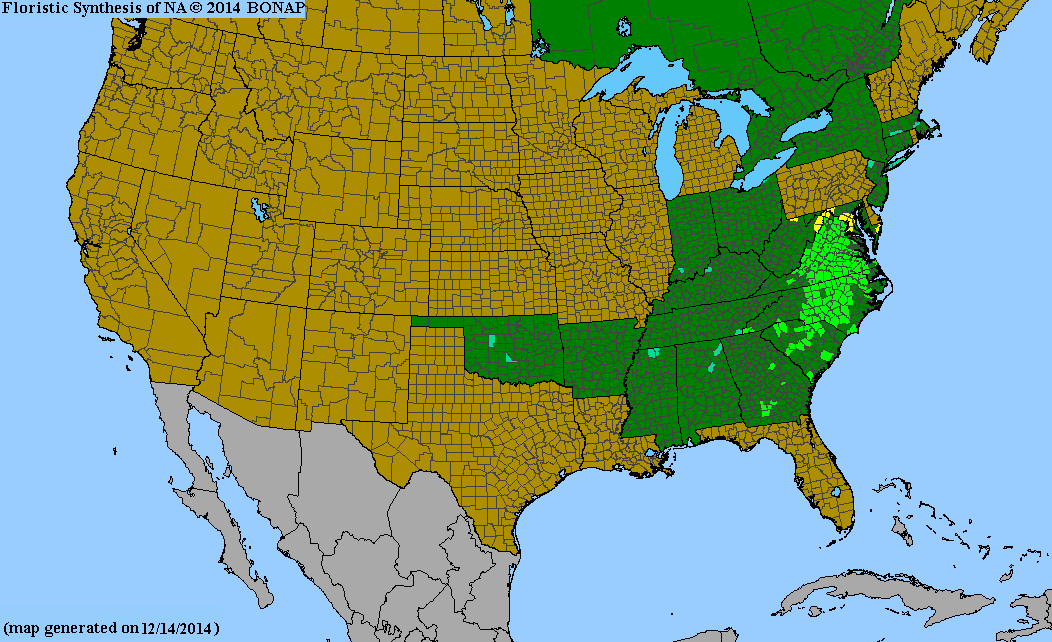
Erigeron pulchellus is
native to Tennessee and across much of the Eastern and Central U.S., I don't think I'd ever heard of it until recently. That's really a pity, because although this species can be a bit shy and modest, I think it makes a very interesting groundcover for partial to full shade. The grey-green basal foliage of my 'Lynnhaven Carpet' specimen grows very low to the ground - rather like
Ajuga, but perhaps hugging the ground even tighter.
In the spring, it sends up airy stalks of lavender flowers that fade to white as they open. Those flowers may attract small pollinators.
After the flowers fade, Robin's plantain fades into the background, but its evergreen leaves do a good job of blocking weeds and I like the way it has spread at a measured pace. In about 18 months, a single small plant has spread into a patch of rosettes perhaps 12 or 18 inches across.
I liked this plant so much that I purchased three more quarts that I'm trialing in various places around the garden to test their tolerance for different levels of sun exposure. The specimen of rose petty that has done well in my garden grows in partial (morning) sun, but I'd say it actually gets mostly shade since it is swamped during the growing season by a 'Rozanne' cranesbill geranium and further shaded by an oakleaf hydrangea growing nearby. When both of those plants drop their leaves in autumn, Robin's plantain reveals herself standing strong, just waiting for her moment in the sun.
 |
| Teucrium chamaedrys, wall germander, August 2015 |
Teucrium chamaedrys, wall germander - 'Prostratum' - Another non-native (sad to say) but one that has proven to be a strong groundcover in my garden. I think I have the
'Prostratum' cultivar that tops out at around 6 inches tall and spreads by underground rhizomes.
Now generally I'm not all that happy when plants (even groundcovers) start spreading underground and popping up in unexpected, non-contiguous locations. I wasn't happy when blue star creeper did that. I wasn't happy when hardy blue plumbago did it either. So why am I willing to cut wall germander some slack when it behaves in a similar fashion?
First of all, it doesn't seem to spread very far underground. I'd guesstimate that most of the new shoots pop up within 4 inches or less of the main clump. That's not too bad.
Secondly, it seems quite easy to uproot any sections of germander that creep too far. In fact, I dug up quite a bit of the clump this fall and transplanted three different plugs to different parts of the garden to see how this will fare with different sun exposures.
I also like the fact that it is more-or-less evergreen (at least semi-evergreen) in Tennessee, so it looks good (and blocks weeds) all year long.
Three small plugs of germander have grown together quite nicely into one decent size contiguous patch over the past 18 months. The stems in this clump seem to do a good job of catching fallen leaves, which I hope means that the plant will improve the soil as the leaves decompose. (The other possibility is that the plant will be smothered by all those trapped leaves.)
Teucrium chamaedrys also has nice long-lasting pale purple flower spikes that attract bees during the summer. I cut off the flower spikes when they were done blooming, but I think I should have trimmed the old stems to the ground. Instead, I cut off the spikes, but left the old stems standing. As a result, I have some bare stems with a bit of new growth on the top.
Next year, I'll try chopping the whole plant near the ground after the flowers fade and will report back on whether it invigorates or hurts the plant.
*****
It probably goes without saying, but YMMV (Your Mileage May Vary).
If you live in a much colder, hotter, drier or wetter zone, none of these recommendations may work for you. If you're in another state or another country, my native and non-native distinctions could be irrelevant or even reversed. But I hope my personal experiences may help you or at least give you inspiration to find the ideal groundcovers for
your garden :)
PS - I'm continuing to trial a number of new plants. I've added some to the garden this autumn and plan to add more in the Spring! Some of these newcomers will be groundcovers. I plan to introduce all the newcomers throughout 2016 and then report back eventually on how those new additions actually perform in the Garden of Aaron!
What are some of your favorite groundcovers?
Have you had good (or not-so-good) experiences with any of the plants I've highlighted above?
Or did I miss a groundcover that works especially well for you?