It's June and the pollinators are buzzing.
The last two posts on lavender and blanket flower have covered some of the buzz, but there's more to come...
 |
| This could be a bumblebee, but I think it's a carpenter bee on hyssop (Hyssopus officinalis) |
 |
| Bumblebee on creeping germander (Teucrium chamaedrys 'Prostratum') |
 |
| Some sort of tiny bee or maybe an ant on 'Natchez' crape myrtle - just starting to bloom on June 2nd. |
 |
| Small bee on yarrow (Alchillea millefolium 'Paprika') |
 |
| Fly on yarrow |
 |
| Hoverfly on wildflower (I believe this is daisy fleabane - Erigeron annuus) |
 |
| Small bee (I believe) on 'Carefree Beauty' rose |
 |
| Indian pinks (Spigelia marilandica) are flourish this year as never before. In previous years, an herbivore (rabbit?) would nibble them down to the nubs repeatedly. Last year, they didn't get to flower at all, and I thought the rabbit had nearly killed two of the three clumps. But they eventually all came back and seem to be flourishing -- this is a clump that I thought was toast just a month ago. It doesn't quite fit with theme of this post as I haven't seen any pollinators on it yet, but it should attract hummingbirds with its long, tubular, red flowers with yellow throats. |
 |
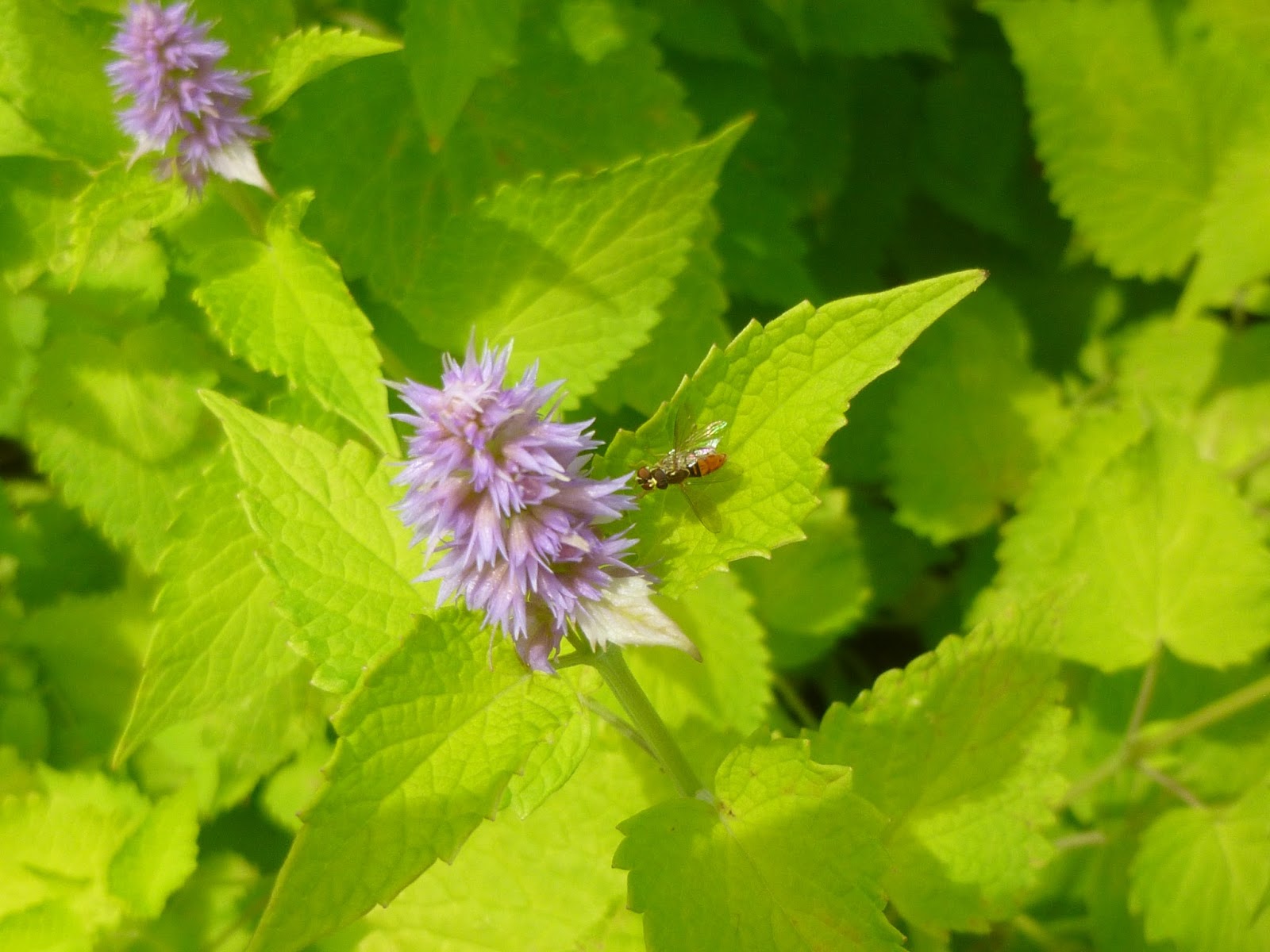
| Look closely and I believe you'll see two hoverflies mating on the leaf of this 'Golden Jubilee' Agastache foeniculum |
 |
| Bumblebee hanging on to Agastache foeniculum (anise hyssop) |
 |
| Which is fuzzier - the bumblebee or the 'Fuzzy Wuzzy' lamb's ear (Stachys byzantina)? |
 |
| Small bee on Coreopsis lanceolata (lanceleaf coreopsis) |
 |
| No pollinators in sight here, but the seedpods swelling suggest that something has succeeded in pollinating this redwhisker clammyweed (Polanisia dodecandra). Recent research from the University of Alberta suggests that redwhisker clammyweed provides both nectar and pollen resources for pollinators. |
 |
Rabbit.
Perhaps the culprit in the destruction of the smooth asters (Symphyotrichum laeve)?
|
 |
| Where there be pollinators, there be spiders... |
 |
Can you spot the spider here?
(The spider's camouflage is enhanced here by my inability to focus correctly. Sorry about that.) |
 |
| The small bee on the Mexican hat (Ratibida columnifera) in the foreground is packing a lot of pollen on its legs! |
Which plants are attracting the most pollinators in your garden?