Showing posts with label Vitex agnus-castus. Show all posts

Saturday, June 27, 2015

Vitex and the Bees

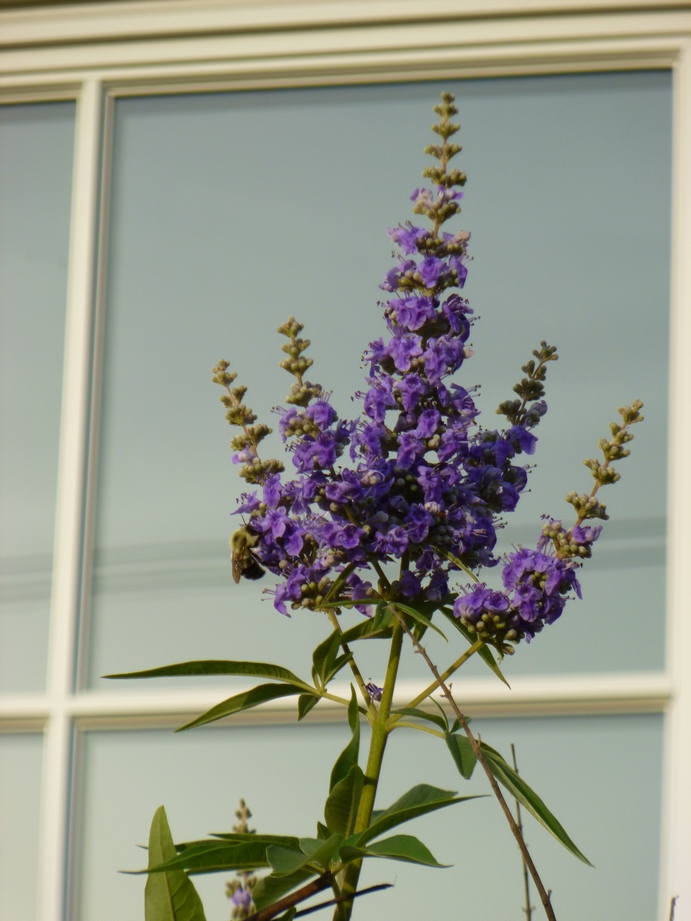
Bumble bee on Vitex agnus-castus (chaste tree) flower spike
Vitex agnus-castus (chaste tree) attracts bumble bees (and other pollinators) from dawn to dusk

Chaste tree is not native to Middle Tennesse (it's actually native to the Mediterranean region), but even though I generally favor native plants, I think more people should plant chaste tree.

As you can see from these photos, it's one of the best plants in my garden for attracting pollinators, especially our native bumble bees.

It seems incredibly tough, fast-growing and drought tolerant. The foliage stays pretty pristine throughout the growing season. You can prune it hard during winter dormancy and it will bounce back better than ever the next year since it flowers on new growth.

I've heard some sources describe it as invasive, and it certainly does produce a lot of seed, but personally I've never seen a chaste tree seedling and the birds don't seem interested in the seeds, so I suspect any seedlings that did occur would pop up right around the parent plant. If it starts to self-sow aggressively at some point in the future, I will come back and amend this post, but for now it seems unlikely to become invasive, at least in Middle Tennessee. The concerns about invasiveness seem to be higher in Texas, for example, but even there, some reputable sources recommend the plant. Virginia Cooperative Extension says that there is no empirical data (at least in Virginia?) to substantiate an invasive claim for this plant.

Bumble bees on chaste tree (Vitex agnus-castus) flower spike
More bumble bees on a chaste tree flower spike

PS -  Looking to get notifications of new bumble bee photos (or other exciting Garden of Aaron news) delivered straight to your email inbox? Now you can subscribe via email!  

Wednesday, June 17, 2015

Goldfinches Love Mexican Hats!


Colorful Mexican sombreros
Photo by Maria de las Mercedes


No, not those Mexican hats...

These Mexican hats (Ratibida columnifera)!

Goldfinches and Mexican hats (Ratibida columnifera)
My apologies if these photos are a little hazy - they were all taken through a windowpane.

Goldfinches and Mexican hats (Ratibida columnifera)
How many goldfinches can you spy in this patch of Mexican hats? I think I see at least five (four males and one female). At various times, I spied up to 8 or 10 goldfinches feeding in this patch, but this was the most I could get in a single photo.

Goldfinch and Mexican hats (Ratibida columnifera)


Goldfinch and chaste tree (Vitex agnus-castus)
OK, this goldfinch is not feeding on Mexican hat seeds, but he is waiting on the branch of a chaste tree (Vitex agnus-castus) before swooping down into the patch of Mexican hats growing below.

Mexican hats are annual flowers, but they self-sow (somewhat vigorously) from year to year. I have many more Mexican hats in my garden this year than I did last year. And with more flowers, comes more bees. With more bees, comes more seeds. With more seeds, comes more birds.

And that's what makes the world go 'round.

PS - If you'd like to stay abreast of the latest developments at Garden of Aaron, you can now subscribe via email! Totally convenient, totally free - what could be nicer?

Thursday, July 3, 2014

A Beautiful Bevy of Blooms in the Early July Garden

The hit parade continues into July.

All of these photos were taken this morning (July 3, 2014).

To all my U.S. readers, I send you early Happy Independence Day wishes!

A panicle of bright fuchsia crape myrtle blooms. In previous years, this crape has been stricken with powdery mildew. After pruning last year to open up the canopy, it seems to be faring better this year (so far). While the white Natchez crapes attracts loads of bees - particularly in the first few weeks of its bloom - I have not noticed any bees visiting this crape.

Bee on Agastache foeniculum "Golden Jubilee" 

I took a step back to give you an idea of the size of this one Agastache. It's HUGE and loaded with flowers. There are perhaps a dozen seedlings scattered around from last year's seeds -- and the plant didn't have nearly as many flowers last year. I wonder how many seedlings I'll get next year?! :-o

OK, no flowers here, but the foliage of Baptisia australis is looking lovely, cool and not-too-floppy, despite the fact that I situated it in too much shade.

Bumblebee visiting Cosmos bipinnatus

Dianthus gratianopolitanus "Firewitch". I did a little experiment a few weeks ago where I trimmed back the old flower stalks on one plant and left the other untouched. As you can see, both are experiencing sparse rebloom. I think the unpruned plant actually has a few more flowers, but the pruned plant looks neater. 

Bee on Gaillardia x grandiflora "Sunset Cutie"

Cheerful bright blooms on Heliopsis helianthiodes "Summer Sun". I wouldn't say it's a wildlife magnet yet, but as the plant gets bigger and more established, it's attracting more bees and birds than last year. 

Hibiscus moscheutos / Hardy Hibiscus. I think this is "Luna". So far, not as much sawfly damage as in previous years (knock on wood products), which means more flowers are opening and the foliage looks much healthier. 

Bee on annual sunflower. I order Lemon Queen sunflower seeds this spring. I seem to have gotten an assortment on random sunflowers of all shapes and sizes. Can't say that I'm devastated (many of them are pretty and interesting in their own ways), but I'm a little peeved.

Two small bees on a soaring annual sunflower over 6-feet tall.

Here's another giant sunflower - maybe 7-feet tall. Even though the flower hasn't opened yet, I thought the bud was so sculptural that it deserved its own portrait.

Here are two bees collecting pollen on a Cucumber Leaf Sunflower (Helianthus debilis Cucumerfolius). I didn't plant any of these seeds this year, which means this sunflower can self-sow in a 6b winter (low -2 Fahrenheit) without any insulating snow cover. The blooms are smaller on the Cucumber-Leaf sunflower, but the plants grow quite tall (~6 feet), start blooming a little earlier than the typical Helianthus annuus and are well-branched with lots of flowers per plant. The bees like the pollen, the gold finches visit for seeds, the squirrels seem to leave them alone.

Here's my row of self-sown Cucumber Leaf Sunflowers. Not exactly "front of border" height, but I don't have the heart to rip them out and I love the floriferous display!

Cherry tomatoes are ripening. These are Super Sweet 100s, purchased as seedlings. I also have lots of self-sown cherry tomatoes from previous years. I've done a pretty poor job of staking them this year, so what I really have is a jumble, but I imagine it will be a productive jumble if I can wade through the stems to pick the cherries. I also have some critter (squirrel? rabbit? chipmunk? groundhog?) that seems to be preying on the low-hanging fruit, both red and green.

No flowers here either, but I'm still loving the Viburnum dentatum foliage. This plant has gumption. I kept it in a garage all winter with barely any water. Not surprisingly, it died to the roots, but has since roared back from the roots with 2-3 feet of new growth and it's still going. I do notice (unhappily) that there seems to be some leaf damage. Perhaps the culprits are the lacebugs that attack a nearby Aronia melanocarpa? 

Bee on Vitex agnus-astus flower spike

Two more bees on Vitex agnus-castus (Chaste Tree)

Can't resist another shot of bees on the Vitex. When in bloom, this plant attracts bumblebees in particular from dawn to dusk!

A step back to give you an idea of the total number of flower panicles on the Vitex bush. This is its second full year in the garden, and after some judicious pruning, I'd say it's about twice as big this year as last year, despite our zone 6b winter (-2 Fahrenheit). It leafed out late - and even so the leaves were frozen to much by a late freeze - but as you can see, it's since recovered and thriving. I think it's added at least 2 feet of vertical growth and made lots of bees very happy!

Wednesday, April 23, 2014

So What's the Damage?

Alchemilla mollis, Lady's Mantle, unhurt by a late freeze, looking bigger and better than ever this year.


The Details:

The weekend of April 12th, temperatures topped out near 80 degrees (Fahrenheit). Then a cold front came crashing through - two nights in the mid-30s and one night where temperatures dipped all the way to 28 degrees Fahrenheit in our neighborhood. (I foreshadowed this cold snap in a blog post last week.)

In true Darwinian style, I left most plants uncovered and unprotected to fend for themselves.

Remarkably and encouragingly, most pulled through without any problems. Here's a list of the ones that laughed off the cold and the few where winter got the last laugh.


Little or No Damage:

- Agastache foeniculum, Golden Jubilee
- Ajuga genevensis (leaves and flowers both unharmed)
- Alchemilla mollis
- Aronia, Chokeberry (buds, flowers and leaves all unharmed)
- Athyrium nipponicum, Japanese Painted Fern (newly planted)
- Baptisia australis (covered with an overturned pot for protection)
- Cercis canadensis, Redbud (flowers and emerging foliage both appear unharmed)
- Chrysogonum virginianum, Green and Gold

Chrysogonum virginianum, Green and Gold, undamaged by the cold, now bursting into bloom.

- Clematis "Crystal Fountain" (leaves and buds both appear unharmed)
- Cranesbill Geraniums (Biokovo, Rozanne and sanguineum)
- Dianthus gratianopolitanus "Firewitch"
- Echinacea purpurea
- Fothergilla gardenii (leaves appear unharmed, some flowers may have been damaged, others seem to be fine)
- Gaillardia x grandiflora "Arizona Apricot"
- Helianthus "Lemon Queen" perennial sunflower
- Hemerocallis, Daylilies
- Hydrangea quercifolia, Oakleaf Hydrangea

Hydrangea quercifolia, Oakleaf Hydrangea, seemed unfazed by the cold. I planted this shrub in autumn 2012 and did not see any flowers last year. Maybe this is the beginning of a flower panicle?!


- Hypericum frondosum "Sunburst"
- Juniperus virginiana, Brodie, Burkii and Grey Owl varieties
- Lavandula, Lavender, "Hidcote" (newly planted)
- Liatris spicata
- Liriope muscari (newly planted)
- Lonicera sempervirens, Coral Honeysuckle (leaves, buds and flowers)
- Malus, Crabapple, "SugarTyme" variety (leaves seem fine, flowers were pretty much finished blooming anyway, so it's hard to gauge whether they would have been damaged)
- Panicum virgatum, Switchgrass, "Northwind" (covered one clump with an overturned pot, but new growth on both protected and unprotected clumps seems equally unharmed)
- Philadelphus x virginalis, Mock Orange, "Natchez" (leaves and buds both seem unharmed)

Philadelphus x virginalis, Mock Orange, Natchez variety, leaves and buds appear totally undamaged by last week's cold snap

- Phlox paniculata
- Platycodon, Balloon Flower (covered one clump with an overturned pot, but the control clump that was not covered looks fine too)
- Polystichum acrostichoides, Christmas Fern (newly planted)
- Rhus aromatica, Fragrant Sumac, "Gro-Low" (buds seem fine, there may be a little foliar damage on some emerging leaves, but I think the majority of emerging foliage seems fine at this point)

Rhus aromatic "Gro-Low" Sumac does not seem to have been set back at all by the freeze
Rhus aromatic "Gro-Low" Sumac does not seem to have been set back at all by the freeze. Check out those beautiful lemon yellow buds and fresh multicolored foliage! I'm enraptured!!

- Stachys byzantina, Lamb's Ear, "Helene von Stein"
- Veronica umbrosa, Prostrate Speedwell, "Georgia Blue" (leaves and flowers both seem unharmed)
- Viburnum prunifolium, Blackhaw (buds and open flowers both seem unharmed)
- Viburnum x pragense, Prague (buds and open flowers both seem unharmed)

Neither the new leaves nor the flowers on the Prague Viburnums were damaged by the late freeze

- Viburnum rhytidophylloides, Alleghany variety (perhaps a little foliage damage on some plants, another seems unharmed)


Moderate damage:

- Agastache rugosa, Honey Bee Blue (perhaps 30% of foliage seems damaged/killed on newly installed plants)
- Aucuba japonica (established leaves seem fine, some of the of emerging new growth may have been damaged)
- Buxus sempervirens, Hardy Boxwood (established leaves seem fine, but new growth seems limp and damaged, I suspect I'll need to break out the pruning shears and give the Boxwoods a haircut back to healthy growth)

Wilted and whitened foliage marks frost and/or freeze damage on a Boxwood (Buxus)


- Cephalotaxus harringtonia, Japanese Plum Yew, "Prostrata" (established foliage seems fine, it looks as though the new growth may have been damaged, but I'm not familiar enough with this newly-installed plant to diagnose the degree of damage with any certainty)


Major damage:

- Ceratostigma plumbaginoides, Leadwort Blue Plumbago (newly emerging foliage seems limp, dark brown and dead)
- Hibiscus syriacus, Rose of Sharon (newly emerging foliage and young leaves on both Rose of Sharons looks limp and dead)

Newly emerging foliage got fried on this Blue Bird Rose of Sharon.  This photo was taken about a week after the cold snap.
Newly emerging foliage got fried on this Blue Bird Rose of Sharon.
This photo was taken about a week after the cold snap. 


- Lagerstroemia indica, Crape Myrtle (most newly emerging foliage looks dead and blackened, fortunately several trees had not yet started to leaf out, interestingly foliage on a few branches of one Natchez crape seems fine, even though foliage on other branches seems dead!)

Luckily not much foliage had emerged before the cold snap on the crape myrtles, which are some of the latest trees here to leaf out. The leaves on this branch that had started emerging seem to be toast. All the green leaves in the background were still dormant buds during the freeze and have just awakened and put out green foliage in the past few days.
Crape myrtle with frozen dead leaves and fresh green leaves on different branches

- Vitex agnus-castus, Chaste Tree (newly emerging foliage appears to have been totally killed)

Vitex agnus-castus foliage appears to have bitten the dust.
No sign of any new foliage yet in the week since the freeze.


So that's the story.

Overall, I was very pleased with the way most plants pulled through.

Monday, July 15, 2013

Oh the Dreadful Wind and Rain!

It was a particularly wet and windy spring at the Garden of Aaron.

But wind is a familiar them in my garden.

In the winter, there's the bone-chilling wind out of the Northwest.

In the summer, we sometimes face a hot and dry wind out of the South that can stress and crisp even those plants that are supposedly heat and drought tolerant.

So my question to all you expert gardeners out there is this: In your experience, which plants are best suited for a windy garden?

I'm interested in all suggestions, including annuals and perennials, but I'm most interested in shrubs and trees, particularly those I might be able to use to construct some sort of windbreaks to protect the less wind-tolerant plants from the harsh winds of fate (and Mother Nature).

Here are some of my own observations from our exposed hilltop garden:

Natchez Crape Myrtle
"Natchez" Crape Myrtle stands strong against the winds that rip across our hilltop garden. 


1. Crape Myrtle (Lagerstroemia indica) shows up on lists of wind-tolerant plants. (Here's one list, here's another.) I agree - to a point. The branches are very good at bending rather than breaking in gale-force winds and the leaves seem tougher than say maple or redbud (see below). But the leaves do get awfully tattered - especially if the winds hit right when new foliage is emerging. I don't expect leaves to look pristine at the end of a growing season, but crape myrtle leaves can get ripped up by the wind and chewed up by insects to the point where they seem shredded fairly early in the season.

Vitex agnus-castus flowers just starting to bloom.
Vitex agnus-castus flowers just starting to bloom. Note how clean and fresh the foliage looks despite the fact that the plant is sited on a windy, hot, full sun corner next to the garage and a baking concrete driveway. Vitex seems cool as a cucumber and perfectly at home.

2. Vitex agnus-Castus (a.k.a. Chaste Tree) made it onto a list published by the Houston Chronicle of trees most likely to survive a hurricane. I'd call that wind-tolerant. (Crape Myrtle was on the list too...) I've got to say, I've got our Vitex right at the corner of our house where it can buffeted by both Northern and Southern winds. So far, it's looking good. I think there was some minimal branch breakage from winter storms, but the spring and summer winds haven't fazed it and the foliage is looking good - clean and fresh, with no signs of stress and hardly any signs of insect predation. I've read comparisons of Vitex vs. Crape Myrtles where people say that Crapes have a denser canopy and are thus better for providing privacy, but I have to say that our young Vitex actually seems far denser than our young Crape Myrtles. Maybe the Vitex canopy opens up more as the tree gets older?

Overall form of young Vitex agnus-castus tree/shrub planted last autumn. Foliage seems relatively dense at this point despite comments to the contrary on the World Wide Web.
Here's a young "Petite Snow" crape myrtle, also planted last autumn at the same time as the Vitex. I'd say the foliage on this is actually much less dense than the Vitex foliage. Also, the Vitex is covered with buds and blooms in its first full year in the garden, whereas there was nary a bud or flower in sight on this crape myrtle in mid-June.


3. Maples and Redbuds both seem stressed by our hot dry winds. In fact, I had two young maples die on me last year. For some reason, I still let myself get talked into planting two new maples in our front yard. Neither of them looks happy in the hot winds of summer. In fact, despite lots of water, some of the leaves are turning color, which I know is not a good sign. The redbuds look slightly more wind-tolerant, but their leaves hang awfully limp when it gets hot, almost like they're panting in the heat.

Cercis canadensis, Eastern Redbud, leaves look stressed

Maple leaves looking stressed. Never a good sign when your maple leaves are changing color in July.


4. Juniperus virginiana, Eastern Red Cedar also shows up on lists of plants suitable for windbreaks. http://plants.usda.gov/factsheet/pdf/fs_juvi.pdf  Our landscaper planted three of these on the hill. They're not looking all that great, but I think that's due less to the wind and more to the fact that we wanted large trees for instant landscape effect but we ended up with sort of small root balls on those trees. Not a good combo. In general, I feel I learned from this past winter that it's probably better to start with smaller trees that would probably be less-stressed by the transplant process. Anyway, I'm not in love with the Eastern Red Cedars. Probably because I find it hard to get too excited about most conifers. But I have to admit that they do seem to be fairly wind-tolerant. 

The shiny and waxy leaves of Camellia sasanqua seem wind-tolerant.

5. Camellias - I don't think most people would think of camellias as being tough plants, but apparently they are surprisingly drought-tolerant and even recommended for windbreaks. Our camellias are in somewhat sheltered settings, but I have to say that they have not seemed fazed at all by last year's heat/drought or by any of the winds that whip around the house. I'm thinking more and more about incorporating these into my windbreak and screening plans. The only problem that I can see is that they don't necessarily grow all that fast in my experience, especially when they are young. So if I plant a small tree - one that would be less likely to suffer transplant shock - it might take a long time to grow to the height and density where it would really help block the wind and provide privacy.

Aronia melanocarpa, Black Chokeberry also seems to be relatively wind-tolerant 

6. Aronias, Chokeberries - Also in a somewhat sheltered spot, but I've got to say that their (second-year) foliage looks really green and fresh this year despite the strong winds of spring and early summer. They definitely looked stressed last year (more by the heat and drought than the wind, I think), but they're looking much better now. I'd need to try them in a less-sheltered spot first, but I could see these trees doing well in a windy situation and/or even potentially being part of a mixed wind break. (Really beautiful foliage, incidentally. Sort of what I have in my mind's eye when I think about what a tree leaf should look like.)

And here are some other shrubs and trees that I'm considering adding to the garden / landscape. Any thoughts based on experiences in your own gardens and/or visits to other gardens on whether any/all of these would be wind-tolerant and/or suitable for windbreaks?

Sunflowers bloom just as cheerfully even after they've been bent sideways by 60-70 mph winds

As for smaller plants, I've found that high winds will bend sunflowers (although they'll usually keep growing), topple cosmos (although they'll often keep growing too) and break plants like Caryopteris and Coneflower. (To qualify that, most of the coneflowers survived the wind storm and look none the worse for wear, but I did lose a couple.) I lost one stem on Hibiscus moscheutos too, but the rest of the plant seems fine.

Callicarpa americana, American Beautyberry. I'd call this an open, lanky shrub (at least in its youth). The leaves will get burnt by strong, hot winds. Despite glowing reviews from some online reviewers, I can not recommend Beautyberry for your garden.

Beautyberry (Callicarpa americana) also seems much happier this year now that I've moved it away from a windy spot to a somewhat sheltered area.

Other perennials, annuals and shrubs that have stood tough and seem relatively unfazed by the winds include:

  • daylilies
  • zinnias
  • French marigold
  • love-in-a-mist
  • creeping raspberry
  • penstemon
  • Phlox paniculata
  • ironweed
  • Veronica (spicata and umbrosa)
  • liatris
  • Malva sylvestris
  • gaura
  • Russian Sage
  • Coral honeysuckle
  • Indian Hawthorn
  • Boxwood
  • Hardy Blue Plumbago
  • Hardy geraniums,
  • Helianthus microcephalus
  • Little Bluestem
  • Salvias
  • Platycodon
  • Monarda
  • Agastache
  • Ilex glabra (inkberry)
  • Azaleas
  • Fothergilla
  • Aucuba
  • Hypericum
  • Joe-Pye Weed
  • borage
  • stachys
  • ajuga
  • Hibiscus moscheutos
  • Heliopsis helianthoides


So...what are your most wind-tolerant annuals, perennials, shrubs and trees? 

And which are the ones that are pushovers (literally) when it comes to getting blown around by the winds?

My dream is to look out the window and not feel that my plants (like the maples and redbuds) are getting tortured by the winds. I'd love to find plants - especially shrubs and small trees - that are wind-tolerant. Heck, I'd like to find plants that revel in getting their leaves ruffled about by the wind. I want to find plants that look as though they're tossing their branches like a model tosses her hair back for a photo shoot or a walk down the runway. And hopefully these stalwart windbreak plants will help reduce the howling gales to manageable breezes so that I can grow more tender waifs in the sheltered microclimate they create.

Is that too much to ask? :-)

PS - The title of this post comes from a lovely but haunting folk song...

Friday, June 28, 2013

Inspired by Vitex at 2013 Southern Living Idea House and Garden

2013 Southern Living Idea House, Nashville, TN
2013 Southern Living Idea House, Nashville, TN, photo by Laurey W. Glenn

Earlier this week, I had a chance to attend a preview party for the 2013 Southern Living Idea House on the outskirts of Nashville, Tennessee.

There is no denying that the home itself - really a collection of buildings, many connected by porches and breezeways - is impressive.

I guess the house is supposed to give visitors ideas to decorate their own home. In this regard, I was impressed in a geeky way by the Lennox wi-fi thermostat. My wife liked the Elsie Swivel Glider Club Chairs and an eye-catching carved wood antelope head. (I knew we were missing something from our home decor!)

As for the gardens, I gotta be honest here and say that there was very little that fired my imagination. I know that the landscape design team employed Southern Living Plants (available at Lowe's and Home Depot), so they were working with sort of a limited palate. (Near as I can tell, the Southern Living collection only includes 8 perennials, for instance.)

Of those perennials, the only one that really caught my eye was a white Agapanthus. I don't know whether these will really endure in the landscape given that Southern Living's own description only rates the plant to zone 8 and we're at the cold end of zone 7 (or the warm end of zone 6 until the most recent USDA zone refresh).

Incidentally, various sources list Agapanthus as being attractive to hummingbirds. Does anyone know if that's the case? I didn't see any hummers on all the plants during my visit, but I doubt the birds would have hung around the party crowd...

There were also some dwarf (5-8 H x 3-4 W) Early Bird crape myrtles that were charming in a modest sort of way. Southern Living claims these crapes start blooming earlier than most and that the bloom season continues for 100-120 days, which would be pretty darn impressive.


Vitex agnus-castus, Chaste Tree, Monk's Pepper (I think the landscaper branched a bit here, because I couldn't find Vitex in the Southern Living Plant Collection)

The only plant that made me stop and take a photo was a limbed up Vitex agnus-castus (a.k.a. Chaste Tree or Monk's Pepper). This was also the only plant in the garden where I saw any pollinators (bumble bees, in this case).

A single bumble bee (I believe) on a Vitex agnus-castus. There were actually two bees that I spotted on this Vitex, but I couldn't get them both in the same photo. They were the only pollinators I saw in the whole garden.
The Vitex was planted in a bed of roses, so it was interesting to see how the bees ignored the roses and went for the Vitex. I've observed on neighborhood walks that some of the most popular roses (Knockouts, for instance) seem to hold zero appeal for bees, but it was instructive to see that given a choice between Vitex and a single-flowered rose, the bees made a beeline (pun intended) for the Vitex.

Just makes me like Vitex that much more.

PS - If you're in the Nashville area and looking for architecture or interior design inspiration, tours of the home cost $12 with various discounts for children, seniors, military and students. A portion of the ticket proceeds reportedly goes to benefit St. Jude Children's Research Hospital.