I recently wrote about a couple of native groundcovers -
golden groundsel and rose petty - that have impressed me with their performance.
(That doesn't mean I won't change my mind with a few more years of growing experience under my belt. That's happened before
many times. But right now, color me impressed. And I like to think that I've learned to wait at least a little longer before passing snap judgments.)
Anyway, it's not all sunshine and roses in the Garden of Aaron.
I've been forced to face some disappointments this spring.
And since one of the main goals of my blog is to help others learn from my mistakes (and successes), I thought I'd share these disappointments with you:
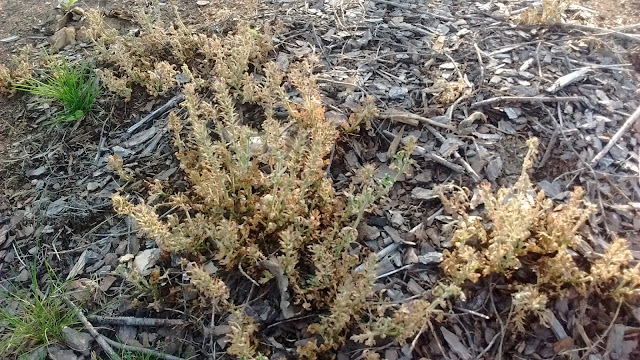 |
| Rose verbena (Glandularia canadensis) not looking its best |
Rose verbena, Glandularia canadensis - Relatively easy to find at local nurseries (though typically in the form of the 'Homestead Purple' cultivar...which
may or may not actually be a hybrid), I'd heard warnings that rose verbena liked good drainage and could die if forced to overwinter in heavy, wet clay soil (which I've got in spades).
Interestingly, rose verbena seemed to survive our relatively mild winter without too many problems.
It even stayed somewhat evergreen and started blooming early in the spring. I saw a swallowtail butterfly nectaring on one of the plants, which made me happy.
But soon, one by one, the rose verbena plants started turning brown and crispy. I'm calling this a failure and assuming either (a) it's a
very short-lived perennial (practically an annual) or (b) it needs much better and lighter soil than I can provide.
It's a shame, because I've been trying to find effective, native groundcovers, and rose verbena had some appealing characteristics - it's fast growing, semi-evergreen in zone 7,
heat and drought tolerant, and has a long bloom season. Unfortunately, it doesn't seem to have the toughness or longevity I need in a groundcover.
 |
Don't see anything here?
That's because I mowed down the old Epimedium foliage a month or two ago and the new slow-to-emerge foliage and flowers got chomped by something (probably a rabbit). Which is a little odd, since the rabbits never bothered Epimediums much before... |
Epimediums, fairy wings, horny-goat weed - I'd had good luck with a hybrid called x
perralchicum 'Frohnleiten'. In fact, I came to like this herbaceous, evergreen-to-semi-evergreen groundcover so much that I featured it on
its own blog post in May 2015.
Most sources recommend cutting off old Epimedium foliage before the new foliage emerges. In years past, I done this with bypass pruners, but as the patch grew a bit larger, I decided to try mowing down the old foliage this year.
I don't know if the mower was to blame, but the new flowers and foliage seemed slow and sparse to emerge this year. I was just starting to see a fair amount of foliage when something - I think a rabbit - came and devoured everything.
That's interesting, because in years past, the rabbits have seemed completely disinterested in Epimedium. Even before my Epimedium displayed a vulnerability to herbivores, I had soured a little on it. The flowers are pretty, but short-lived and rather inconspicuous. It grows slowly, which can be a good thing (you won't have to worry about it conquering a garden bed while your back is turned), but it also means that you'll be waiting a loooooong time for this groundcover to cover some ground and start displacing weeds.
Although 'Frohnleiten' has grown fairly well here in Middle Tennessee, the other Epimediums that I tried (x
warleyense and x
versicolor 'Sulphureum') have not fared nearly as well. They haven't been growing as long and I've heard that Epimediums are notoriously slow to settle in, but Sulphureum disappeared during last year's autumn drought and hasn't been seen since. The
warleyense hybrid hung in there, but barely sent up any new foliage so far this spring, and what did emerge was eaten just the same as the 'Frohnleiten'.
I haven't given up quite yet on my Epimediums at this point. If they recover from the rabbit attack and send up new foliage, I'll be tickled pink.
And if that does happen, next spring I think I'll just leave the old foliage to decompose naturally without cutting it at all. I tried that last year, and even though the rough, leathery, tattered old foliage detracts a bit from the freshness of the flowers and new leaves, it also provides a contrast that makes it easier to
see the bronzy new foliage on 'Frohnleiten' (which can otherwise be a challenge to notice against a background of mulch or dirt) and also I suspect that the old foliage deters herbivores from chowing down on the new growth.
Still, even if my Epimediums do stage a comeback, I can't imagine getting any more at this point, and I'd only consider recommending them for a very small garden where the slow horizontal growth rate would be an asset, or a larger garden where groundcover needs were somehow minimal.
 |
| Partridge berry (Mitchella repens) does cover ground, but it's a pretty subtle plant. You might easily overlook it in a large garden. And the ultra low-growing foliage doesn't block all the weeds. |
Partridge berry, Mitchella repens - I've gone back and forth on this plant. Much like with Epimedium, one of my main complaints would be that it's a sloooooow spreader. And the leaves are tiny. Which means that even where it does spread, weeds can still force their way through.
 |
| A close-up on the partridge berry. Note how the small weed - probably some type of Oxalis - has poked its head through the partridge berry foliage without any difficulty. Having a ground-hugging plant like partridge berry has some advantages - there's no need to chop down old stems or seedheads, you won't have to worry about it swamping any nearby plants - but it does limit the weed-blocking role it can play in the garden. |
That said, I don't want to be too harsh on this native plant. It blocks some weeds. It's essentially evergreen in Middle Tennessee. It had a few tiny flowers last year, though if it produced any berries, I didn't notice. I certainly wouldn't discourage anyone from using this, nor am I contemplating removing mine. In fact, I just added another clump of this plant to the garden this spring.
But I'm a bit disheartened at its slow spread and imagine it will be many years (if ever) before I have a nice, thick, noticeable clump like
this.
Again, if you have a very small garden or a garden with only a small patch of bare ground to cover, this might be just the ticket.
PS - Partridge berry is so diminutive that I've often wondered how it avoids getting smothered by leaves in its native woodland habitat. According to
Brooklyn Botanic Garden, it generally grows on steep slopes where fallen leaves slide away. If you have it growing on flat land (like I do), you might need to brush away leaves to let it see the light.
 |
| Chomped toad lily. |
Toad lily, Tricyrtis hirta 'Miyazaki' - Bought this one on a whim during a nursery visit this spring. Turns out that it makes excellent rabbit food. (Or food for some other herbivore, but the signs point to a bunny.)
How about you? Any groundcover / perennial disappointments recently? Or happy surprises? 😎


