Showing posts with label Blue Star Creeper. Show all posts

Monday, August 26, 2013

Groundcover Warning: Blue Star Creeper, Pratia pedunculata, Laurentia fluviatils, Isotoma fluviatilis


Blue Star Creeper, pretty flowers, pretty aggressive, pretty finicky about growing conditions, etc.

Blue Star Creeper, a.k.a. Pratia pedunculata, Laurentia fluviatilis or Isotoma fluviatilis

Pros:

- Spreads fairly quickly. Tiny plants 2-3 square inches can form an expanding patch 10-15 feet wide within 2-3 years.

- Profusion of charming light blue flowers in spring for several weeks. Bloomed starting mid-May this year and was still covered in flowers in early June. In cool summer climates, Blue Star Creeper might bloom all summer. I say that because our temperatures have been cooler than average most of this summer (highs in the mid-80s or lower many days) and Blue Star Creeper started reblooming in late July. The flowers do seem to attract some small bees, wasps and/or hoverflies.

- In spring, the foliage can make a lush green carpet.

- Tough. Survives heat, cold, drought and wet conditions (though it may not look good in the process).


Cons:


I ripped up a patch of Blue Star Creeper here a couple of weeks ago. Clearly I did not get it all, because bits and pieces are creeping back. Gonna have to try to dig it out again. Could take a few tries (at least) to eradicate Blue Star Creeper from a garden bed.

- Hard to control. Blue Star Creeper spreads on below-ground rhizomes. And it tends to travel a little...unpredictably, not necessarily advancing in a straight line, but suddenly popping up several feet away. When I decided that Blue Star Creeper was insinuating itself where I did not want it, I started digging with my Cobra weeder and found that Blue Star Creeper had made a thick web of white roots below the surface (see photo below). When you try to uproot this Creeper, the roots are likely to break, leaving bits and pieces below ground to resprout. This extensive underground root system makes controlling or eradicating Blue Star Creeper a challenging proposition - at least through manual means. (I have not tried spraying it with any herbicide because I tend to avoid using such chemicals when possible.) Since the plant grows so close to the ground and the leaves are so small, that also makes it hard to get a grip to pull up a patch. The fact that Blue Star Creeper is an invasive exotic is another strike against it since we can't count on co-evolved predators or pathogens to keep it under control. That being said, at least Blue Star Creeper is diminutive. Generally it only grows a few inches tall, so at least it's not about to climb and strangle a tree as kudzu might.

These roots are just a small representative sample of the web that Blue Star Creeper has woven underneath the soil. It's pretty scary stuff. My advice -- stay far, far away. I imagine I'll be fighting to get rid of this for years to come. I wouldn't mind having a small patch, but I don't think that's possible unless I wanted to grow Blue Star Creeper in a pot.


- Not native to the U.S. The nomenclature is very confusing on Blue Star Creeper, but according to Paghat, there are actually two different species that are frequently marketed under the same common name, one from Australia and one from New Zealand.

- Doesn't block weeds all that well. Blue Star Creeper's small size may be an asset in terms of making it not-that-thuggish, but it also makes it only partially effective as a weed-blocker. So it's kind of a lose-lose situation - the Blue Star Creeper insinuates itself like a weed, but it's not actually thick or tall enough to shade out other weeds like clover. And as Paghat says, "some weeds are practically nursed by the mat of [Blue Star Creeper] foliage, and weeding will mean ripping out big patches of the ...creeper."

- It just doesn't look that good much of the year. Heat and cold and drought and wetness may not kill it, but they can make it look like Hell warmed over. More specifically, in cold weather, the plant may brown and sort of disappear under the soil. In hot weather (especially in full Tennessee sun) the plant may bake to a crisp and disappear. In drought, you guessed it, Blue Star Creeper pulls a disappearing act. That's sort of a pity, because if the plant were green and mat-forming all year, at least I could consider using it as a lawn alternative (assuming that deep metal or plastic edging could control its spread...which I don't know for sure). It's so low-growing that at least it never needs mowing!


Conclusion:

To sum up, Blue Star Creeper is aggressive, invasive (in the U.S.), offers poor weed suppression and has low aesthetic appeal for much of the year. I can't recommend Blue Star Creeper for the Southeast and I certainly would urge caution before adding it to your garden. Read some of the other negative experiences that Dave's Garden reviewers have had. Blue Star Creeper is one of the few plants that I regret planting. I'm now trying to undo that mistake and warn others from making the same error.

PS - If you'd like to stay abreast of the latest developments at Garden of Aaron, you can now subscribe via email! Totally convenient, totally free - what could be nicer?

Sunday, November 4, 2012

The Late October Tennessee Garden

Dear Readers,

Apologies for my long absence.

I was traveling for three weeks in September-October and then needed to take care of some business (the kind that pays the bills) before I get back to blogging. Mea culpa. 

As for the travels, I look forward to sharing photos and thoughts on Spanish and French gardens in upcoming posts.

But for now, I thought it might be fun to share some photos of the garden in October:

Sweet Alyssum never really got established in the hot spring or early summer, but it has done better in the cooler fall weather - though not as well as last year. I am thinking about trying a heavy winter overseeding to see what happens.

Autumn Joy sedum. Since it's my first time growing this kind of sedum, I'm not sure why some leaves are yellowing and whether it's a real problem or just a cosmetic issue.

A reblooming azalea. It was here when we bought the house, so I don't know the variety. This one has Eastern exposure.

Another reblooming azalea. I like this one better! Unfortunately, since I didn't plant it, I don't know the name of this one either. There are about five identical azaleas on this (North) side of the house.

Western exposure - French marigolds, zinnias and a recently planted Vitex agnus-castus (a.k.a. Chaste Tree or Monk's Pepper)
A close-up on the leaves, flowers and seeds of the Vitex. The plant is supposed to be a fast-grower to 15-25 fee tall and wide. I have high hopes, but am trying to temper my expectations. The tree is reportedly deciduous, but still has mostly green leaves even now in early November (a couple of weeks after this photo was taken)

Blue Star Creeper (strangely the plant seems to have about five Latin names). I planted Blue Star Creeper in a Western-facing landscaped bed last year. It blooms prettily in the spring, but gets baked into oblivion in the summer, returning in the autumn. I thought I'd see how it might do on the East side of the house, so I transplanted this patch in September. It seems to be settling in nicely, but I'm concerned as to whether low winter temps will damage the plant. I'll post updates to let you know.

It doesn't look like much, but this part of the buffalo grass patch that I planted back in August. It might be hard to tell from this photo, but I think all the plugs have survived and some have started to spread nicely, but unfortunately they didn't really get a good enough toehold before the weather turned cool, which I believe slows their growth and quickly makes them go dormant. If I were ever to plant buffalo grass again, I would try to plant it in June I think to give the plants a whole summer of robust growth. But I will try to keep the patch weeded this winter in the hopes that next spring when it warms up the buffalo grass will form a thick enough groundcover to exclude most weeds.

In late October, the backyard still was full of zinnia and French marigold blooms. Pretty much all day long, especially on sunny days, the flowers were alive with bees and butterflies skipping from bloom to bloom. It was a beautiful sight!

Heavily-blooming camellia, Eastern exposure. We didn't get any blooms at all on this plant last year. I scattered some acid fertilizer beneath it in late summer / early fall. Perhaps that helped? I really like these flowers. Unlike the one red camellia bush that bloomed last year (but so far just has buds this year), the white petals gently fall off and decorate the ground so that it looks as though there is a patch of snow beneath the plant. And as you can see, the 'flowers' have a sort of pinkish tinge. Just lovely! Sadly, since it was here when we bought the house, I can't identify the variety. Maybe Winter's Snowman or Snow Flurry?

Another shot of some of the blooms on the (pinkish-)white camellia.

A nearby pink camellia has been blooming as well. Not as many flowers, but these are still beautiful! Again, this was here when we bought the house, so not sure of the variety. Perhaps Pink-a-Boo or Kanjiro?

The cherry tomato vines (Riesentraube and Sungold) were still covered with fruit in late October. (Of course the ground below them was also littered with fallen fruit.) Since our HOA requires a lawn with few weeds and since we have not been able to achieve that without hiring someone to spray chemicals and since I don't feel comfortable growing food alongside those chemicals, this will probably be the last tomato plant we grow for a while.... :(

I think the cosmos plants bloomed better in October than they did in the spring or summer!

This is the Eastern side of the house, where I had a bed of English marigolds (Calendula officinalis) during the summer. They have, ahem, reseeded rather heavily and sprouted prodigiously in the fall weather. I wasn't a huge fan of the English marigolds, so I'm not so thrilled about the heavy reseeding. But I imagine that many of these plants will die from the cold before they have a chance to create a third-generation of English marigolds! I have uprooted some, but I am leaving others just to see how much cold weather they can withstand.

This was one of the few English marigold plants that I left in the ground. I had uprooted most in August/September when they stopped blooming and became infested with leafhoppers. Clearly, the plant has bounced back and begun blooming in the cooler weather. 

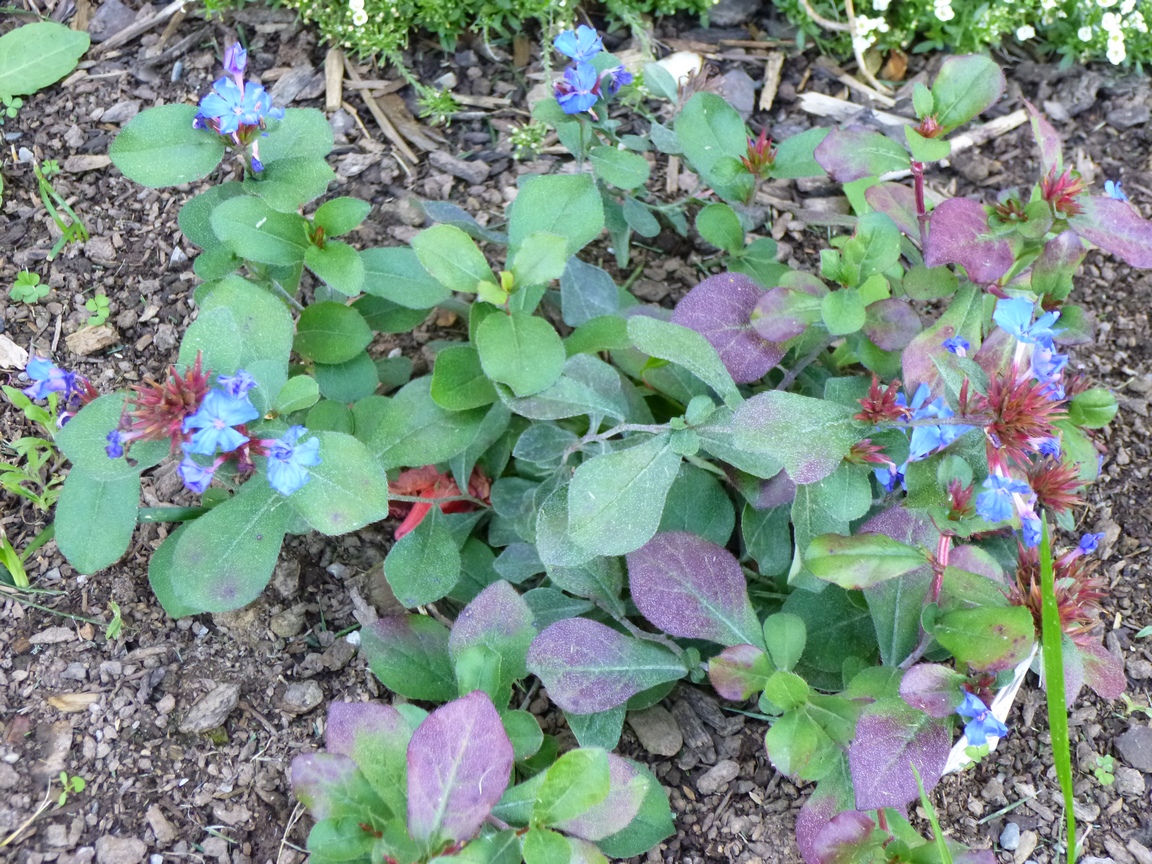
Hardy Blue Plumbago apparently turns a beautiful shade of purple in the autumn. Just another bonus to one of my favorite perennials!

I was worried that everything would be dead in the garden after three-plus weeks of neglect, so it was uplifting and heart-warming to see this gold-and-orange patch of French Marigolds (Tagetes patula). Just gorgeous! The butterflies and bees were all over these flowers. And I think that there were quite a few moths as well, including perhaps a hummingbird moth - the first one I've ever seen in Tennessee! A wonderful autumn sight. Definitely a plant that I would recommend - if the seedlings could survive in the drought and 100+ temps we had this past summer and mature into these types of flowering plants, then I'm pretty sure they can almost anything the Southeast can throw at them. Highly recommended!

The okra plant that I transplanted in September and highlighted in a blog post is still alive. I don't think it was warm enough while I was gone for the plant to produce any mature pods, but it was still nice to see it standing.

Pineapple Sage (Salvia elegans) looked miserable all summer - leaves curled in the drought, I thought it would die despite the supplemental water I gave it. By September, with cooler temps, the planted looked healthier, but I didn't expect it would double or triple in size while I was gone and throw up these sprays of red flowers. What a nice surprise! I think these flowers are supposed to attract hummingbirds, but sadly I saw only a single hummingbird make a brief visit. Maybe you need a whole patch of these plants to catch a hummingbird's attention?

Just another perspective showing the size and shape of the Pineapple Sage.

One more shot of a butterfly visiting some zinnia flowers. (Notice the smaller dun-colored skipper butterfly in the upper right hand corner of the photo. I didn't intentionally try to capture both butterflies in the frame, but there were so many butterflies flitting about that I just happened to get lucky.) I love butterflies and I love zinnias. Fortunately, they also seem to love each other.

Follow the garden from one season to another with a free email subscription.

Saturday, May 19, 2012

Shots in the Garden! (May 13-19, 2012)

Blue Star Creeper (Laurentia fluviatilis), groundcover
Garden Cosmos (Cosmos bipinnatus), also known as Mexican Aster, self-sowing and self-cleaning annual, thrives in heat and full sun
Cosmos again, looking down at a 3-foot tall plant that self-sowed into raised garden bed. Cosmos attracts bees and butterflies for its pollen, as well as gold finches for its seed.
Gaura lindheimeri 'Siskiyou Pink', see May 7th video for more information


Sweet Alyssum (Lobularia maritima), grown from seed, the flowers look more lavender in real life, should bloom spring until frost (with a mid-summer shearing) and attracts butterflies and many small beneficial insects

Rozanne Perennial Geranium, 2008 Perennial Plant of the Year, easy care, forms a spreading mat of attractive foliage topped with stunning purple-blue flowers. Each flower is short-lived, but the plant is self-cleaning and new flowers bloom continuously over a long season.
Dianthus gratianopolitanus 'FireWitch', just planted a couple of weeks ago, has flourished so far in windy and warm conditions that wreaked havoc on other plants. Self-cleaning flowers are supposed to be fragrant on hot, sunny days, but I confess I have not yet gotten down on my hands and knees to sniff and find out!

Viola tricolor, Johnny Jump-Up, also known as Wild Pansy and Heartsease. I have read that the flowers and leaves are edible (which is why I sprinkled the seeds in the vegetable garden among the lettuce), but I'm not sure how to prepare it so I haven't tried any yet. Still, it is a very cheerful little flower that brightens up the veggie garden.
Lonicera sempervivens 'Blanche Sandman'. Also known as Trumpet Honeysuckle, this native vine is supposed to attract hummingbirds. As the flowers unfurl, they remind me of a Dr. Seuss drawing!