Showing posts with label Tagetes patula. Show all posts

Saturday, July 23, 2016

Shots in the July Garden - A Bevy of Blooms for Bees and Butterflies!


It's been a bit of a challenging year to garden so far.

We had a really dry spring (a 7 inch rainfall deficit at one point).

Then we made that up with torrential rains in July, but we've settled (like much of the country) into an uncomfortably hot and humid weather pattern.

So even though I don't want to toot my horn, I must say I'm rather pleased that the garden has been looking pretty good - - and with very little supplemental water (I think I've only watered with a hose about 4 times this year, plus other occasional spot waterings with a can.)

Without further ado, here are some scenes that caught my eye when I was in the garden on July 20th.

Lantana camara

Gaillardia x grandiflora and bumblebee

Gaillardia x grandiflora and a teeny-tiny bee (not its real name)

Hibiscus moscheutos, this is the straight species version of our native hibiscus. (I also have the 'Luna Pink Swirl' hybrid or cultivar of H. moscheutos.) This is my first year growing the straight species. It's in full sun on an unamended clay hillside and seems to be thriving, despite the fact that it would probably prefer wet-to-moist conditions.

Perovskia atriplificolia, Russian sage. I moved three Russian sages to more of a full sun location and generally they seem much happier and more floriferous in their new spot. That said, I've still seen some of the yellowing foliage and even wilting of entire branches that I've noticed when they were in partial shade. It's my opinion that they do not like our humidity (which has been especially high this summer) or the heavy clay soil. The Russian sage flowers seem highly attractive to pollinators, especially honeybees.

Coreopsis verticillata 'Zagreb', attracts lots of little pollinators

French marigold, Tagetes patula 

Hibiscus syriacus, rose of Sharon, 'Diana' cultivar

Cosmos bipinnatus and bee.

Agastache foeniculum (anise hyssop) and bee

'Red Rocks' penstemon and bee. I have three of these Red Rocks penstemons. I cut back two of them after the main bloom and left the third one (this one) uncut. They're all starting to rebloom a little now, which makes me think that it may not make any difference (at least in terms of stimulating more flowers) whether or not you cut them back. That said, I'll keep an eye on the plants over the next month or two to see whether there's any difference in terms of flower quantity or overall form between the penstemons that were pruned and those that were left au naturel.

Lagerstroeima indica 'Natchez' (crape myrtle). In bloom for about two months now. The flowers attract lots of pollinators. (Not every crape myrtle seems equally attractive to pollinators. I rarely see any pollinators on my pink-flowered crape, but these white-flowered Natchez crapes are often buzzing with bees all day.)

Cosmos bipinnatus with skipper butterfly. White-flowered 'Diana' rose of Sharon (Hibiscus syriacus) in the background.

Glandularia canadensis (rose verbena)

Large milkweed bug (Oncopeltus fasciatus) on rose milkweed (Asclepias incarnata)

More Cosmos bipinnatus with bumblebee


If you look very closely, you can see lots of pollinators crawling through the flower cluster on this Asclepias incarnata (rose milkweed). Oh and there's a large milkweed bug hanging out beneath a leaf in the lower part of the picture! 

Coreopsis lanceolata (lanceleaf coreopsis)


Coreopsis tinctoria (plains coreopsis) with pollinator

Heliopsis helianthoides (false sunflower) with bumblebee


Polanisia dodecandra (redwhisker clammyweed)

Helianthus annuus (sunflower) with bees

Ailanthus webworm moth on Agastache foeniculum (anise hyssop)

Aralia racemosa (American spikenard), those are the tiny greenish-white flowers -- not very showy, but they do seem to attract a lot of little pollinators. The plant itself is in morning sun and afternoon shade. It's hanging tough, but it doesn't seem all that happy. I plan to try to transplant it to a shadier spot this autumn.
 
Just a pretty, colorful tableau - sweet alyssum (Lobularia maritima) in the front, 'Rozanne' cranesbill geranium behind it and a few blue balloon flowers (Platycodon grandiflorus) peeking into the upper left corner.


Hope you enjoyed this quick tour through the July garden.

What are some of your favorite summer flowers blooming in your garden right now? 

Instagram

Follow Aaron Dalton on Feedio

Friday, December 28, 2012

Gardens of Spain 3 - Cordoba

The palm trees and thin conifers of Cordoba, as seen from a tower in the Alcazar castle

The final stop of our Spanish journey takes us to Cordoba, formerly the capital of the Moorish state of Al-Andalus.

The most famous site (justly so) in Cordoba is the Mezquita, a mosque that was transformed into a cathedral hundreds of years ago when the Christians reconquered Spain from its Muslim rulers.

But Cordoba also has its own Alcazar, a castle with "delightful gardens".

To be honest, I'd say that if you find yourself in Cordoba, you should skip the Alcazar. The interior is bare (or covered in pigeon dung) and the gardens (as with the ones in Granada and Sevilla) seemed overrated to me.

But I did find a few garden-related sights of interest...

By and large, I found the Alcazar gardens of Cordoba just as dull as the other famous Spanish gardens we visited. As with the others, hedges were ominpresent in this garden, although here at least some were trimmed into whimsical topiary shapes. I did like the cheerful bed of French Marigolds (Tagetes patula, I presume) encircling the vase. Interestingly, despite its name, I just discovered that "French" Marigolds, as well as "African" Marigolds, are both native to Mexico and Central America!

Pretty blue flowers. They looked a little like phlox, but I think this was growing on a bushy vine that covered a wall. Can phlox do that? Sadly, none of the plants in Cordoba's Alcazar garden had markers to identify them by name.

My wife leaned in close to the phlox plant, and there among the foliage we spotted this very large grasshopper.
This kingly statue tries to project an air of power and authority, but this pigeon is not impressed.

None of the plants or landscaping here were necessarily all that special, but I wanted to include this photo from our Cordoba hotel - Hospederia Banos Arabes de Cordoba - simply because it did show the Spanish taste for courtyard gardens. In this case, the garden contains a small plunge pool and curtained sofa. Do you have a courtyard garden in your home? Or have you seen other courtyard gardens that you admired? I feel there is something very nice about having a private and enclosed garden, somewhat protected from the elements, easily accessed from many parts of a home. I wish that courtyard garden design was more prominent in U.S. housing customs.


Get all the latest updates at Garden of Aaron (typically 3x per week) with an email subscription.

Sunday, November 4, 2012

The Late October Tennessee Garden

Dear Readers,

Apologies for my long absence.

I was traveling for three weeks in September-October and then needed to take care of some business (the kind that pays the bills) before I get back to blogging. Mea culpa. 

As for the travels, I look forward to sharing photos and thoughts on Spanish and French gardens in upcoming posts.

But for now, I thought it might be fun to share some photos of the garden in October:

Sweet Alyssum never really got established in the hot spring or early summer, but it has done better in the cooler fall weather - though not as well as last year. I am thinking about trying a heavy winter overseeding to see what happens.

Autumn Joy sedum. Since it's my first time growing this kind of sedum, I'm not sure why some leaves are yellowing and whether it's a real problem or just a cosmetic issue.

A reblooming azalea. It was here when we bought the house, so I don't know the variety. This one has Eastern exposure.

Another reblooming azalea. I like this one better! Unfortunately, since I didn't plant it, I don't know the name of this one either. There are about five identical azaleas on this (North) side of the house.

Western exposure - French marigolds, zinnias and a recently planted Vitex agnus-castus (a.k.a. Chaste Tree or Monk's Pepper)
A close-up on the leaves, flowers and seeds of the Vitex. The plant is supposed to be a fast-grower to 15-25 fee tall and wide. I have high hopes, but am trying to temper my expectations. The tree is reportedly deciduous, but still has mostly green leaves even now in early November (a couple of weeks after this photo was taken)

Blue Star Creeper (strangely the plant seems to have about five Latin names). I planted Blue Star Creeper in a Western-facing landscaped bed last year. It blooms prettily in the spring, but gets baked into oblivion in the summer, returning in the autumn. I thought I'd see how it might do on the East side of the house, so I transplanted this patch in September. It seems to be settling in nicely, but I'm concerned as to whether low winter temps will damage the plant. I'll post updates to let you know.

It doesn't look like much, but this part of the buffalo grass patch that I planted back in August. It might be hard to tell from this photo, but I think all the plugs have survived and some have started to spread nicely, but unfortunately they didn't really get a good enough toehold before the weather turned cool, which I believe slows their growth and quickly makes them go dormant. If I were ever to plant buffalo grass again, I would try to plant it in June I think to give the plants a whole summer of robust growth. But I will try to keep the patch weeded this winter in the hopes that next spring when it warms up the buffalo grass will form a thick enough groundcover to exclude most weeds.

In late October, the backyard still was full of zinnia and French marigold blooms. Pretty much all day long, especially on sunny days, the flowers were alive with bees and butterflies skipping from bloom to bloom. It was a beautiful sight!

Heavily-blooming camellia, Eastern exposure. We didn't get any blooms at all on this plant last year. I scattered some acid fertilizer beneath it in late summer / early fall. Perhaps that helped? I really like these flowers. Unlike the one red camellia bush that bloomed last year (but so far just has buds this year), the white petals gently fall off and decorate the ground so that it looks as though there is a patch of snow beneath the plant. And as you can see, the 'flowers' have a sort of pinkish tinge. Just lovely! Sadly, since it was here when we bought the house, I can't identify the variety. Maybe Winter's Snowman or Snow Flurry?

Another shot of some of the blooms on the (pinkish-)white camellia.

A nearby pink camellia has been blooming as well. Not as many flowers, but these are still beautiful! Again, this was here when we bought the house, so not sure of the variety. Perhaps Pink-a-Boo or Kanjiro?

The cherry tomato vines (Riesentraube and Sungold) were still covered with fruit in late October. (Of course the ground below them was also littered with fallen fruit.) Since our HOA requires a lawn with few weeds and since we have not been able to achieve that without hiring someone to spray chemicals and since I don't feel comfortable growing food alongside those chemicals, this will probably be the last tomato plant we grow for a while.... :(

I think the cosmos plants bloomed better in October than they did in the spring or summer!

This is the Eastern side of the house, where I had a bed of English marigolds (Calendula officinalis) during the summer. They have, ahem, reseeded rather heavily and sprouted prodigiously in the fall weather. I wasn't a huge fan of the English marigolds, so I'm not so thrilled about the heavy reseeding. But I imagine that many of these plants will die from the cold before they have a chance to create a third-generation of English marigolds! I have uprooted some, but I am leaving others just to see how much cold weather they can withstand.

This was one of the few English marigold plants that I left in the ground. I had uprooted most in August/September when they stopped blooming and became infested with leafhoppers. Clearly, the plant has bounced back and begun blooming in the cooler weather. 

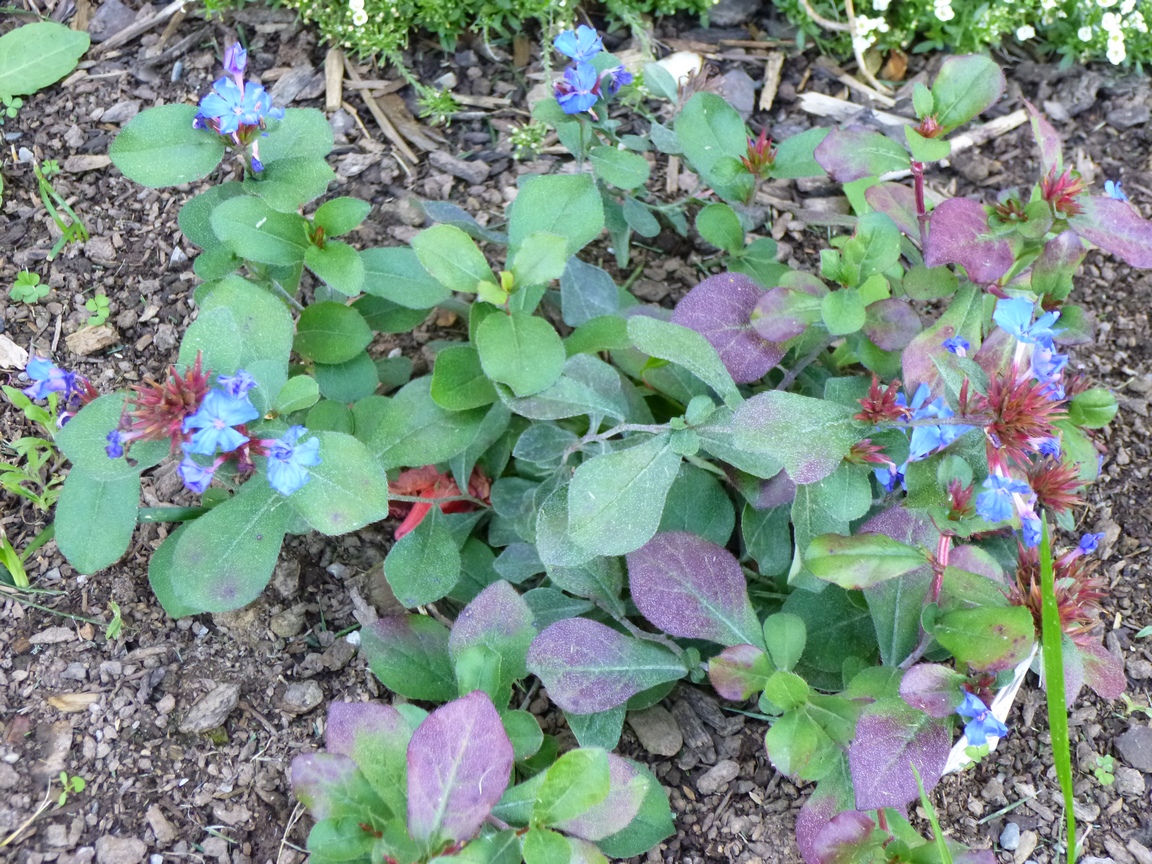
Hardy Blue Plumbago apparently turns a beautiful shade of purple in the autumn. Just another bonus to one of my favorite perennials!

I was worried that everything would be dead in the garden after three-plus weeks of neglect, so it was uplifting and heart-warming to see this gold-and-orange patch of French Marigolds (Tagetes patula). Just gorgeous! The butterflies and bees were all over these flowers. And I think that there were quite a few moths as well, including perhaps a hummingbird moth - the first one I've ever seen in Tennessee! A wonderful autumn sight. Definitely a plant that I would recommend - if the seedlings could survive in the drought and 100+ temps we had this past summer and mature into these types of flowering plants, then I'm pretty sure they can almost anything the Southeast can throw at them. Highly recommended!

The okra plant that I transplanted in September and highlighted in a blog post is still alive. I don't think it was warm enough while I was gone for the plant to produce any mature pods, but it was still nice to see it standing.

Pineapple Sage (Salvia elegans) looked miserable all summer - leaves curled in the drought, I thought it would die despite the supplemental water I gave it. By September, with cooler temps, the planted looked healthier, but I didn't expect it would double or triple in size while I was gone and throw up these sprays of red flowers. What a nice surprise! I think these flowers are supposed to attract hummingbirds, but sadly I saw only a single hummingbird make a brief visit. Maybe you need a whole patch of these plants to catch a hummingbird's attention?

Just another perspective showing the size and shape of the Pineapple Sage.

One more shot of a butterfly visiting some zinnia flowers. (Notice the smaller dun-colored skipper butterfly in the upper right hand corner of the photo. I didn't intentionally try to capture both butterflies in the frame, but there were so many butterflies flitting about that I just happened to get lucky.) I love butterflies and I love zinnias. Fortunately, they also seem to love each other.

Follow the garden from one season to another with a free email subscription.