Showing posts with label azalea. Show all posts

Wednesday, November 18, 2015

Last of the Bloomers

I think it's almost "lights out" for the flowers in the Garden of Aaron this year.

Temperatures are forecast to drop in the coming days (40s for high on Sunday, lows in the 20s), but up to this point, unusually warm autumn weather to date has allowed some brave bloomers to strut their stuff right into Thanksgiving territory.

Mexican sage, Salvia leucantha, has bloomed for months from summer to late autumn. In recent weeks, it became a magnet for bees and other pollinators.

Sweet alyssum (Lobularia maritima), also a long bloomer, very popular with mini pollinators (hoverflies, etc.)

Most of the hardy geraniums stopped blooming long ago, but 'Rozanne' hybrid geranium carries on with a few last flowers. Unfortunately, Rozanne doesn't have the same winter presence as some of my other favorite cranesbill geraniums. Where Geranium sanguineum and Geranium cantabrigiense seem more or less evergreen here in zone 6/7, 'Rozanne' has acted behaved like a true herbaceous perennial, dying back to the ground each year. 


This unknown Camellia sasanqua has had a great year. As you can see, if you pick a camellia with open, single flowers, you'll give the bees a banquet!

A few of the flowers on this group of reblooming azaleas have been blasted by frost, but the shrubs are still putting on a magnificent show!
OK, no flowers here, but the fall foliage on this Virginia creeper (Parthenocissus quinquefolia) certainly shines on its own.


No flowers here, but I love the pop of the red chokeberries (Aronia arbutifolia) against the variegated aucuba (Aucuba japonica) in the background.


Thanks for reading and commenting this past year.

I'll continue to post in the weeks and months ahead, though most likely at a more lugubrious pace than during the growing months, but I do look forward to sharing information with you on plants I've added to the garden this fall, seeds I'll be winter-sowing and so forth.

Best wishes to you all (in the Northern hemisphere) for a warm and cozy winter season. And to you in the Southern hemisphere... Happy Spring :)


Instagram

Follow Aaron Dalton on Feedio

Tuesday, April 29, 2014

April Showers Bring Lots of Flowers

Clematis "Crystal Fountain", purchased from Brushwood Nursery in 2012, growing very happily at the base of a Natchez Crape Myrtle
Clematis "Crystal Fountain", purchased from Brushwood Nursery in 2012. I seem to have failed at training this clematis into a crape myrtle, but nonetheless it is growing very happily at the base of that tree.

OK, it's not quite May yet (ergo I can't call these "May flowers"), but the recent torrential downpours we've been receiving in Middle Tennessee and throughout the South seem to be unleashing pent up Spring energy. Suddenly numerous flowers dot the garden landscape with a brilliant backdrop of lush green foliage.

Here are some of the late April highlights at Garden of Aaron:

Side view of flower spikes on Ajuga genevensis (partial shade setting)

Overhead view of flower spikes on Ajuga genevensis (full sun setting)

Aquilegia vulgaris "Winky Rose", purchased from Bluestone Perennials in 2011

This is the first year I have an Aquilegia vulgaris "Winky Rose" self-sown seedling!

Aronia melanocarpa, still full of flowers and pushing new growth

Unknown pink azalea flower
The pink azaleas in the front of the house have begun to flower. They were here when we moved in, so I don't know the variety. Below the fresh new green leaves you can see quite a bit of damage on the older leaves, but this variety fared much better than another variety (possibly Encore?) that I shovel-pruned.


Baptisia australis (Blue False Indigo) flower spikes
This is the second year in the garden for Baptisia australis (Blue False Indigo) and the first year it has produced flower spikes. Very exciting! I didn't really plan it, but the flowers appear around the same and blend nicely with the blue Ajuga genevensis flowers growing (just out of the picture) nearby.

Lonicera sempervirens (Coral Honeysuckle) flowers, close-up

Lonicera sempervirens, Coral Honeysuckle, growing at the foot of the front porch steps
Lonicera sempervirens (Coral Honeysuckle) growing at the foot of the front porch stairs. I hard-pruned this last winter so nearly all of what you're seeing here is new growth!

Dianthus gratianopolitanus "Firewitch". Remember how I included Firewitch on last year's list of failed plant relationships? Well, going against the advice of Taylor Swift, Firewitch and I are getting back together!

Epimedium x perralchicum "Frohnleiten", beautiful new foliage

Gaillardia x grandiflora "Sunset Cutie"
Gaillardia x grandiflora "Sunset Cutie", new addition from Mary's Greenhouse. Looking a little bedraggled, but bravely blooming nonetheless.

Chrysogonum virginianum, Golden Star, Green and Gold, "Allen Bush" flowers
Chrysogonum virginianum, Golden Star, Green and Gold, "Allen Bush" variety. Hardy to zone 5 and described as semi-evergreen, the foliage on this plant still burned badly without any snow cover during this past harsh winter, but it has recovered nicely and makes a charming (though diminutive) plant. 

Flower buds on Spigelia marilandica, Indian Pink
Another new addition to the garden from Mary's Greenhouse, these are the buds on Spigelia marilandica, Indian Pink, a Tennessee native whose flowers reportedly attract hummingbirds!

Fresh new Liatris spicata (Blazing Star, Gayfeather) foliage emerges

Beautiful new foliage on a Cercis canadensis (Redbud) tree.
(This is another plant that I was too quick to jilt. We're getting back together too.)

Cercis canadensis, Redbud seed pod
When the Redbud has finished its floral show, pollinated flowers may produce these beautiful seed pods

New foliage emerges on Rose of Sharon alongside frost-killed leaves
Two weeks after its newly emerging leaves were destroyed by a late freeze, Rose of Sharon is giving it another shot and pushing out fresh new foliage.

New leaves on Vitex agnus-castus, Chaste Tree
The new Vitex agnus-castus (Chaste Tree) leaves were also killed by the mid-April cold snap, but the plant has produced a second round of new foliage.


Flower spikes on Salvia nemorosa, Woodland Sage
Salvia nemorosa, either "May Night" or "Blue Hill". I'm tempted to get back together with Woodland Sage, but then I remember how it looked last August...

Helianthus "Lemon Queen" perennial sunflower foliage
This miniature forest of foliage is a second-year Helianthus "Lemon Queen" perennial sunflower. The foliage in the lower right corner of the photo is Phlox paniculata "David"

Tiarella cordifolia "Pink Skyrockets" flower spikes
Yep, here's another relationship I might have ended too soon. Tiarella cordifolia "Pink Skyrockets" seems to have weathered the winter with ease and is looking good in the late April garden.

Saturday, January 25, 2014

In Memory of a Gardener: Cecile Kaplan Dalton, 1936-2014


On January 8, 2014, my mother passed away.

As far as we know, she died peacefully and quickly in her sleep.

I guess it's not a bad way to go, but we were shocked at her sudden and unexpected death.

Naturally I'm grateful to my mother in many ways, but for the purposes of this blog, I'd like to pay homage to her for getting me started on the garden path.

Both my parents gardened when I was a little boy. We had a large garden - or what seemed large to me at the time - on the one flat patch of land what is otherwise a vertiginous piece of suburban Pennsylvania land. The garden was enclosed by a fence, chicken wire perhaps, but rabbits would still tunnel underneath and groundhogs would clamber over. My father's job (as he tells it) was to dig and remove the countless rocks that made their way to the surface each year. No matter how many he dug, new ones seemed to migrate upward. I gather my mother did more of the sowing and watering. My brother, my sister and I were sometimes given the task of harvesting. I seem to remember in particular snapping off ripe corn cobs and then husking them outdoors so my mother could make sweet corn on the cob in the summertime.

When I was perhaps four or five years old, as I recall, my mother gave me own little garden patch by the back door. It could not have been more than 10-20 square feet, but it seemed plenty big to me at the time. I don't recall whether she let me choose my garden seeds or suggested what crops I should plant, but I do remember cultivating crunchy crisp radishes and sweet strawberries. (Well, the chipmunks and slugs got plenty of the strawberries, but I think I managed to snag a few too.)

And that was that. The garden later fell into disrepair when my parents tired of battling the challenging soil and the countless varmints who lived in the woods behind the house. In the 1980s, we installed a pool in the backyard where the garden had once stood. The pool is still there and has been the scene of many happy memories.

Through the intervening years, my inner gardener slumbered. When my mother asked my teenage self to come help her push a cart at the garden center so she could buy bulbs, ferns, perennials and her beloved azaleas, I complied but only with much grumbling. I was more interested in baseball, girls, movies, books and computer games (not necessarily in that order).

I took for granted the cool wild woods behind our property, the towering oaks and conifers that grew on the uphill slope, all the daffodils and tulips that poked their heads up each spring thanks to my mother's annual bulb-planting sprees. (I did help with the bulb-planting, but the exercise of trying to insert the bulb planter into ground that seemed to have more rocks than dirt did little to increase my enthusiasm for gardening! To this day, I've mostly steered clear of bulbs.)

Oh I always loved Nature. Some of my fondest memories from my college years in New England involve hikes with my girlfriend or other friends through autumnal or wintery woods, but I spent a much greater percentage of my time holed up in vast libraries trying to decipher the wisdom supposedly set down by Great Thinkers.

After graduating from college, I spent some months at home. The leaves that autumn were glorious - fiery reds, brilliant oranges, glowing golds. I decided to collect a box full of them. Rather than scoffing, my mother helped with the project. I remember her hunting among the leaves with me to find the finest specimens. (I also learned some valuable lessons on the transience of things. Unpressed, even the best of the fallen autumn leaves soon curl, dry and transmogrify into something more subtle and more fragile.)

Then came a decade in The City, where nature was pushed to the edges like an afterthought. The years passed quickly, hurried along by the rushing pace of the ceaseless crowds. But I think the door back to the garden cracked open just a little there when I found myself irrationally fixated on a houseplant. I lived in a Brooklyn apartment that looked out on a concrete courtyard and the back wall of a municipal building. Outside of a narrow slice of sky, the view was entirely unnatural. But there in a corner of the apartment thrived a tough and forgiving plant, the only green living thing in sight. I can't remember the name now, but I think it was a type of Sansevieria.

I met my wife in The City and together we finally left in late 2009, journeying down to Tennessee (taking the houseplant with us naturally). We got an apartment at first, but at least this one had views of some woods. The apartment also had two balconies and on one of these, we installed a few pots - a bucket of hyacinths that my sister had sent as a housewarming gift, and then my first foray into edible gardening in nearly 30 years: a pot of basil and a pot of mint.

I was hooked.

With just water and sunshine, we could harvest herbs to enliven our meals.

And yet even then, as we made the decision to put down roots here in Tennessee and look for a house, the garden was still somewhat of an afterthought. I was so ignorant that I gave little thought to the landscape around the houses we toured. We knew we wanted a patch of land for space and privacy, but the content of that land - the topography, the plants, the soil, the wind, the light - these were things that I mostly overlooked.

We picked a place, moved in March 2011 and I remember going shopping with my wife for seeds. She chose Cosmos and Zinnias. The first brave seedlings popped out of the ground a little while later and I was in love.

That was just a few years ago, but I'm glad I had those few years to reconnect with my mother on the subject of gardening.

We had wildly different gardening styles and tastes. She loved azaleas, crocuses, tulips, daffodils, daylilies, roses, rhododendrons and hostas. She could not understand my enthusiasm for sunflowers. She lamented the fact that the mature trees on the property she and my father shared in Pennsylvania -- the same land where I had grown up 30-plus years earlier -- cast too much shade on the roses and blueberries. I sympathized, even if I was stuck at the other extreme with a sun-baked backyard in a much newer development practically devoid of shade.

For years, my siblings and I tried to encourage my parents to sell the old homestead and move to something smaller, less hilly and more sensible, but she refused to countenance such a step. The driveway may have been steep and treacherous, but she loved the hillside perch with the backyard forest with all the birds who came to visit the porch feeders in the winter. (She did not love the grey squirrels forever trying to figure out a way to knock down the feeders and devour the seed therein, but she got her exercise jumping up from the table to chase the squirrel away whenever it made its appearance.) When the leaves fell, they revealed a valley vista that stretched for miles.

Recently she had begun spending winters down in Longboat Key, Florida. My older brother generously rented and then ultimately purchased a condo for her overlooking the Gulf. She loved to watch the dolphins who would swim offshore and the pelicans smoothly gliding by and then suddenly plunging into the surf in search of their aquatic prey.

When my wife and I visited her there, we would go to Marie Selby Botanical Gardens to admire the orchids or stroll the Ringling Bayfront Gardens. On our last trip in the winter of 2013, she booked a garden tour for us at the Ringling where we marveled at massive banyan trees and admired the brilliant amaryllis.

This past summer, the last time I saw her, my siblings and I all gathered for the first time in perhaps 25 years or more at our old Pennsylvania home. The humidity was enervating and the mosquitoes were more vicious than I'd ever remembered, but I prevailed upon everyone to take a daytrip to a nearby pleasure garden called Chanticleer that none of us had ever visited before.

My sister's son was there too - not yet two years old at the time - and I think my mother really enjoyed seeing him explore the garden. I remember him being especially fascinated by the sleek koi who came to the edges of their pond to gaze up at us curiously, beseechingly.

Even at Chanticleer we had our differences. I think she found it hard to understand why I hoped (and still hope) to add Rattlesnake Master, Eryngium yuccifolium to my garden, but even as others rushed ahead to complete the tour and escape the sauna-like combination of heat and humidity, we took our time to examine a rampant, lush Dutchman's Pipe vine or marvel at a hedge of hydrangeas in dazzling full bloom.

I wish my mother could see my garden this year. I wish she could be there at the end of this long, cold winter when the frozen ground softens, when the daffodils raise their cheery heads, when the bees return to work the coneflowers, the crape myrtles, the sunflowers, the cosmos and the vitex.

I am still such an inexperienced and foolish gardener, still fumbling my way along, making myriad mistakes to accompany my few successes. How I wish she would have lived to see my garden flourish, that she could have walked along the paths I dream of making under shade trees not yet planted, along vegetable garden beds I have not yet sowed. How I wish I could show her the garden of my dreams that I hope to bring to fruition someday.

And yet I am grateful -- grateful that we had some years to talk about gardens, to reminisce about the vegetables she used to grow, to hear her explain why peas taste best straight from the vine (because the sugars turn rapidly to starch once the pods are picked), to share news about which birds we'd spotted frolicking in our backyards.

I'm thankful that she introduced me to gardening those many years ago. As the obituary below indicates, my mother was a teacher both by profession and temperament. She taught me a great deal about gardening and about life.

I know whatever I manage to grow now and in the future will spring from a seed she planted in me long ago.

And I hope that her heaven is a seaside garden, redolent with roses, ablaze with azaleas, with a shaded bench to watch the dolphins and pelicans just offshore. I hope I can visit her there someday.


Obituary for Cecile Kaplan Dalton


Accomplished college professor, beloved mother and grandmother, Cecile Kaplan Dalton passed away January 8, 2014 at the age of 77. 

The only child of Yetta and Nathan Kaplan, Dr. Dalton was born on November 29, 1936 in Chicago, Illinois. She graduated Phi Beta Kappa from Northwestern University with a bachelor’s degree in chemistry. 

Although they grew up blocks apart on Chicago’s West Side, she and her husband Dr. David R. Dalton first met in college at Northwestern’s Chemistry Club. They went on to earn PhD degrees in chemistry from UCLA in the early 1960s and then moved to Columbus, Ohio for post-doctoral work at Ohio State University before eventually settling in the Philadelphia suburbs. 

Cecile and David Dalton were married 56 years and had three children together: Nathaniel, Rachel Bailey and Aaron. 

Dr. Dalton had a successful career in both industry and academia. For many years, Dr. Dalton taught organic chemistry at Swarthmore College, Bryn Mawr College and Temple University. She had a passion for teaching post-baccalaureate students who had returned to college to complete their prerequisites for medical school. 

Dr. Dalton loved opera and classical music. After she retired from academia, Dr. Dalton applied her considerable organizational talents to serving as an Officer on the Board of Directors for the Philadelphia Opera Guild. 

An enthusiastic traveler and bon vivant, Dr. Dalton enjoyed trips to Japan, the Caribbean, Israel and especially to her beloved Florence, Italy where she would rent an apartment for months at a time and immerse herself in the language and culture. 

In recent years, Dr. Dalton had begun spending the winters in Longboat Key, Florida, where she made new valued friendships, volunteered in the library at Temple Beth Israel and supported the educational and conservation activities of the Mote Aquarium. 

She is survived by her husband, her children and four grandchildren. Graveside service and burial took place Sunday, January 12th at Chicago’s Westlawn cemetery, Eastview section, 7801 West Montrose Avenue, Norridge, IL 60706. 

In lieu of flowers, contributions in Dr. Dalton’s memory are requested for American Friends of Magen David Adom (PO Box 52158, Philadelphia PA 19115) or Mote Marine Laboratory & Aquarium (Attn: Development Office, 1600 Ken Thompson Parkway, Sarasota, FL 34236). 

(Another obituary for my mother appeared in The Philadelphia Inquirer on January 19th.)

Saturday, May 4, 2013

Meet the New Front Foundation!


Remember how we ripped out the old front foundation plants and then tried to reinvent the border by stocking up on shrubs last autumn?

Well, it's time to check back in with the front foundation plantings and see how things are shaping up. (I wish I could take you in order from one side of the border to the other, but Blogger's bulk upload feature doesn't work quite that smoothly for me, so the photos are presented in no particular order)


Agastache foeniculum, Anise Hyssop, "Golden Jubilee", a few leaves deteriorated or got mulched, so I removed them, but otherwise, this plant seems to be doing fine. Hope to see flowers in the summer.


One of the new Aquilegia vulgaris from Gardens in the Wood. This one is my favorite - a creamy white flower over fresh blue-green folage. 

Aronia arbutifolia "Brilliantissima", the beautiful white flowering show is pretty much done now and the plant is sending out new foliage. Interested to see whether it will actually produce fruits this year. 
Aronia melanocarpa, either "Autumn Magic" or "Viking" (not sure which is which), this is the last of three aronias to still have flowers. It is sort of charting a middle course between the Aronia arbutifolia (which concentrated first on flowers and then on foliage) and the other Aronia melanocarpa (which had a few flowers but seems to have focused this year on pumping out some large and beautiful leaves)
Aronia melanocarpa, either "Autumn Magic" or "Viking" (not sure which is which), love the beautiful leaves on this plant which seem really large for such a young tree 
I'm not a huge fan of azaleas for numerous reasons. At least at our property, the foliage frequently looks diseased (I don't do any spraying) and the plants themselves are unexciting outside of their short bloom season. The flowers do not seem to attract any bees or butterflies or other beneficial insects. (At least none that I can see.) And they don't seem to produce any fruit for birds or mammals. Plus the dead flowers look awful hanging onto the plant after bloom season. The plants are not self-cleaning (like crape myrtles or redbuds) and the flowers do not come off easily (as with daylilies, for instance, or camellias), so it's a chore to get the plants looking good after they bloom. All that being said, I imagine we'll keep them for now. My wife likes the azaleas in bloom and I have to admit, they really are beautiful when covered with flowers. This it their peak time to shine. Plus we're lucky enough to have inherited plants that do rebloom a bit in the autumn. That said, I don't think I'd add azaleas to any future garden of mine nor would I recommend it in Tennessee, especially if your garden does not have acidic soil. 
Aucuba japonica, Gold Dust Plant, seems to be happily settling in and sending out new foliage, which emerges all light green and then presumably changes later on to the variegated and speckled look. It was planted last autumn.

This is actually a pink azalea from the Northeast side of the house. I cheated a little by including it since it's not in the front foundation. But it is probably my favorite of the azaleas. Even though its foliage is very sparse, it still manages to cover itself with blooms.

Callicarpa americana, Beautyberry, a bit slow to leaf out, but I'm liking the shape and texture of the new leaves, interested to see how it performs this year in its more sheltered Eastern exposure. Last year, it was absolutely thrashed to pieces in a windy Southwestern spot. It seems much happier here so far. 
At the top of the photo is Tiarella cordifolia, Foamflower, "Pink Skyrockets". Contrary to its bold name, this tiarella actually has smaller and less prominent flowers than the more modestly-named Pink Brushes. Otherwise, it seems fairly similar to its Pink Brushes sibling.

Lower down is Stachys officinalis, Betony, Hummelo. Just added last month, the plant is doing well so far and looking healthy. It is supposed to have flowers that last from July to September! 
 Unknown autumn-blooming camellia, here when we moved in, seems to be sending out a lot of new growth shoots this year 
Camellia sasanqua, either Kanjiro or Pink-a-Boo (not sure which is which), seems to be settling in just fine after having been planted last autumn 
Unknown camellia, here when we arrived, a lot of the foliage seems less-than-healthy. Not sure what the problem is and I don't plan on spraying. The camellias sometimes seem to go through cycles of having foliage problems here and then recovering on their own. At least that's the pattern so far. I will probably give it some acidic fertilizer at some point.

- Lonicera semervirens, Coral Honeysuckle, this is one of the two cultivars - Alabama Crimson and Blanche Sandman - that are both growing nicely and sending out long tendrils that I'm trying to guide onto the porch railings with moderate success. Once the tendrils are tied to the railings for a little while, they often start curling around the railings and then are able to hang on by themselves. Lots of flowers this year, but sadly have not seen a single hummingbird on them yet. :(  Still the flowers and foliage are beautiful and it's nice to see my dream of climbing flowers along the railings coming true with this plant. 
Geronimo Crape Myrtle - Not sure this was the best choice for a foundation plant. Like all crape myrtles, it takes a long time to leaf out and then a number of branches did not leaf out fully. This plant was pretty inexpensive for its size, but it came from an unknown nursery. I wonder if maybe the roots were not so healthy? Or maybe it's just settling in. I pruned it back a bit after I took this photo and will probably do some more pruning in a few weeks when I see which branches look like they definitely won't leaf out no matter how long I wait. 
Crape myrtle, Tonto, which I believe was a Monrovia plant, seems to be leafing out much more robustly and fully on its Northeast corner than the Geronimo crape myrtle on the Southeast corner. We'll see if Geronimo catches up or if Tonto continues to perform better this summer. 
Dryopteris x australis, Dixie Wood Fern, seems to be acclimating nicely and sending out new fronds, a number of the fronds have fallen over, which doesn't really bother me, but I wonder if that is normal or if something has gone wrong? 
Fothergilla gardenii, nice white bottlebrush flower show this spring for several weeks, I'm liking the new foliage that's emerging now


Gardenia jasminoides "Jubilation", planted last autumn, this is one of the few plants that is not looking happy right now. Lots of yellowing leaves. Could be that it was unhappy with the long cold winter, or could be that the soil is not acidic enough? I will try adding some acidic fertilizer. 
Geranium x cantabrigiense "Biokovo", in bloom when I added it in April, I like the delicate pink-white flowers, the foliage seems smaller than some of the other Cranesbill perennial geraniums. 
Origanum vulgare, Golden Marjoram, "Aureum", doing great so far this year, much better than last year, looking very healthy, hoping I might get to see the pink/mauve summertime flowers that did not appear last year when the plant was struggling.

Veronica peduncularis (a.k.a Veronica umbrosa) "Georgia Blue", the flowering that was so cheerful in late winter when nothing else was blooming has mostly stopped, although there are still often a couple of open tiny blue flowers each day. The foliage still looks marvelous and healthy. Wish this would spread more!

- Ceratostigma plumbaginoides, Hardy Blue Plumbago, late to emerge, it has since sent up vigorous leaves that are larger than anything I saw last year. But the plants do not appear to have spread much yet (unfortunately). 
New foliage on one of the three Ilex glabra, Inkberry Holly shrubs that I added last autumn. The bushes weren't sexed, but hopefully I have a mix of males and females so that I'll have black berries that will attract birds later on. Looking forward to seeing whether my Ilex glabras produce flowers that attract hummingbirds as they are supposed to do.
A broader perspective on Ilex glabra to show the overall impression the plant makes.

- Alchemilla mollis, Lady's Mantle, seems to be settling in nicely, growing and expanding a little, I have high hopes for this one! As mentioned before, looks absolutely lovely after a rain or when gilded with the morning dew (but looks nice at other times as well). 
Hydrangea quercifolia, Oakleaf Hydrangea, "Snowflake", has leafed out nicely, I was absolutely smitten with this plant, but I've come down to Earth just a little bit, I did notice that some of the leaves were hit hard with what seems to be a fungal disease. Apparently oakleaf hydrangeas are susceptible to such problems at times of high moisture (we've had lots of rain lately). I picked off the worst-affected leaves. We'll see if that helps. 
Pachysandra procumbens, Alleghany Spurge, seems to have settled in nicely, does not appear to have spread much yet, but the new foliage looks great and the old foliage seems to be deteriorating pleasantly back into the soil. 
Phlox paniculata "Blue Boy"

Phlox paniculata "Eva Cullum" 

Platycodon grandiflorus, Balloon Flower, planted early last autumn, Platycodon has reappeared vigorously this year, with another newly planted Platycodon right behind it 

- Scabiosa columbaria, Pincushion Flower, the flowers are cute, but the whole plant is tiny. I'm sure I read somewhere that Scabiosa is supposed to grow 12-18 inches tall. Really? Because the plant is only about 3 inches tall at this point! 
Sedum ternatum, has been flowering for about a month since purchased. It seems happy and healthy in their partial shade setting 
Stargazer Lily
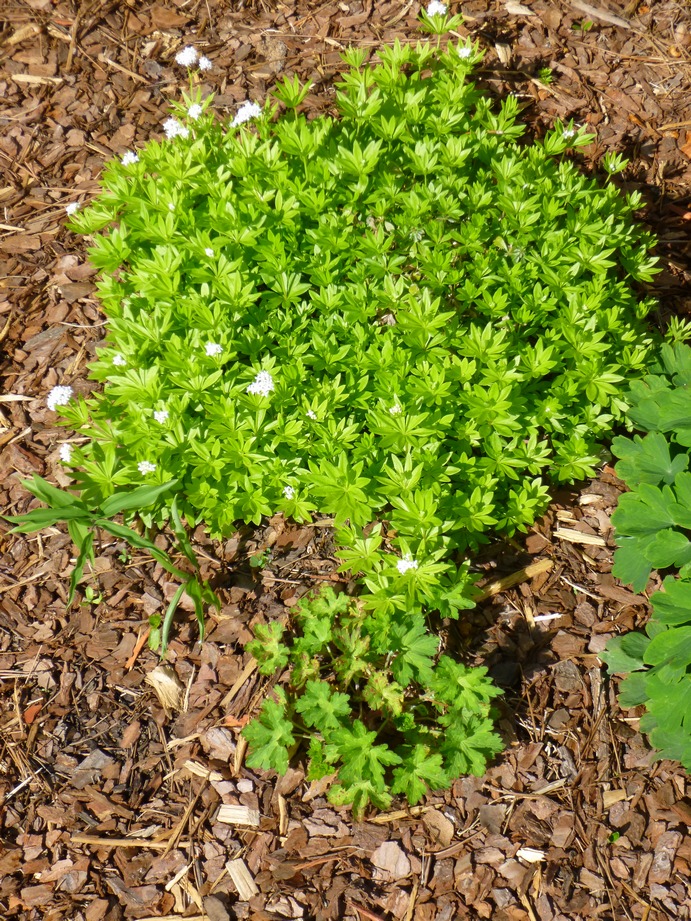
 Galium odoratum, Sweet Woodruff. I've already sung the praises of this plant many times. This year I have finally gotten to see the white flowers which have just started opening over the past week or so. Looking forward to clipping some stems and trying to dry some of the flowers/foliage, which is supposed to bring out its fragrance. 
Tiarella cordifolia, Foamflower, "Pink Brushes", my favorite of the tiarellas I purchased last month, this one has nicely variegated foliage like the others and the most prominent flowers. 
Tiarella cordifolia, Foamflower, "Running Tapestry", I like the foliage a lot, but this foamflower has fared the worst of the three I purchased last month. It frequently wilts if it goes a few days without rain, and we have not even gotten into the heat of the summer. I did move all three Tiarellas from a morning shade/afternoon sun setting to a spot where they get more gentle morning sun/afternoon shade. The other two tiarellas seem fairly happy with their situation, but I'm worried about this one. (Frankly I'm worried about all of them once we get into the heart of the summer, but I'm prepared to baby them a little this year in the hopes they'll be tougher once they get established.)

The ajuga in the background has been putting on quite a blue show!
 
This variegated ajuga, has been flaunting its blue flower spikes for weeks and weeks. Unfortunately, it does not seem to have attracted any bees, but then sadly I have not seen many pollinators at all in the garden yet this year. 
Veronica spicata, Spike Speedwell, "Giles Van Hees", just starting to bloom
Clematis integrifolia, Solitary Clematis, late to emerge, I thought it was dead after the plant really struggled in last year's heat and drought, probably it was not smart to expect a plant that is native to Russia to perform well in Tennessee. Nonetheless, Clematis integrifolia has made a strong comeback so far this year. Not sure how it will do once the real summertime heat kicks in, but we shall see. No flowers yet, but the foliage looks clean, healthy and robust. 
Here's the other Lonicera sempervirens. Hard to believe, but I've yet to see any hummingbirds working these red tubular flowers! Do I need to put up a sign that says, "Hummingbirds welcome?"

Geranium sanguineum "New Hampshire". I'm really liking this one for its thick spreading foliage and the pink flowers. I saw a Geranium sanguineum at the Nashville botanic gardens last year. It seemed really tough there so I'm hoping mine will be also.


So that's the highlights! I may have missed one or two specimens (somehow skipped over the Monarda didyma "Jacob Cline"), and I didn't talk about the annuals like the Sweet Alyssum seed I scattered throughout the front of the bed or the Cosmos bipinnatus seedlings that are popping up here and there (not to mention a few English marigold seedlings from the flowers that filled the beds last year), but I think this probably gives you and idea of the rich diversity that I've aimed for in the front border.

Hope you've enjoyed the tour and that it wasn't too exhausting. Going forward, I think I'll try to limit my future posts to a maximum of 5 or so photos at a time.

Meanwhile, questions, suggestions and exclamations are all welcome using the new Disqus comment platform!