Showing posts with label Burkii Eastern Red Cedar. Show all posts

Tuesday, May 5, 2015

In Full Swing - Clematis, Penstemon, Sumac, Sage, False Indigo and More!


Things are in full swing in the garden - bees are buzzing, flowers are blooming, leaves are expanding, plants are growing, everything there is life (except where there is death).

I apologize for the lull in posting photos. My camera is currently traveling overseas (along with my wife), but my kindly neighbor Christian generously lent me his camera so that I could capture some scenes from the early May garden.

(There are a lot of photos, so I'll split them into two posts. This post will focus on the back garden, the next one on the front and side gardens.)

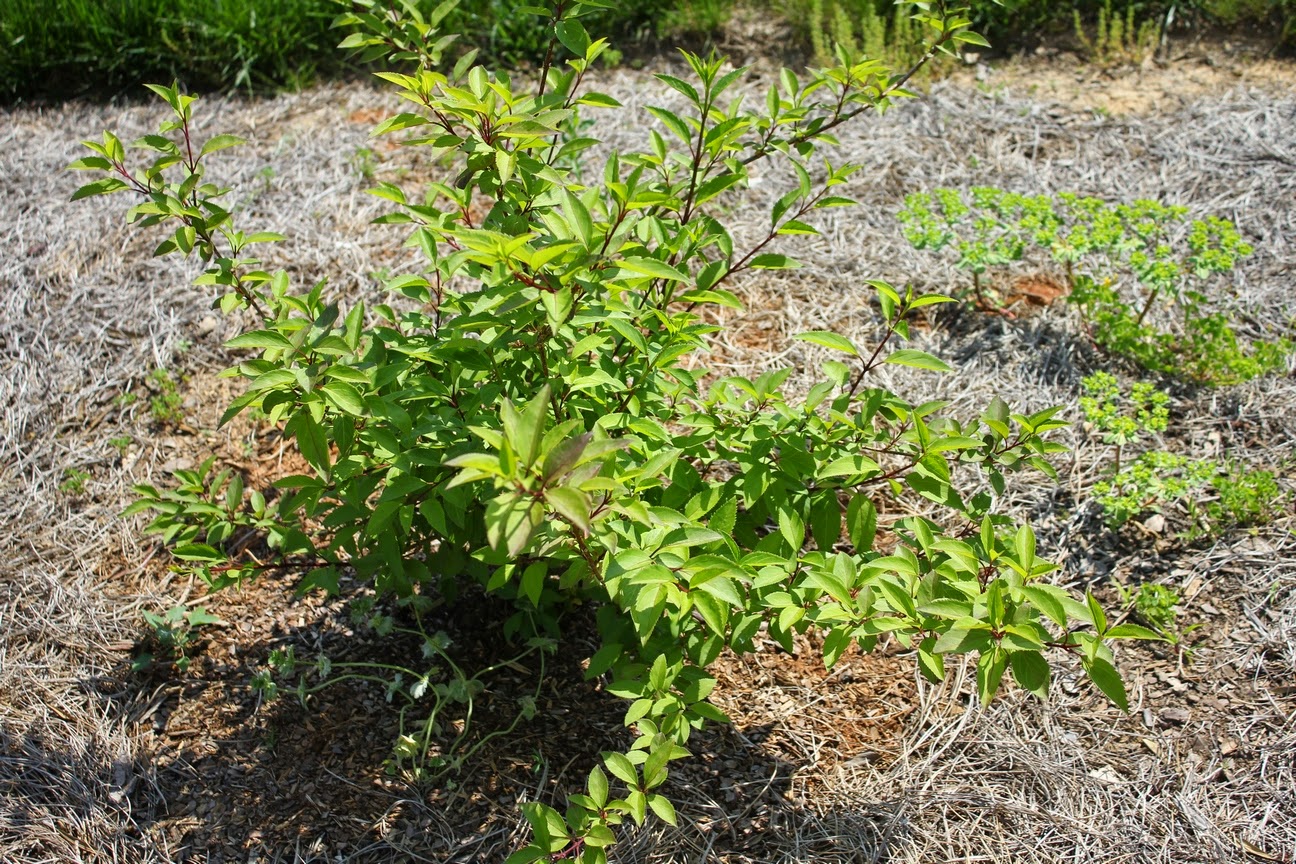
Abelia x grandiflora, dwarf cultivar. I'd thought it was 'Rose Creek', but I think it was mislabeled, so I'm not sure of the cultivar. Whatever it is, it seems to be settling in nicely during its first year in the garden. I don't usually like bright yellow plants, but I like the contrast here against surrounding greenery.

My favorite plant in the garden these days is Baptisia australis (blue wild indigo). In its third full year in the garden, it has sent up multiple stalks of pretty blue flowers that (as you can see here) attract bees!

The Burkii eastern red cedars (Juniperus virginiana) are loaded with berries/cones. The branches were coated with rust fungus earlier during our wet spring, but that issue seems to have abated (at least for now) as the weather has turned drier and warmer.

Clematis 'Crystal Fountain'. We had this clematis tied up into the crape myrtle tree with biodegradable twine. The twine degraded in some rain storms this spring and the vine fell to the ground, but it doesn't seem too much worse for the wear and actually makes a rather nice groundcover. Make lemonade from lemons and all that...

Nothing too exciting here - Forsythia x intermedia 'Lynwood Gold'. But I must admit that the shrub looks very healthy. The foliage was a lovely shade of green earlier in the spring. I'm not over-the-moon on Forsythia. It's totally overplanted and the flowers seem relatively useless in terms of supporting wildlife, but I have to give it props for toughness.

What happened here!? 'Lemon Queen' perennial sunflower is not looking her best.  I need to investigate further, but my initial suspicion is some sort of fungal rot. It's not a pretty picture, but I believe gardening blogs should honestly show the good, the bad and the ugly.

Lantana camara 'Miss Huff', first year in the garden, first blooms.

Panicum virgatum (switchgrass) 'Northwind' -- This is my second year with switchgrass in the garden. I cut back the old stems myself in March. It seems to me that in a normal-to-harsh winter here, I could easily wait until the end of March or even the beginning of April to make such a cutback. The old stems look good all winter and into spring, so the cutback is only needed to make way for new growth. But that new growth doesn't start in earnest until mid-April. Cut back your grasses too early, and you have relatively unattractive stubble mocking you for a month.

Penstemon x mexicali 'Red Rocks', first year in the garden

Acer rubrum (red maple), not sure which cultivar, but whatever the name, it's turning into quite a nice little tree. As long as the deer don't try ripping up the bark again (like they did a couple of winters back), I hope it will be OK.

Fuzzy berries forming on fragrant sumac (Rhus aromatica) 'Gro-Low'. The small yellow flowers that preceded the berries seemed to be a big hit with all sorts of small pollinators (probably a motley crew of bees, wasps and flies).

Salvia greggii (autumn sage), not sure whether this is 'Flame' or 'Rose Pink', but in either case both survived the winter (I was holding my breath since they're rated marginally hardy in Mid-Tennessee) and have started blooming. Last year, the autumn sage flowers attracted hummingbirds.

As with the azaleas I inherited at the front and side of the house, I feel like this ornamental sage ('May Night'?) looks good for a couple of weeks and then looks like Death warmed over the rest of the year. Still those brief bursts of beauty - especially in the Spring - have won it a place in the garden for now. The lamb's ear 'Helene von Stein' in the background looks good most of the year, including now.

Looks like there should be lots of crabapples this year on the 'Sugar Tyme' crab.

This is not too impressive, but I'm just happy that my wax myrtles (Morella cerifera) survived the winter. Although evergreen further South, they pretty much defoliated here. Then again, I probably shouldn't have planted marginally hardy plants in November. Both plants almost made it through the winter intact, but one got chomped by a deer (I presume) right before Spring arrived. This is the one that didn't get chomped. (The other is still alive, but only barely.)

Purple coneflower (Echinacea purpurea) wilting in early May. Not a good sign of drought tolerance when we're still 5-6 weeks away from the official start of summer.

As with the 'Lemon Queen' sunflower, I'm not sure what happened here, but a portion of the Hyssopus officinalis (hyssop) seems to have wilted out practically overnight. Hyssop is a fast grower, so I'll try just trimming out the damaged section and hoping for a recovery.

Stay tuned, more photos coming soon from the front garden!

Tuesday, April 7, 2015

The Puffer and the Juniper


OK, so I didn't have an actual pufferfish on my juniper... (photo via a different Aaron)

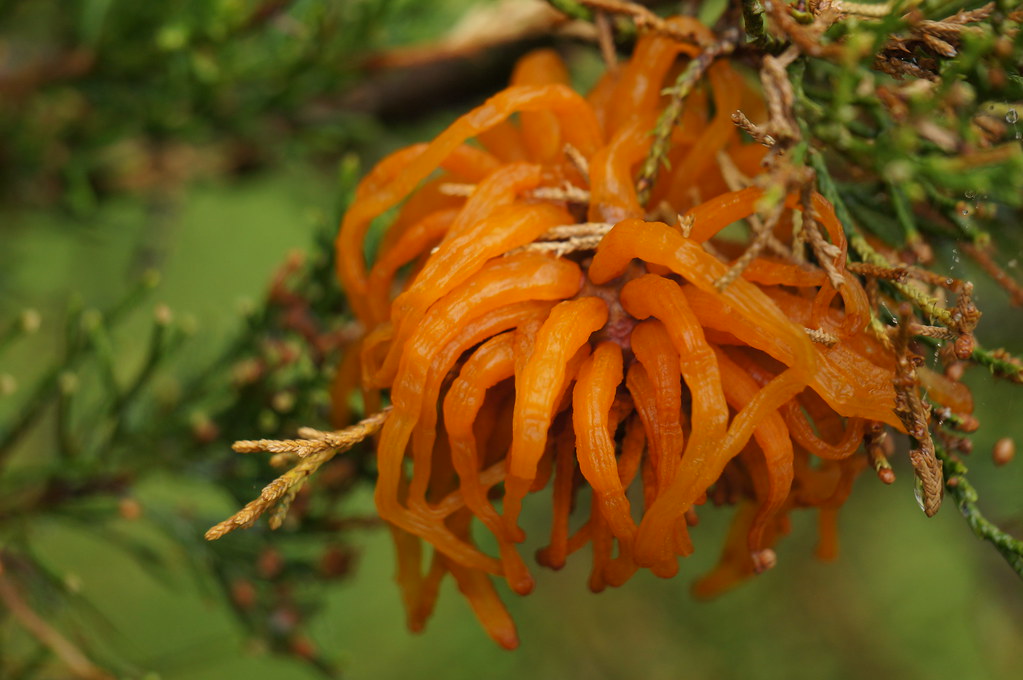
But you have to admit there is some family resemblance with these cedar-apple rust fungi (Gymnosporangium juniperivirginianae) that I found on a couple branches of my Burkii eastern red cedars (Juniperus virginiana).

If I had not removed the fungal galls, the tiny brown protrusions (called telia) that you can see in the previous photo would have absorbed water from the warm spring rains and transmogrified into these jelly-like orange horns composed of thousands of two-celled spores called teliospores. The telia go through multiple swell-shrink cycles as they absorb water and then dry out. With each cycle, apparently the horns get longer and release more fungal spores. From what I understand the fungal galls typically don't cause much damage to the junipers, but if the spores land on young apple (Malus spp.) leaves or twigs under appropriate moisture and temperature conditions, they can infect those plant tissues. From what I understand, the fungal galls typically don't cause much damage to junipers, but since I have a crabapple growing nearby, I'm trying to remove any galls that I find to reduce the infection risk on the crabapple so that the tree stays healthy and able to produce flowers for the insects and fruit for the birds. (My limited understanding of this topic comes from reading materials prepared by experts at institutions like Cornell and the Missouri Botanical Garden. Photo by Mike Lewinski)

Thursday, February 7, 2013

The bigger they are...

This is not what you want to see when you open the blinds and look out the window in the morning.

...the more expensive they are to cut down.

When two big branches from our ~100-year old oak tree fell on our driveway, they revealed rotted wood and a cracked trunk.

This was a *big* tree. How big? I couldn't even get the whole tree in the photo! I think the guys who cut it down estimated it was around 75-feet high. Notice how one big branch fell directly on top of the other branch, which in turn ripped the trunk as it fell in a chain-reaction. The upper branch is just resting on the lower branch, completely disconnected from the trunk. That made me really nervous and created a certain urgency around having the tree removed ASAP.

The tree had to come down for safety's sake.

On a neighbor's suggestion, I turned to Mike Hite and his company, Creative Tree Service.

It took several days, a crew of about six guys (including couple of acrobatic tree-climbers who could have given Cirque du Soleil a run for its money) and some really big chainsaws and to de-tree the yard.

I was really impressed with the work of Mike and his employees. So I asked his permission to post a few photos and videos of his team at work:

Let's get started! Can you spot the two men in the tree? They're rigging ropes both for their own safety and also so that they (and their colleagues on the ground) will have a way to lower the branches as gently as possible as they are severed with a chainsaw.

Is that really a safe place to stand?
Working their way up the tree. Naturally, they're starting with the lower branches and working their way up so that each branch they cut has a clear path to the ground.

Meanwhile, on the ground, lots of chainsaw work and heavy lifting.

The canopy is nearly gone now...

Watcha doin' today? Oh, just hanging out. In a tree. With a chainsaw on my hip. The usual.

Taking a breather...Must be a nice view from up there.

Time to bring in the stump grinder!

Check out that big hunk o' stump. Yep, it's hollow. Amazing that the outer ring of wood was able to hold up all that weight. Thank goodness!

And now some videos of Arborists in Action!


After the tree was cut up and gone, we were left with just a sawdust-filled hole where the stump had been ground out.

But I found a landscaper who installed a new landscape bed and a number of new trees in the front yard - Maples, Redbuds and Eastern Red Cedars. (Stay tuned for photos of the new bed in an upcoming post...though I may wait until the trees start leafing out to publish photos.)

For the first time, I now feel like our home is really 'grounded' in the landscape rather than looming over an empty lawn.

But none of the new trees we've planted will grow as big as that oak (I hope)!

On the bright side, there were no acorns to rake this year.

But I am feeling bad for the squirrel who used to live in the oak and was forced to relocate...