Showing posts with label Helianthus Lemon Queen. Show all posts

Tuesday, May 5, 2015

In Full Swing - Clematis, Penstemon, Sumac, Sage, False Indigo and More!


Things are in full swing in the garden - bees are buzzing, flowers are blooming, leaves are expanding, plants are growing, everything there is life (except where there is death).

I apologize for the lull in posting photos. My camera is currently traveling overseas (along with my wife), but my kindly neighbor Christian generously lent me his camera so that I could capture some scenes from the early May garden.

(There are a lot of photos, so I'll split them into two posts. This post will focus on the back garden, the next one on the front and side gardens.)

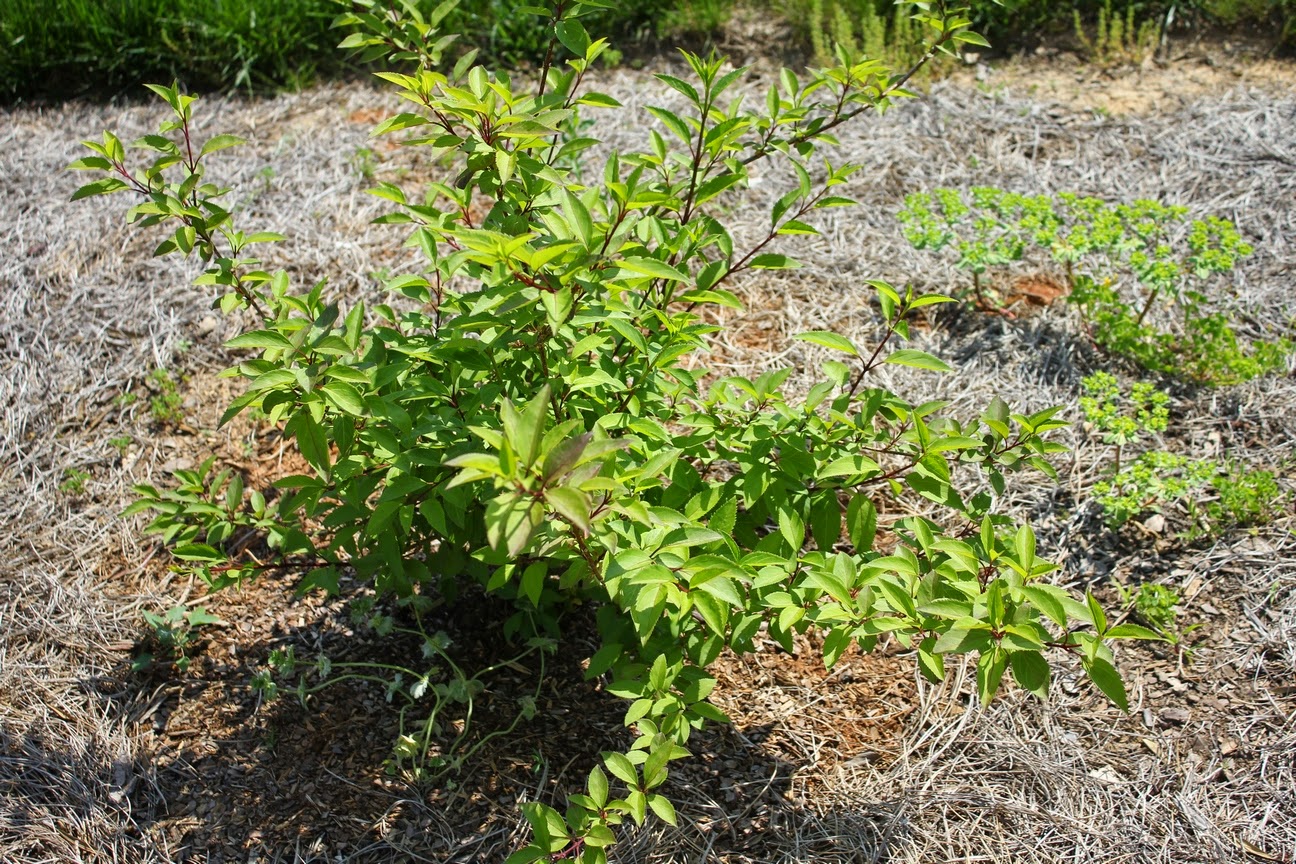
Abelia x grandiflora, dwarf cultivar. I'd thought it was 'Rose Creek', but I think it was mislabeled, so I'm not sure of the cultivar. Whatever it is, it seems to be settling in nicely during its first year in the garden. I don't usually like bright yellow plants, but I like the contrast here against surrounding greenery.

My favorite plant in the garden these days is Baptisia australis (blue wild indigo). In its third full year in the garden, it has sent up multiple stalks of pretty blue flowers that (as you can see here) attract bees!

The Burkii eastern red cedars (Juniperus virginiana) are loaded with berries/cones. The branches were coated with rust fungus earlier during our wet spring, but that issue seems to have abated (at least for now) as the weather has turned drier and warmer.

Clematis 'Crystal Fountain'. We had this clematis tied up into the crape myrtle tree with biodegradable twine. The twine degraded in some rain storms this spring and the vine fell to the ground, but it doesn't seem too much worse for the wear and actually makes a rather nice groundcover. Make lemonade from lemons and all that...

Nothing too exciting here - Forsythia x intermedia 'Lynwood Gold'. But I must admit that the shrub looks very healthy. The foliage was a lovely shade of green earlier in the spring. I'm not over-the-moon on Forsythia. It's totally overplanted and the flowers seem relatively useless in terms of supporting wildlife, but I have to give it props for toughness.

What happened here!? 'Lemon Queen' perennial sunflower is not looking her best.  I need to investigate further, but my initial suspicion is some sort of fungal rot. It's not a pretty picture, but I believe gardening blogs should honestly show the good, the bad and the ugly.

Lantana camara 'Miss Huff', first year in the garden, first blooms.

Panicum virgatum (switchgrass) 'Northwind' -- This is my second year with switchgrass in the garden. I cut back the old stems myself in March. It seems to me that in a normal-to-harsh winter here, I could easily wait until the end of March or even the beginning of April to make such a cutback. The old stems look good all winter and into spring, so the cutback is only needed to make way for new growth. But that new growth doesn't start in earnest until mid-April. Cut back your grasses too early, and you have relatively unattractive stubble mocking you for a month.

Penstemon x mexicali 'Red Rocks', first year in the garden

Acer rubrum (red maple), not sure which cultivar, but whatever the name, it's turning into quite a nice little tree. As long as the deer don't try ripping up the bark again (like they did a couple of winters back), I hope it will be OK.

Fuzzy berries forming on fragrant sumac (Rhus aromatica) 'Gro-Low'. The small yellow flowers that preceded the berries seemed to be a big hit with all sorts of small pollinators (probably a motley crew of bees, wasps and flies).

Salvia greggii (autumn sage), not sure whether this is 'Flame' or 'Rose Pink', but in either case both survived the winter (I was holding my breath since they're rated marginally hardy in Mid-Tennessee) and have started blooming. Last year, the autumn sage flowers attracted hummingbirds.

As with the azaleas I inherited at the front and side of the house, I feel like this ornamental sage ('May Night'?) looks good for a couple of weeks and then looks like Death warmed over the rest of the year. Still those brief bursts of beauty - especially in the Spring - have won it a place in the garden for now. The lamb's ear 'Helene von Stein' in the background looks good most of the year, including now.

Looks like there should be lots of crabapples this year on the 'Sugar Tyme' crab.

This is not too impressive, but I'm just happy that my wax myrtles (Morella cerifera) survived the winter. Although evergreen further South, they pretty much defoliated here. Then again, I probably shouldn't have planted marginally hardy plants in November. Both plants almost made it through the winter intact, but one got chomped by a deer (I presume) right before Spring arrived. This is the one that didn't get chomped. (The other is still alive, but only barely.)

Purple coneflower (Echinacea purpurea) wilting in early May. Not a good sign of drought tolerance when we're still 5-6 weeks away from the official start of summer.

As with the 'Lemon Queen' sunflower, I'm not sure what happened here, but a portion of the Hyssopus officinalis (hyssop) seems to have wilted out practically overnight. Hyssop is a fast grower, so I'll try just trimming out the damaged section and hoping for a recovery.

Stay tuned, more photos coming soon from the front garden!

Friday, May 2, 2014

Some Things Get Better with Age....Others Not So Much

I've been feeling more than the usual aches and pains recently in the garden.

Blame it on the fact that my wife and I planted four trees, several large shrubs and dozens of perennials over the past few weeks.

After all the heavy digging, it was ironic when I somehow strained a back muscle planting a tiny 4-inch Salvia greggii.

Don't worry -- the pain isn't too bad (as long as I don't bend over). ;-)

So I've been thinking about how age is reflected in the garden. I don't know about you, but when I plant a perennial, a shrub or a tree (most anything but an annual), I have high hopes that the plant will get better and stronger with time.

Sometimes, this wish comes true. Perennial Lemon Queen Sunflower looks about five-times bigger, bushier and stronger than it did last year.

Perennial "Lemon Queen" Sunflower doing its best impression of a shrub
only a month after emerging from dormancy


All the aronias have been going from strength to strength in the past couple of years -- more flowers, more berries, more healthy foliage, taller plants.

But then there are other plants that seem to have a tougher time of it with each passing year. (I can sympathize!!)

I'm talking about plants like Gaura lindheimeri. I've seesawed back and forth in the past on whether I love this plant (gorgeous pink flowers over a long bloom season) or whether I'm ready to shovel-prune it (mass of ugly dead stems in the spring that seem to take forever to green up).

Gaura lindheimeri in late April. Not looking promising.

This year, I think Gaura is trying to save me the trouble of making up my mind. All of the gauras are a little later than usual in making their spring comeback. When I didn't see any growth at all, I started hacking down through the dead stems and found that many of them were rotted and could pretty much twist away in my hands. Not a good sign.

It looks like what they say about Gaura needing good drainage really is true. And my heavy clay soil just isn't cutting it.

(I know that when some perennials start dying out in the middle, it's time to try to divide them, but I've heard that gaura is taprooted and therefore does not take well to division. Has anyone successfully divided a gaura before?)

That said, when I ripped away all the dead foliage, at least I discovered what looks like a bit of healthy foliage on the outskirts of the plant. Maybe I'll get at least one more good year out of the gaura? And I think there are a couple of seedling plants nearby.

A tiny bit of healthy foliage offers hope that a piece of Gaura may have survived to bloom another day

That's more than can be said for Russian Sage. Initially one of our favorite plants due to its silvery foliage and pretty blue flowers that attract bees, Russian Sage has gone downhill year by year. The experts say to cut Russian Sage back in the spring when it starts leafing out, but the plants aren't regrowing any leaves on the old wood, they seem to be sending up new shoots from the base. That creates a bit of an issue with new foliage emerging from a mound of dead wood.

New foliage (surrounded by dead wood) growing from the base of Russian Sage 

Worse than that, much of the new foliage starts wilting and browning within a few days of unfurling. This happened in earlier years too, but the whole process seems to be happening even faster this year. I suspect poor drainage may be the culprit here too.

New Russian Sage foliage wilting just days after appearing. Not a pretty sight.


I tried cutting away as much dead foliage as I could and leaving the healthiest looking new stems, but I suspect that these Russian Sages may all go to the great compost pile in the sky before the year is out.

Leaving the best Russian Foliage intact in the hopes it will serve as the core of a healthy plant this year


What's the lesson here? I guess for me it's a reminder not to rush to judgment. For better and worse, I'm often quick to praise a plant to the skies or heap scorn upon it.

Patience....Patience.

Sometimes a plant that soars in the spring will flame out before the year is done. Other times (frequently?) it can take a plant several years to settle into a new home, prove its mettle and show its true colors.

Which plants in your garden get stronger year by year? And which ones have petered out over time?