Showing posts with label Juniperus virginiana. Show all posts

Tuesday, April 7, 2015

The Puffer and the Juniper


OK, so I didn't have an actual pufferfish on my juniper... (photo via a different Aaron)

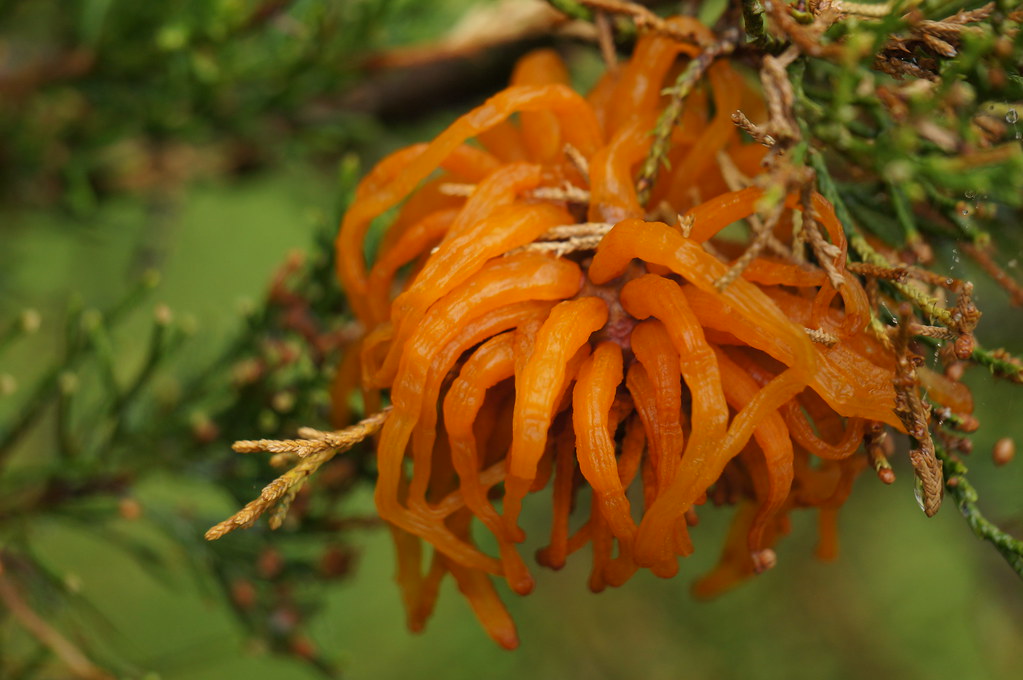
But you have to admit there is some family resemblance with these cedar-apple rust fungi (Gymnosporangium juniperivirginianae) that I found on a couple branches of my Burkii eastern red cedars (Juniperus virginiana).

If I had not removed the fungal galls, the tiny brown protrusions (called telia) that you can see in the previous photo would have absorbed water from the warm spring rains and transmogrified into these jelly-like orange horns composed of thousands of two-celled spores called teliospores. The telia go through multiple swell-shrink cycles as they absorb water and then dry out. With each cycle, apparently the horns get longer and release more fungal spores. From what I understand the fungal galls typically don't cause much damage to the junipers, but if the spores land on young apple (Malus spp.) leaves or twigs under appropriate moisture and temperature conditions, they can infect those plant tissues. From what I understand, the fungal galls typically don't cause much damage to junipers, but since I have a crabapple growing nearby, I'm trying to remove any galls that I find to reduce the infection risk on the crabapple so that the tree stays healthy and able to produce flowers for the insects and fruit for the birds. (My limited understanding of this topic comes from reading materials prepared by experts at institutions like Cornell and the Missouri Botanical Garden. Photo by Mike Lewinski)

Saturday, March 22, 2014

And They're Back!

Yellow daffodil
Daffodils have been blooming for weeks now in Middle Tennessee
The earliest blooms got felled by nights in the teens, but new flowers have taken their place

If you’re anything like me, you start looking forward to spring around, oh, January 2nd. 

But it’s a long, cold slog from the dawn of the New Year until many plants starting showing signs of life here on the zone 6-7 border in Middle Tennessee. Trees like Crape Myrtle and Vitex may be able to handle our summer heat, but they can take until mid-April to start leafing out. And perennials like Hardy Hibiscus can hide below ground until at least that time.

Since this winter was particularly harsh, I was worried that Spring would come late. But a stretch of temperatures in the 50s and 60s has breathed new life into the garden. 

(Note that the forecast over the next few days calls for a cold spell with lows in the lower-20s. I'll post updates of any damage. If I don't show damage, that means the plant seems to have emerged unscathed. No news equals good news in this case.)

Fuzzy new growth on an Arrowwood Viburnum
These plants sat in the garage all winter with barely any water.
I bought them too late last year (via mail order) and the weather turned brutal before I could get them in the ground.
Mea culpa. 
And yet, they survived. Color me impressed.
Alleghany Viburnum
New leaves on Alleghany Viburnum. Actually, the leaves have looked this way for weeks now.
It's my first spring with this plant, so I'm not sure if this is normal or when they'll unfurl.

"Vera Jameson" Sedum
"Vera Jameson" Sedum  

Salvia nemorosa (either May Night or Blue Hill, not sure which)

Redbud buds
Red buds on a redbud tree

Phlox paniculata "David"
Phlox paniculata "David", third year in the ground
I do like that P. paniculata emerges so early and the young leaves look beautiful.
They tend to look tired and tattered later in the summer in Middle TN.
I may try thinning out the stems this year to see if that helps improve air circulation and prevent mildew.

Phlox paniculata "Blue Boy"
Beautiful foliage

Mock Orange, Philadelphus x virginalis "Natchez"

Hydrangea quercifolia, Oakleaf Hydrangea "Snowflake"

Maple tree flowers
Maple tree flowers

Nigella damascena, Love in a Mist, self-sown seedling

Love in a Mist and a little Henbit
Loads of Love in a Mist (and a little Henbit, which is a weed, but a pretty one)
If you grow Love in a Mist, be aware that it can self sow enthusiastically unless seed heads are removed.
(The seed heads do stay on the plant a long time without shattering, so it should not be too hard to prevent or limit self-seeding if desired.)

Stachys byzantina, Lamb's Ear "Helene von Stein"
Note that I left last year's dead leaves to decay. 
Most sources advise raking the dead leaves away in the spring, but I wanted to see what would happen if I left them. So far, the Lamb's Ear seems to be doing just fine. I hope the old leaves will decay in warm weather and provide the plant with nutrients. It's a little unsightly at the moment, but I presume the new leaves will soon cover the old foliage.

Close up of Stachys byzantina, Lamb's Ear "Helene von Stein"
Close up on the Lamb's Ear. 
Love the fuzzy foliage.


Geranium x Cantabrigiense, Cambridge Geranium "Biokovo"

Juniperus virginiana "Grey Owl"
(I cheated here a little. There are no flowers or new leaves to show here, but this new addition to the garden performed beautifully through the cold weather and deserves a moment in the spotlight.)

Viola tricolor, Johnny Jump Up
I had lots of these last year, but this is the only flower I've seen so far this year. 
Hopefully more will soon appear.  


Gaillardia grandiflora “Arizona Apricot”
 Gaillardia grandiflora “Arizona Apricot”
Gaillardias reportedly are susceptible to root rot in heavy clay soils, so I wasn’t sure if this would come back at all, but it seems to have survived. (Plus you can see how poorly the plant was rooted last year. Now that it's taken root more firmly, hopefully it will perform even better in 2014.)

Forsythia
My neighbor's forsythia. All the forsythias in the neighborhood have burst into bloom in the past few days.

Daylily new foliage
Daylilies. 
As I've mentioned in other blog posts, I'm not a huge fan of daylilies for most of the year.
But I do love the exuberant fresh green foliage in early springtime!


Clematis "Crystal Fountain"
I'm trying to train this clematis to climb a crape myrtle, so far with limited success.

Echinacea purpurea, Eastern Purple Coneflower
I leave the seedheads standing over the winter  both to feed the birds and to help the Coneflowers multiply.
This strategy seems to be working!


Rubus calycinoides (a.k.a. Rubus pentalobus), Creeping Raspberry
I was under the impression that Creeping Raspberry was an evergreen groundcover, instead it seems to be performing like an herbaceous perennial in my zone 6/7 garden. 
This is a little disappointing. 
But I'll be patient. Perhaps the old stems will sprout new leaves later in the spring?
Anyway, it's nice to see new growth and know the plant is not dead!

Camellia buds after cold winter
Unknown camellia.
Several young camellias were severely damaged by our cold winter.
You can see that this established camellia suffered some foliage damage too. 
Still, I'm impressed it did not drop its buds. They seem poised to bloom any day now.

Sedum "Autumn Joy"
Sedum "Autumn Joy"

Alchemilla mollis, Lady's Mantle
As with the Lamb's Ears, I'm experimenting with leaving the old foliage in the hopes it will decay and fertilize the plant.

Aronia arbutifolia "Brilliantissima", Red Chokeberry

Ajuga genevensis, Geneva Ajuga

Agastache foeniculum, Anise Hyssop "Golden Jubilee"
Love the coloration on these early leaves. Later, they'll turn bright gold.

Agastache foeniculum, Anise Hyssop "Golden Jubilee" with coccoons
Close up on a bunch of tightly-packed cocoons on the old stems of the Golden Jubilee Agastache.
I've no idea what species spun these cocoons, but perhaps I'll get to see if/when they hatch! 
Anyone have any guesses?

So...how’s spring shaping up in your garden?

Monday, February 17, 2014

A Hard Winter, A Lot of Damage, A Little Hope

This has been a hard winter in Tennessee.

For the first time in years, the mercury dipped below zero degrees (-2 was the lowest I saw) and we had several nights in the zero to 5 degree range.

The lack of insulating snow cover and gusty breezes in my windswept hilltop garden compounded the impact of the cold temperatures.

The result? Zone-pushing plants took a real hit -- and even some broadleaf evergreens that should have been OK in my zone (like Sarcococca confusa) seem to have been killed or severely wounded.

After singing the praises of camellias in previous years, now I'm faced with the hard truth that they are only marginally hardy in Middle Tennessee.

A young camellia that I planted in November in a windy, relatively sunny spot seems to have suffered severe damage. 
Even this established camellia in a shadier and slightly more sheltered spot seems to have damage on about half its foliage.

And then there's Raphiolepsis umbellata, a.k.a. Indian Hawthorn. There were three of these in the back foundation bed (SW exposure) when we moved in. Native to India and Southern China, these members of the rose family are champs when it comes to tolerating heat and drought. They barely blinked and certainly did not wilt even when temperatures regularly soared past 100 degrees during the summer of 2012. Wind and humidity didn't faze them. Rabbits and deer didn't bother them. But the cold seems to have got the better of them.

Even the most cold-tolerant varieties are only rated as being hardy to 5 degrees Fahrenheit, and we've fallen below that number a couple of times this winter. I'm seeing what looks like significant foliage damage on all three Hawthorns. Of course, having never dealt with this before, I don't know whether the plants will shed their leaves in the spring and grow new ones, or whether they're not long for this world.

Indian Hawthorn in happier times (July 2013)

A toasted Indian Hawthorn in February 2014. Not looking promising...


Here are some photos of a few other plants that are not looking their best:

Ajuga reptans - Looks awful, but since it is rated as being hardy to zone 4, I presume it will bounce back


Ajuga genevensis - Much less common but a zone hardier than A. reptans, looks relatively thick, lush and unperturbed by zero degree temps.


Rubus calycinoides, Creeping Raspberry looking crispy. Hopefully this one will bounce back. It's rated to zone 6, but it's in a sunny, windy spot where it probably faced unusually high winter stress.


Stachys byzantina, Helene von Stein, Lamb's Ear - Most of this looks dead, but rated as hardy to zone 4, so I'm hoping it's just playing possum. There's a bit of fresh new growth peaking out from under the rubble of last year's leaves. The question is: Do I need to rake away the old growth this spring, or should I let it stay and decompose as mulch/fertilizer?


Veronica peduncularis, Prostrate Speedwell "Georgia Blue" - Looking fairly dreadful, but rated as hardy to zone 4 or 5, so again, I'm hoping this will bounce back as the weather warms.

What about the deciduous plants like crape myrtle, vitex, rose of sharon, fothergilla, chokeberry or redbud? Any damage they've suffered in these cold spells won't be visible for months until the plants leaf out (or not). I'll try to post an update when that happens.

It's hard not to get discouraged seeing how poorly some of the new and established plants have fared in this hard winter. But gardening teaches humility. I've gone back to the drawing board a bit this winter, scratching some ideas off the list and trying to find others that can withstand whatever heat, cold, floods or drought Tennessee's climate can throw at them!


So....where does the Hope come in?

Well, I did add two new shrubs to the garden that have impressed me so far with their toughness:

Juniperus virginiana "Grey Owl" -- rated to zone 2, this charming evergreen with a soft grey-green color has seemed fairly unperturbed, which is no real surprise as it's rated hardy to zone 2. Supposed to eventually reach 3-feet high by 6-feet wide, I'm considering getting several more as replacements for the Indian Hawthorns. As an Eastern Red Cedar, it's native to Tennessee, which is another plus in my book. 

Viburnum x rhytidophylloides --  Yes, the Latin name is daunting. And the 'common' name of Lantanaphyllum Viburnum really isn't that much friendlier. But last November, I bought and planted the pronounceable and esteemed "Allegheny" variety, which is supposedly more resistant to bacterial leaf spot than the species. (Always a good thing.) Allegheny viburnum is supposed to tolerate drought, pollution and heat. Thrown into the crucible its first winter in the ground, I can report that it has held onto at least a few of its leaves, which turned a lovely purplish color. And it's very encouraging to see the new baby leaves taking shape at a time when there are not many other signs of life in the garden.


So hope does spring eternal!

A maple branch starts to color up against a bright blue sky on a clear and seasonable February day.

Monday, July 15, 2013

Oh the Dreadful Wind and Rain!

It was a particularly wet and windy spring at the Garden of Aaron.

But wind is a familiar them in my garden.

In the winter, there's the bone-chilling wind out of the Northwest.

In the summer, we sometimes face a hot and dry wind out of the South that can stress and crisp even those plants that are supposedly heat and drought tolerant.

So my question to all you expert gardeners out there is this: In your experience, which plants are best suited for a windy garden?

I'm interested in all suggestions, including annuals and perennials, but I'm most interested in shrubs and trees, particularly those I might be able to use to construct some sort of windbreaks to protect the less wind-tolerant plants from the harsh winds of fate (and Mother Nature).

Here are some of my own observations from our exposed hilltop garden:

Natchez Crape Myrtle
"Natchez" Crape Myrtle stands strong against the winds that rip across our hilltop garden. 


1. Crape Myrtle (Lagerstroemia indica) shows up on lists of wind-tolerant plants. (Here's one list, here's another.) I agree - to a point. The branches are very good at bending rather than breaking in gale-force winds and the leaves seem tougher than say maple or redbud (see below). But the leaves do get awfully tattered - especially if the winds hit right when new foliage is emerging. I don't expect leaves to look pristine at the end of a growing season, but crape myrtle leaves can get ripped up by the wind and chewed up by insects to the point where they seem shredded fairly early in the season.

Vitex agnus-castus flowers just starting to bloom.
Vitex agnus-castus flowers just starting to bloom. Note how clean and fresh the foliage looks despite the fact that the plant is sited on a windy, hot, full sun corner next to the garage and a baking concrete driveway. Vitex seems cool as a cucumber and perfectly at home.

2. Vitex agnus-Castus (a.k.a. Chaste Tree) made it onto a list published by the Houston Chronicle of trees most likely to survive a hurricane. I'd call that wind-tolerant. (Crape Myrtle was on the list too...) I've got to say, I've got our Vitex right at the corner of our house where it can buffeted by both Northern and Southern winds. So far, it's looking good. I think there was some minimal branch breakage from winter storms, but the spring and summer winds haven't fazed it and the foliage is looking good - clean and fresh, with no signs of stress and hardly any signs of insect predation. I've read comparisons of Vitex vs. Crape Myrtles where people say that Crapes have a denser canopy and are thus better for providing privacy, but I have to say that our young Vitex actually seems far denser than our young Crape Myrtles. Maybe the Vitex canopy opens up more as the tree gets older?

Overall form of young Vitex agnus-castus tree/shrub planted last autumn. Foliage seems relatively dense at this point despite comments to the contrary on the World Wide Web.
Here's a young "Petite Snow" crape myrtle, also planted last autumn at the same time as the Vitex. I'd say the foliage on this is actually much less dense than the Vitex foliage. Also, the Vitex is covered with buds and blooms in its first full year in the garden, whereas there was nary a bud or flower in sight on this crape myrtle in mid-June.


3. Maples and Redbuds both seem stressed by our hot dry winds. In fact, I had two young maples die on me last year. For some reason, I still let myself get talked into planting two new maples in our front yard. Neither of them looks happy in the hot winds of summer. In fact, despite lots of water, some of the leaves are turning color, which I know is not a good sign. The redbuds look slightly more wind-tolerant, but their leaves hang awfully limp when it gets hot, almost like they're panting in the heat.

Cercis canadensis, Eastern Redbud, leaves look stressed

Maple leaves looking stressed. Never a good sign when your maple leaves are changing color in July.


4. Juniperus virginiana, Eastern Red Cedar also shows up on lists of plants suitable for windbreaks. http://plants.usda.gov/factsheet/pdf/fs_juvi.pdf  Our landscaper planted three of these on the hill. They're not looking all that great, but I think that's due less to the wind and more to the fact that we wanted large trees for instant landscape effect but we ended up with sort of small root balls on those trees. Not a good combo. In general, I feel I learned from this past winter that it's probably better to start with smaller trees that would probably be less-stressed by the transplant process. Anyway, I'm not in love with the Eastern Red Cedars. Probably because I find it hard to get too excited about most conifers. But I have to admit that they do seem to be fairly wind-tolerant. 

The shiny and waxy leaves of Camellia sasanqua seem wind-tolerant.

5. Camellias - I don't think most people would think of camellias as being tough plants, but apparently they are surprisingly drought-tolerant and even recommended for windbreaks. Our camellias are in somewhat sheltered settings, but I have to say that they have not seemed fazed at all by last year's heat/drought or by any of the winds that whip around the house. I'm thinking more and more about incorporating these into my windbreak and screening plans. The only problem that I can see is that they don't necessarily grow all that fast in my experience, especially when they are young. So if I plant a small tree - one that would be less likely to suffer transplant shock - it might take a long time to grow to the height and density where it would really help block the wind and provide privacy.

Aronia melanocarpa, Black Chokeberry also seems to be relatively wind-tolerant 

6. Aronias, Chokeberries - Also in a somewhat sheltered spot, but I've got to say that their (second-year) foliage looks really green and fresh this year despite the strong winds of spring and early summer. They definitely looked stressed last year (more by the heat and drought than the wind, I think), but they're looking much better now. I'd need to try them in a less-sheltered spot first, but I could see these trees doing well in a windy situation and/or even potentially being part of a mixed wind break. (Really beautiful foliage, incidentally. Sort of what I have in my mind's eye when I think about what a tree leaf should look like.)

And here are some other shrubs and trees that I'm considering adding to the garden / landscape. Any thoughts based on experiences in your own gardens and/or visits to other gardens on whether any/all of these would be wind-tolerant and/or suitable for windbreaks?

Sunflowers bloom just as cheerfully even after they've been bent sideways by 60-70 mph winds

As for smaller plants, I've found that high winds will bend sunflowers (although they'll usually keep growing), topple cosmos (although they'll often keep growing too) and break plants like Caryopteris and Coneflower. (To qualify that, most of the coneflowers survived the wind storm and look none the worse for wear, but I did lose a couple.) I lost one stem on Hibiscus moscheutos too, but the rest of the plant seems fine.

Callicarpa americana, American Beautyberry. I'd call this an open, lanky shrub (at least in its youth). The leaves will get burnt by strong, hot winds. Despite glowing reviews from some online reviewers, I can not recommend Beautyberry for your garden.

Beautyberry (Callicarpa americana) also seems much happier this year now that I've moved it away from a windy spot to a somewhat sheltered area.

Other perennials, annuals and shrubs that have stood tough and seem relatively unfazed by the winds include:

  • daylilies
  • zinnias
  • French marigold
  • love-in-a-mist
  • creeping raspberry
  • penstemon
  • Phlox paniculata
  • ironweed
  • Veronica (spicata and umbrosa)
  • liatris
  • Malva sylvestris
  • gaura
  • Russian Sage
  • Coral honeysuckle
  • Indian Hawthorn
  • Boxwood
  • Hardy Blue Plumbago
  • Hardy geraniums,
  • Helianthus microcephalus
  • Little Bluestem
  • Salvias
  • Platycodon
  • Monarda
  • Agastache
  • Ilex glabra (inkberry)
  • Azaleas
  • Fothergilla
  • Aucuba
  • Hypericum
  • Joe-Pye Weed
  • borage
  • stachys
  • ajuga
  • Hibiscus moscheutos
  • Heliopsis helianthoides


So...what are your most wind-tolerant annuals, perennials, shrubs and trees? 

And which are the ones that are pushovers (literally) when it comes to getting blown around by the winds?

My dream is to look out the window and not feel that my plants (like the maples and redbuds) are getting tortured by the winds. I'd love to find plants - especially shrubs and small trees - that are wind-tolerant. Heck, I'd like to find plants that revel in getting their leaves ruffled about by the wind. I want to find plants that look as though they're tossing their branches like a model tosses her hair back for a photo shoot or a walk down the runway. And hopefully these stalwart windbreak plants will help reduce the howling gales to manageable breezes so that I can grow more tender waifs in the sheltered microclimate they create.

Is that too much to ask? :-)

PS - The title of this post comes from a lovely but haunting folk song...