Showing posts with label deer. Show all posts

Monday, May 16, 2016

Class of 2016 -- Coreopsis lanceolata, lanceleaf coreopsis


Lanceleaf coreopsis (Coreopsis lanceolata) started to bloom on May 11th.

Why I'm growing Coreopsis lanceolata in my garden...

1) Lanceleaf coreopsis is native to Tennessee and throughout much of the Eastern U.S.

2) Missouri Botanical Garden says it can grow in full sun and tolerate deer, drought, heat and humidity. (I've got all of those in abundance!)

3) I found an 1890 (!) article in The Garden magazine saying that C. lanceolata grew "exceptionally fine" on heavy clay soil during wet summers.

4) Michigan State University says that lanceleaf coreopsis flowers are very attractive to bees and other beneficial insects.

5) The Missouri Prairie Foundation says that C. lanceolata seeds provide food for finches.


Do you grow lanceleaf coreopsis? If so, what has been your experience with this plant?

Instagram

Follow Aaron Dalton on Feedio

Friday, April 29, 2016

Tastiest Plant in the Garden?


Apparently smooth asters are irresistible to rabbits and/or deer...

It was a massacre committed in the dead of night. Symphyotrichum laeve (smooth aster) did not stand a chance. I think the culprit ate most of the evidence... 


Instagram

Monday, June 29, 2015

Luna in Bloom


Nine flowers on Hibiscus moscheutos 'Luna' (rose mallow)
Nine (I counted) flowers open at once on this Hibiscus moscheutos 'Luna' (rose mallow). That's the most flowers I've ever seen in one day on this plant!


After much anticipation, I looked out the window this morning and saw the rose mallow (Hibiscus moscheutos) covered in giant flowers!

I believe this is the 'Luna Pink Swirl' cultivar that has been named a Louisiana Super Plant. And if it can thrive in the heat and humidity and rain storms of Louisiana, that bodes well for its ability to shine in Tennessee too.

On the other hand, gardeners in more northerly climes should note that H. moscheutos may be hardy as far north as zone 4! (Most sources list zone 5a as the hardiness limit, but Chicago Botanic Garden cites zone 4, and who am I to argue with the CBG?)


Close up on Hibiscus moscheutos 'Luna' (rose mallow) flowers

I think I've had this plant for 3 or 4 years now and it seems to get a bit bigger and better each year. The first couple of years, the foliage and the buds were attacked by hibiscus sawfly, but fortunately (knock on drywall) that seems to have been less of a problem the last couple of years. 

Perhaps the garden is in balance to the point where something beneficial is keep the hibiscus sawfly in check?

Also, interestingly, whereas something (perhaps the bunny below or maybe a deer?) devoured all the foliage on the Hibiscus coccineus (scarlet rosemallow) that I tried planting this year, the rose mallow has suffered very little nibbling.

Rabbit on path in Tennessee garden
Hoppy Monday...


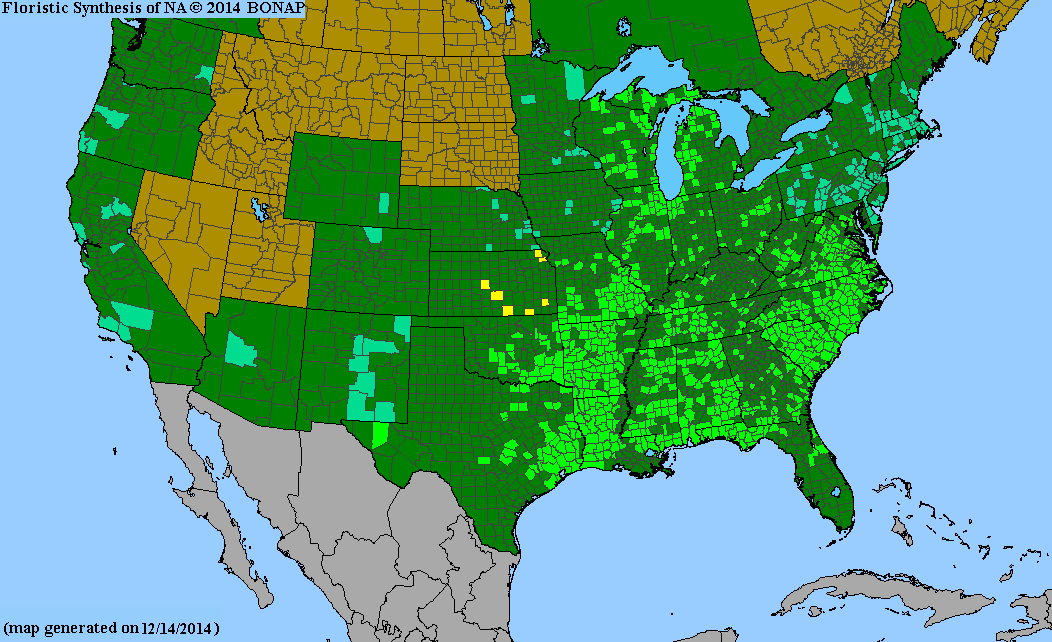
According to BONAP, Hibiscus moscheutos is native throughout the Southeast, Mid-Atlantic and much of New England and the Midwest. Despite being a native plant with large, prominent flowers, I don't see it attract many (any) pollinators. Maybe other cultivars are better at attracting beneficials? 

It is very well-behaved in the garden. It has never self-sowed in my garden and shows no inclination to spread. About the only negative thing I can say about the plant is that it is late to emerge in the spring. But have patience, and you will be rewarded with gorgeous, plate-size, dramatic flowers. 

In the garden, these flowers tend to last for just a day (or part of a day) before being replaced the next with new flowers. As a cut flower, I think it typically looks good for at least a few days in a bowl of water. (Update - I was wrong. It still only stays fresh for about a day or two at most as a cut flower.) Makes a nice centerpiece, don't you think?


Hibiscus moscheutos 'Luna' (rose mallow) flower in glass bowl


PS -  When a flower blooms in the garden, does anyone notice? You'll be among the first to know if you subscribe to Garden of Aaron via email!  

Monday, May 21, 2012

Down the Garden Path 2012 -- Nashville Garden Tour & Plant Sale

My wife and I had the pleasure of taking a Garden Tour this past weekend. The 13th Annual Down the Garden Path tour sold tickets to visit nine gardens as a fundraising effort for the Lupus Foundation of America, Mid-South Chapter.

All in all, it was a wonderful day. True, the heat and humidity were a little oppressive around noon, but a tremendous hail/lightning/thunder storm dropped the temperatures by 20 degrees in the early afternoon and made the rest of the tour much more comfortable.

Here are some of the photo highlights from our tour:

Lacecap Hydrangea (Hydrangea macrophylla normalis). I really liked the lacecap, but my wife liked the mophead ones better. Which do you like best?

Koi pond with water plants. Notice the heron statues behind the pond in the center of the photo. According to the owner of this garden, herons are territorial birds. Most of the time, if a heron flies over and looks down and sees what looks like another heron, it will bypass the garden, sparing the fish.
Close-up of the heron statues. Heron statues can ward off real live herons, which are solitary and territorial birds. The only problem is that the statues may actually attract  herons during mating season.

Lilies, after the rain

Hibiscus. Lots of people think that hibiscus is just a tropical flower, but hardy hibiscus (a.k.a. Rose of Sharon) plants are hardy perennials that can tough it out as far north as Zone 4!
Elegant fountain in shady woodland garden setting. This fountain was crushed by a falling tree that was uprooted in a storm, but the owner had the fountain rebuilt and restored to working order. I feel like fountains can have a cooling, soothing effect in any garden. 
Close-up on the big frog sitting next to the fountain.  Used with restraint, statuary can enhance a garden. Here it adds a touch of whimsy. 
We came around a bend in one garden and found ourselves facing this realistic deer statue. I loved the positioning and realism of the statue, although personally I think we have so many real, live, plant-destroying deer in Tennessee that I wouldn't erect a statue to one in my garden!
Next to this plant was a sign that read, "Ugly plant. Beautiful blooms only one night per year." This, my friends, is the Night-Blooming Cereus. Actually a type of spineless, climbing cactus, Cornell says a mature (4 or 5-year old) plant should bloom every two weeks from midsummer to autumn. The flowers are supposed to be extremely fragrant, but you had better be a night owl, because they don't reach full potency until after midnight. Not at all frost tolerant, it seems like Cereus would have to be grown in a pot in Tennessee and brought indoors over the winter. In frost-free parts of Florida, the plant can apparently climb as much as 40 feet.
Inviting bench swing with several types of clematis vines. Notice the adjacent meerkat statues.
Unknown pink flowers leaning against tall verbena. Wish that the gardener had been around to ask about the plant ID.
Rose Campion (Lychnis coronaria)
Unknown flower. Maybe a type of Monarda?
Hardy Gardenia. This plant had an incredible fragrance! We actually visited this garden twice, primarily to spend more time lingering and burying our noses in these flowers with their heavenly scent! 
Close-up on gardenia flower. Middle Tennessee is supposed to be right on the Northern edge of the hardy gardenia's range, but I may have to try growing one in a protected spot for a chance at inhaling that perfume again.