|
| 'Blue Bird' rose of Sharon (Hibiscus syriacus) |
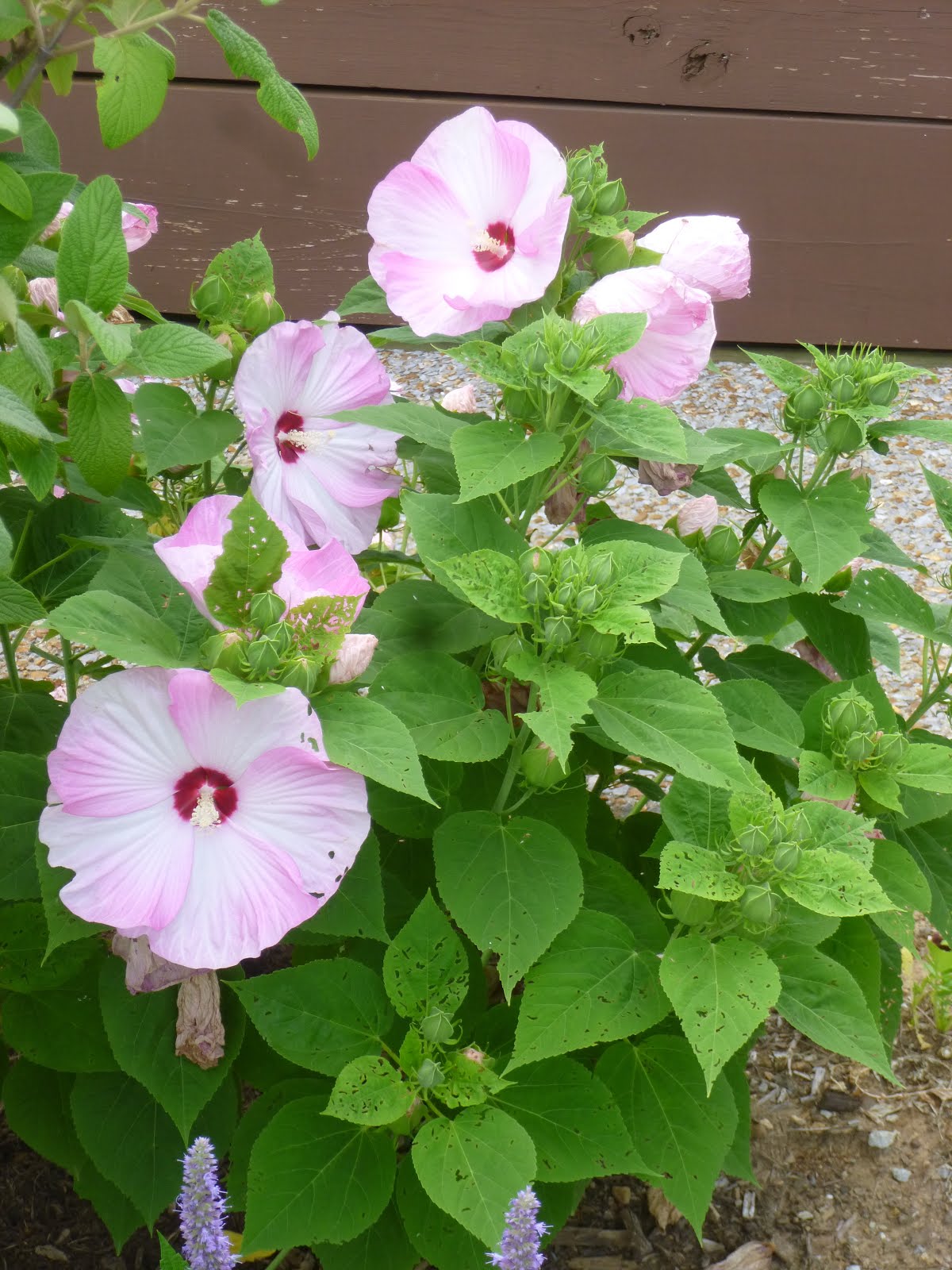 |
| Hibiscus moscheutos 'Luna Pink Swirl' |
 |
| Native rose mallow (Hibiscus moscheutos) |


|
| 'Blue Bird' rose of Sharon (Hibiscus syriacus) |
|
| Hibiscus moscheutos 'Luna Pink Swirl' |
|
| Native rose mallow (Hibiscus moscheutos) |
 |
| Lantana camara |
 |
| Gaillardia x grandiflora and bumblebee |
 |
| Gaillardia x grandiflora and a teeny-tiny bee (not its real name) |
 |
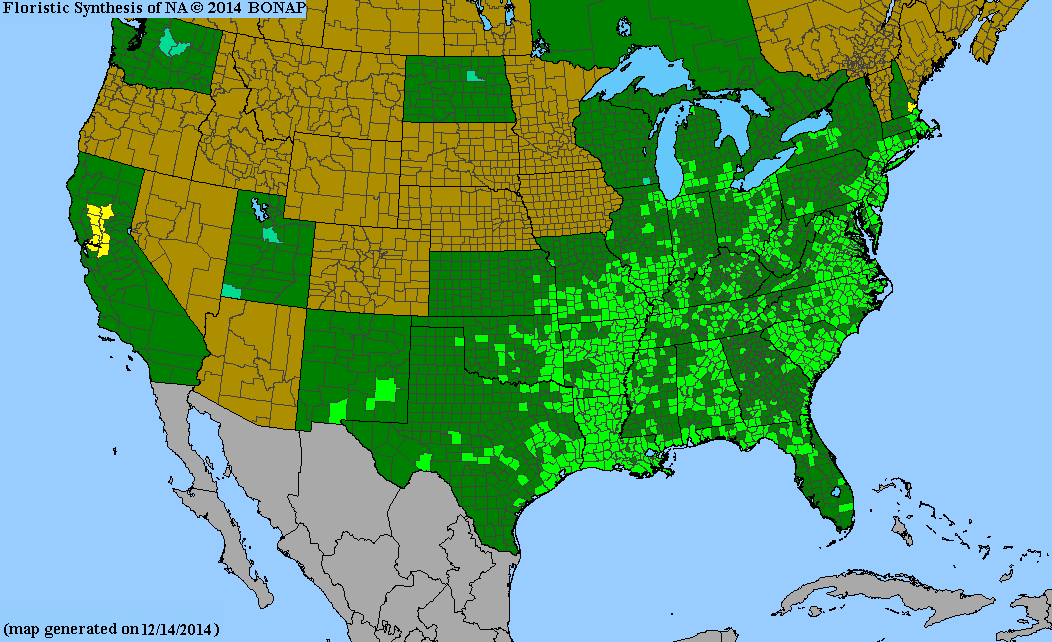
| Hibiscus moscheutos, this is the straight species version of our native hibiscus. (I also have the 'Luna Pink Swirl' hybrid or cultivar of H. moscheutos.) This is my first year growing the straight species. It's in full sun on an unamended clay hillside and seems to be thriving, despite the fact that it would probably prefer wet-to-moist conditions. |
 |
| Perovskia atriplificolia, Russian sage. I moved three Russian sages to more of a full sun location and generally they seem much happier and more floriferous in their new spot. That said, I've still seen some of the yellowing foliage and even wilting of entire branches that I've noticed when they were in partial shade. It's my opinion that they do not like our humidity (which has been especially high this summer) or the heavy clay soil. The Russian sage flowers seem highly attractive to pollinators, especially honeybees. |
 |
| Coreopsis verticillata 'Zagreb', attracts lots of little pollinators |
 |
| French marigold, Tagetes patula |
 |
| Hibiscus syriacus, rose of Sharon, 'Diana' cultivar |
 |
| Cosmos bipinnatus and bee. |
 |
| Agastache foeniculum (anise hyssop) and bee |
 |
| 'Red Rocks' penstemon and bee. I have three of these Red Rocks penstemons. I cut back two of them after the main bloom and left the third one (this one) uncut. They're all starting to rebloom a little now, which makes me think that it may not make any difference (at least in terms of stimulating more flowers) whether or not you cut them back. That said, I'll keep an eye on the plants over the next month or two to see whether there's any difference in terms of flower quantity or overall form between the penstemons that were pruned and those that were left au naturel. |
 |
| Lagerstroeima indica 'Natchez' (crape myrtle). In bloom for about two months now. The flowers attract lots of pollinators. (Not every crape myrtle seems equally attractive to pollinators. I rarely see any pollinators on my pink-flowered crape, but these white-flowered Natchez crapes are often buzzing with bees all day.) |
 |
| Cosmos bipinnatus with skipper butterfly. White-flowered 'Diana' rose of Sharon (Hibiscus syriacus) in the background. |
 |
| Glandularia canadensis (rose verbena) |
 |
| Large milkweed bug (Oncopeltus fasciatus) on rose milkweed (Asclepias incarnata) |
 |
| More Cosmos bipinnatus with bumblebee |
 |
| If you look very closely, you can see lots of pollinators crawling through the flower cluster on this Asclepias incarnata (rose milkweed). Oh and there's a large milkweed bug hanging out beneath a leaf in the lower part of the picture! |
 |
| Coreopsis lanceolata (lanceleaf coreopsis) |
 |
| Coreopsis tinctoria (plains coreopsis) with pollinator |
 |
| Heliopsis helianthoides (false sunflower) with bumblebee |
 |
| Polanisia dodecandra (redwhisker clammyweed) |
 |
| Helianthus annuus (sunflower) with bees |
 |
| Ailanthus webworm moth on Agastache foeniculum (anise hyssop) |
 |
| Aralia racemosa (American spikenard), those are the tiny greenish-white flowers -- not very showy, but they do seem to attract a lot of little pollinators. The plant itself is in morning sun and afternoon shade. It's hanging tough, but it doesn't seem all that happy. I plan to try to transplant it to a shadier spot this autumn. |
 |
| Just a pretty, colorful tableau - sweet alyssum (Lobularia maritima) in the front, 'Rozanne' cranesbill geranium behind it and a few blue balloon flowers (Platycodon grandiflorus) peeking into the upper left corner. |
 |
| The top photos show 'Luna Pink Swirl', a cultivar of our native Hibiscus moscheutos. The bottom photos are two different cultivars of rose of Sharon (Hibiscus syriacus), 'Blue Bird' on the left (looks bluer in person) and 'Diana' on the right. Both species seem to be totally hardy in my garden - H. moscheutos behaves as an herbaceous perennial, while H. syriacus grows as a deciduous shrub. |
 |
| Nine (I counted) flowers open at once on this Hibiscus moscheutos 'Luna' (rose mallow). That's the most flowers I've ever seen in one day on this plant! |

 |
| Hoppy Monday... |

 |
| A panicle of bright fuchsia crape myrtle blooms. In previous years, this crape has been stricken with powdery mildew. After pruning last year to open up the canopy, it seems to be faring better this year (so far). While the white Natchez crapes attracts loads of bees - particularly in the first few weeks of its bloom - I have not noticed any bees visiting this crape. |
 |
| Bee on Agastache foeniculum "Golden Jubilee" |
 |
| I took a step back to give you an idea of the size of this one Agastache. It's HUGE and loaded with flowers. There are perhaps a dozen seedlings scattered around from last year's seeds -- and the plant didn't have nearly as many flowers last year. I wonder how many seedlings I'll get next year?! :-o |
 |
| OK, no flowers here, but the foliage of Baptisia australis is looking lovely, cool and not-too-floppy, despite the fact that I situated it in too much shade. |
 |
| Bumblebee visiting Cosmos bipinnatus |
 |
| Dianthus gratianopolitanus "Firewitch". I did a little experiment a few weeks ago where I trimmed back the old flower stalks on one plant and left the other untouched. As you can see, both are experiencing sparse rebloom. I think the unpruned plant actually has a few more flowers, but the pruned plant looks neater. |
 |
| Bee on Gaillardia x grandiflora "Sunset Cutie" |
 |
| Cheerful bright blooms on Heliopsis helianthiodes "Summer Sun". I wouldn't say it's a wildlife magnet yet, but as the plant gets bigger and more established, it's attracting more bees and birds than last year. |
 |
| Hibiscus moscheutos / Hardy Hibiscus. I think this is "Luna". So far, not as much sawfly damage as in previous years (knock on wood products), which means more flowers are opening and the foliage looks much healthier. |
 |
| Bee on annual sunflower. I order Lemon Queen sunflower seeds this spring. I seem to have gotten an assortment on random sunflowers of all shapes and sizes. Can't say that I'm devastated (many of them are pretty and interesting in their own ways), but I'm a little peeved. |
 |
| Two small bees on a soaring annual sunflower over 6-feet tall. |
 |
| Here's another giant sunflower - maybe 7-feet tall. Even though the flower hasn't opened yet, I thought the bud was so sculptural that it deserved its own portrait. |
 |
| Here are two bees collecting pollen on a Cucumber Leaf Sunflower (Helianthus debilis Cucumerfolius). I didn't plant any of these seeds this year, which means this sunflower can self-sow in a 6b winter (low -2 Fahrenheit) without any insulating snow cover. The blooms are smaller on the Cucumber-Leaf sunflower, but the plants grow quite tall (~6 feet), start blooming a little earlier than the typical Helianthus annuus and are well-branched with lots of flowers per plant. The bees like the pollen, the gold finches visit for seeds, the squirrels seem to leave them alone. |
 |
| Here's my row of self-sown Cucumber Leaf Sunflowers. Not exactly "front of border" height, but I don't have the heart to rip them out and I love the floriferous display! |
 |
| Cherry tomatoes are ripening. These are Super Sweet 100s, purchased as seedlings. I also have lots of self-sown cherry tomatoes from previous years. I've done a pretty poor job of staking them this year, so what I really have is a jumble, but I imagine it will be a productive jumble if I can wade through the stems to pick the cherries. I also have some critter (squirrel? rabbit? chipmunk? groundhog?) that seems to be preying on the low-hanging fruit, both red and green. |
 |
| No flowers here either, but I'm still loving the Viburnum dentatum foliage. This plant has gumption. I kept it in a garage all winter with barely any water. Not surprisingly, it died to the roots, but has since roared back from the roots with 2-3 feet of new growth and it's still going. I do notice (unhappily) that there seems to be some leaf damage. Perhaps the culprits are the lacebugs that attack a nearby Aronia melanocarpa? |
 |
| Bee on Vitex agnus-astus flower spike |
 |
| Two more bees on Vitex agnus-castus (Chaste Tree) |
 |
| Can't resist another shot of bees on the Vitex. When in bloom, this plant attracts bumblebees in particular from dawn to dusk! |
 |
| A step back to give you an idea of the total number of flower panicles on the Vitex bush. This is its second full year in the garden, and after some judicious pruning, I'd say it's about twice as big this year as last year, despite our zone 6b winter (-2 Fahrenheit). It leafed out late - and even so the leaves were frozen to much by a late freeze - but as you can see, it's since recovered and thriving. I think it's added at least 2 feet of vertical growth and made lots of bees very happy! |