Tuesday, August 7, 2012

Good Read - Seeking Tougher Roses


Rose in the Brooklyn Botanical Garden, photo by David Gardiner Garcia

I came across the interesting story in the New York Times the other day about a curator (fancy title!) at the New York Botanical Garden trying to identify and promote tough roses that can grow without herbicides, pesticides and even without much fertilizer or supplemental water!

Here's a link to the story: Leading the Search for a Self-Reliant Bloom

What do you think of the article?

Personally, I don't have any roses in my garden now, but I do aspire to someday plant some and hope to install just these kind of tough-as-nails roses.

But I have noticed that some of the tough (and IMHO overplanted) roses in our neighborhood - the Knockout Roses - don't seem to attract many bees, and I would want a rose I plant to be a pollinator-magnet in addition to being tough and beautiful.

Is it asking too much to want it all? ;-)

When I do buy, I'm thinking of ordering from the High Country Roses catalog, probably one or more of the Species Roses.

ps - Today is the last day to enter the Southern Exposure Seed Exchange sweepstakes. I'll choose and contact a winner tomorrow!

Monday, August 6, 2012

Close Up #1 -- Japanese Cucumbers, Southern Delight and Progress

Here's a new type of post on GardenofAaron.com that I hope to repeat semi-regularly where I'll take an in-depth look at one particular kind of plant in the garden.

Today, let's take a close up look at the two varieties of Japanese cucumber - Southern Delight and Progress - that I'm growing in the garden. Both of these are grown from seed that I purchased online at Kitazawa Seed.


Baby cucumber. Most cucumbers have both male and female flowers. The female flowers are the ones with a baby cucumber at the base.
Both the Progress and Southern Delight varieties are supposedly bred to withstand heat and disease.

They survived the all-time Nashville record heat (109 degrees) and all the 100+ days in late June / early July. But they did grow much better when temperatures fell back into the 90s.


If the female flower is not pollinated, the baby cucumber will dry up and fall off. That was a problem I had last year for a while, which forced me to try hand pollination with a very small paintbrush with limited success. Pollination seems to be better this year, perhaps because of all the zinnias and cosmos I've planted among the vegetables to attract pollinators. Here, pollination seems to have occurred and the baby cucumber is getting darker and longer.

Last year, my cucumbers sprawled all over the ground and I think the lack of air circulation might have contributed to the plants getting either powdery or downy mildew, which basically killed the cukes. So this year, I wanted to trellis them for better air circulation, but I wasn't sure of the best way to do it, so I experimented by taking some leftover hardware cloth in the garage and bending it into a tunnel that I secured to the ground with landscape staples (pounded in with a rubber mallet) and weighted down with bricks and heavy stones.


Cucumbers starting to cover the makeshift trellis. I think we've got Progress on the left and Southern Delight on the righ in this picture.


For whatever reason, I'm totally charmed by the curliness of the cucumber tendrils

Here's a young Japanese cucumber. It seems to me that the blossoms hang on the end of these Japanese cucumbers more persistently than on the 'American' cukes I grew last year. Love the huge, healthy green leaves!


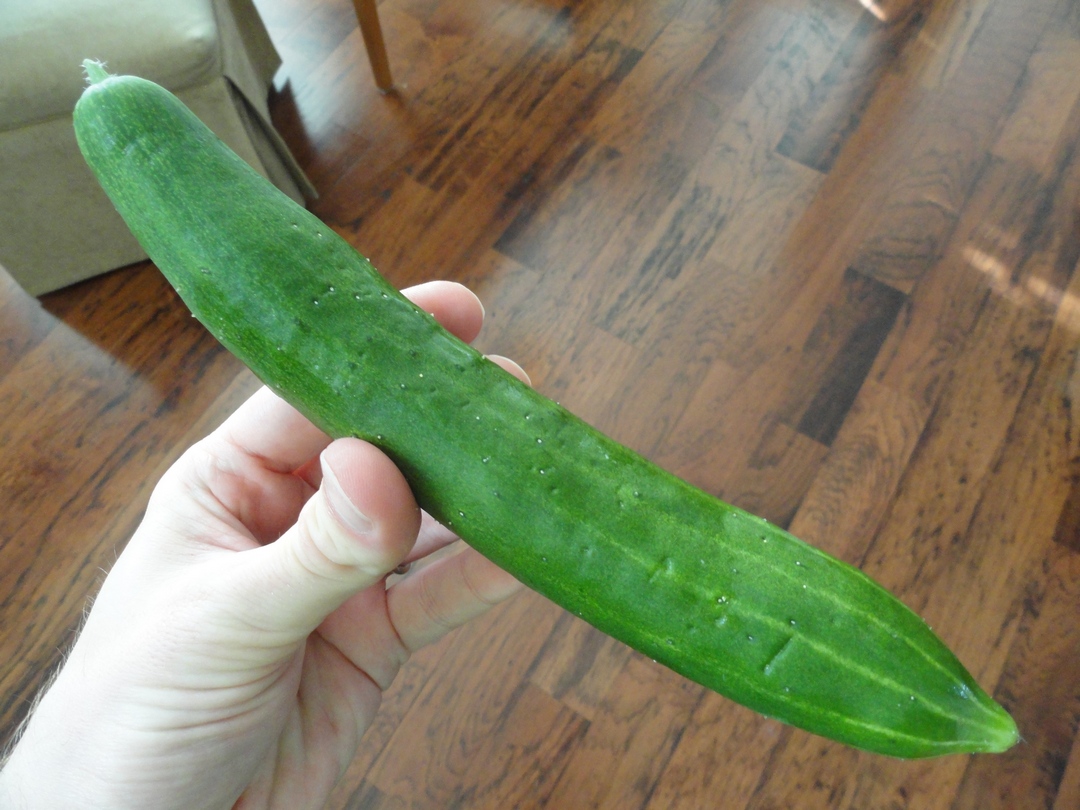
One thing that has surprised me about the Japanese cucumbers is just how thin they are! I know that the catalog describes them as approximately 1-inch diameter (versus maybe 2-3 inches on a typical 'American' cuke?) but they still seem really slender to me. Well, I guess that means I can justify eating more cukes at each meal!

Fortunately, the skin is so thin on a Japanese cucumber that there's no need to peel the cuke. At least, I don't peel them. I just wash them thoroughly and slice them up with the skin on, then eat them with a little salt. Yummy!

They grow up so fast...


Sadly, despite the trellising, the plants did end up afflicted with some disease. Some of the leaves yellowed, others got blotchy. Some of the cucumbers grew deformed. Trying to diagnose the problem on the Internet, I suspected bacterial wilt. And I found some insects clustered on the growing tips that I suspected were juvenile leaf-footed bugs. I knocked a bunch of them off into a bucket of soapy water which effectively killed them without harming the plant or any other beneficial insects nearby.

On an optimistic note, some of the plants seem to have recovered somewhat, which would suggest that maybe the problem is not bacterial wilt, since I believe that's supposed to always lead to the rapid irreversible demise of the cucumber plant...

Anyway, I'm happy that the plants are still forging onward. The other day I even harvested two cucumbers that were long and straight and healthy-looking.

Cucumbers are not problem-free plants and it seems like they do require some pampering and watering in the South, but they're still one of my favorite things to grow (and eat) so far!

Japanese cucumbers tossed with a little salt. What could be cooler and more refreshing in the summertime?


Questions:

- Have you ever grown Japanese cucumbers? If so, do you peel them or just eat them with the skin on?


- What is your favorite variety of cucumber to grow and why?

- Do you experiment with any wild cucumber recipes or do you just eat them sliced or in a salad?

There's still a little time left to enter the Southern Exposure Seed Exchange sweepstakes, which ends tomorrow (August 7th) at 11:59 p.m. Central time!

Friday, August 3, 2012

GardenofAaron.com Video - Zinnias, Garden Phlox, Sunflowers and lots of Crape Myrtles!

You know, I feel like it's only really rained a couple of times all summer here in my little patch of Middle TN.

This morning, I heard the weatherman say that we're only an inch or so below normal in Nashville. Well, that may be the official rain gauge at the airport or Downtown or wherever they measure these things, but there are an awful lot of storms that have skittered by north and south of us while missing us entirely.

It happened a few nights ago when we had loud rolls of thunder and lots of heat lightning flashes, but just a little drizzle.

And it happened today where we got a steady rain for all of 2 minutes. By the time I got outside to take a look, the rain had stopped, the sun was out and the atmosphere felt like a steam bath.

So I can't say I'm surprised that some of the zinnias are throwing in the towel, giving up the ghost, calling it quits. Same for a lot of the cosmos. They may be drought-tolerant, but they need some decent downpours every once in a while!

What amazes me more is the way that plenty of plants continue to tough out the heat and the drought in this full-sun, clay soil cauldron. And that's the topic of this short video walk around my garden a couple of days ago:


In other news, you still have a few days left to enter the GardenofAaron.com / Southern Exposure Seed Exchange Sweepstakes for a chance to win 5 seed packets of your choice from the Southern Exposure catalog!

To enter is sign up for the GardenofAaron.com email list, verify your email subscription and leave a comment on the sweepstakes post, where you'll also find the full contest rules. The contest ends at 11:59 p.m. on Tuesday August 7, 2012.

Wednesday, August 1, 2012

Expert Interview #1 and Sweepstakes #1 - Ira Wallace, Southern Exposure Seed Exchange

Growing a garden from seed can produce tasty rewards, like these juicy and sweet Sun Gold cherry tomatoes!

As one of the co-owners of the Southern Exposure Seed Exchange (SESE) co-op, Ira Wallace is extremely knowledgeable about seeds, particularly when it comes to the edible plants that predominate in the SESE catalog.

As Ira's biography details, she has had a wealth of experiences from her early days volunteering at Florida's Sarasota Succulent Society, to her learning experiences on a kibbutz in Israel, an organic farm in Denmark and a cooperative community in Canada where she became a certified plantsman.

In addition to her work at SESE, Ira serves on the board of the Organic Seed Alliance, writes for Mother Earth News and helps organize the Heritage Harvest Festival at Monticello (September 14-15 this year).

So given this busy schedule, we're thrilled that she agreed to an interview with GardenofAaron.com so that we can share Ira's expertise with you now in our first Expert Interview:

(FYI -- I asked Ira these questions a couple of weeks ago and just found time to publish the blog post now, so please take into account that her answers were provided in mid-July. Apologies for the delay in publishing them!)

GardenofAaron.com: Your website says that you carry more than 700 varieties of vegetable, flower, herb, grain and cover crop seeds. Are all these seeds organic and how do you choose which varieties to carry?

Ira Wallace: Over 400 of our varieties are USDA certified organic and many of the remaining varieties are grown sustainably by small part-time farmers and gardeners committed to seed saving and preserving heirloom varieties. We work to help more seed growers get certified organic and to help more certified organic farmers add seed production to the mix produced on their farm.
We trial all of our varieties on our farm here in Central Virginia. Many of them are family heirlooms sent to us by customers like Shronces' Deep Black peanuts or varieties developed by southern universities or extension stations like Tropic tomato from Florida or the nematode resistant Carolina Wonder pepper.

We also like to offer the fruit of successful on-farm and amateur breeding programs like the Cross Continental Breeding program that Craig LeHoullier and many others are working on. Brett Grosghal at Ev'nStar Farm has given us some great Winter Hardy Greens. Frank Morton at Wild Garden Seeds does amazing work with lettuce. Folks love his Wild Garden lettuce mix. The USDA gene bank has been really helpful for getting seed samples of older varieties no longer available commercially to try. From those and other sources we offer the best from our trials in the Southern Exposure catalog.

GardenofAaron.com:  Is it too late to plant some additional garden crops in the Southeast?

Ira Wallace: Actually, this is a great time to plant crops. You can still plant summer crops like summer squash, cucumbers and zucchini, but you would want to plant a variety that matures quickly, like Yellow Crookneck squash (55 days to maturity) or Spacemaster cucumber (60 DTM). 

GardenofAaron.com: How about planting fall crops?

Ira Wallace: It can be hard for organic gardeners to get seedlings started in the middle of summer, particularly due to pressure from insects. I like to cover the seedlings with a floating reemay cover. Of course, it doesn't look pretty, but that's why I group all my seedlings into a dedicated bed where I can keep them watered and protected with the reemay. Then when the temperatures cool down and the plants are more established, I transplant them throughout the garden.

As the weather cools, these crops grow fantastically well with little pressure from insect pests that are less active in the colder weather. I always get much larger, nicer heads of broccoli and cauliflower in the fall than I do in the spring.Other seeds to sow in a rich bed with afternoon shade from tall crops like corn or staked tomatoes and beans are cilantro, cabbage, broccoli, collards, salad greens, Chinese cabbage, Asian greens, beets and carrots. Wait until it is cooler in late August or September for arugula, kale, spinach and lettuce.

I use the seedling bed covered with floating row cover for many types of seedlings, except root crops which are better sown in place because they do not transplant well.

GardenofAaron.com: What about waiting until the weather cools - here that could mean into October - to plant fall/winter crops?
Ira Wallace: The problem with waiting that long is that the plants really won't grow much during the winter. But if you plant something like Bloomsdale Spinach, it should overwinter well in the South, especially if it is well-mulched, and then grow really well in the springtime as the weather warms up. Bloomsdale is a particularly good variety for over-wintering since it grows low to the ground, which affords it better protection from hard freezes versus the types of spinach that grow more vertically. On the other hand, autumn is the time to plant crops like garlic and onions that you would then harvest the following May or June.

GardenofAaron.com: Speaking about mulch, what sort of mulch do you like to use in your garden?

Ira Wallace: I like to use straw, particularly because it has few weed seeds. We also use hay sometimes. As for wood chips, we use those mostly on the paths between the beds.

GardenofAaron.com: And then do you turn in the straw to act as a soil ammendment?

Ira Wallace: We do! We like to add as much organic material to the soil as possible. We turn in the straw and we also grow cover crops like buckwheat that we turn into the soil. Here in Virginia, those beds where we have gardened for a number of years have been transformed from red clay soil into brown gold.

GardenofAaron.com: How about fertilizer? Do you use any type of fertilizer in particular in your gardens?

Ira Wallace: We used to use a lot of chicken manure, but then we realized that we were raising the level of phosphorus quite a bit, so we don't really use much of that anymore.

Mostly nowadays we just use amendments like earthworm castings or mushroom compost that we can get from an organic mushroom growers.

I would encourage gardeners to see if they can find interesting and unusual fertilizer sources nearby. For example, one of my gardening friends is able to get okara, which is a byproduct of tofu production. Okara is naturally high in nitrogen and can make a great soil amendment to an organic garden.

GardenofAaron.com: Are there any particularly interesting or unusual varieties of seed in your catalog that you think gardeners might find exciting?

Ira Wallace: We have these really neat seeds from a plant called an Egyptian Walking Onion. These are perennial onions that are quite hardy to zone 4. You can eat the green stalks anytime and dig the onion bulbs themselves in fall and winter, using what you want and replanting the rest. But you actually don't even have to dig the bulbs at all, because the stalks themselves produce aerial bulblets!

GardenofAaron.com: Thanks for your time and your advice, Ira! We hope you'll participate in an interview again in the future!

Sweepstakes Notice! 

Ira Wallace has generously offered to have Southern Exposure Seed Exchange be our first GardenofAaron.com sweepstakes sponsor.

One lucky winner will receive Five (5) Seed Packets of his or her choice from among those seed packets priced at $4 or less in the Southern Exposure Seed Exchange catalog. This covers most of the 'regular' size seed packets in the catalog, which is one of the most exciting and diverse mail-order catalogs that I have seen. The SESE seed catalog includes vegetables, flowers and herbs, many of them unusual heirloom varieties you may not find elsewhere.  

To be eligible to win, all you need to do is subscribe to the GardenofAaron.com email list and post a comment below saying what (if anything) you are hoping or planning to plant this autumn.

Update 8/2/2012 - When you sign up for an email subscription, FeedBurner (which manages the email list) will send you a verification request. You must verify your email and activate your subscription by 8/7/2012 at 11:59 p.m. Central time to be eligible to win the sweepstakes.

Sweepstakes Rules (with apologies for all the legalese):

- No purchase necessary to enter. A purchase or payment of any kind will not increase your chances of winning.

- Contest only open to persons 18 years of age or older who are residents of the contiguous United States
- Winner can choose any five available seed packets in the Southern Exposure Seed Exchange catalog with a listed retail price of $4 or less each. 

- Prize includes shipping and handling from Southern Exposure Seed Exchange to winner's mailing address in the contiguous United States.

- Total maximum approximate retail value of this prize is $25, although prize value may be lower depending on seed packets chosen by the winner.

- This sweepstakes began on Wednesday, August 1, 2012. The contest will run for one week. To be eligible to win, you must have signed up for the email list and posted a comment by 11:59 p.m. U.S. Central time on Tuesday, August 7, 2012.

- On Wednesday, August 8, 2012, GardenofAaron.com will choose one (1) winner from among the eligible entries by using a random number generator website. The number of eligible entries received determines the odds of winning. Winner will be notified by email (if the commentator's profile contains an email address) or via a posting on GardenofAaron.com (if the commentator's profile does not contain an email address). Winner will have 72 hours from the time of being contacted by email and/or GardenofAaron.com blog posting to respond and confirm acceptance of prize.

- To receive the prize, winner must agree to allow GardenofAaron.com to identify his/her comment as the winning comment.

- To receive the prize, winner must also acknowledge that acceptance, participation and use of the prize is solely at his/her own risk and therefore must unconditionally and forever release, discharge and agree to hold harmless GardenofAaron.com, Southern Exposure Seed Exchange and any of their officers, directors, employees, agents or contractors from any and all claims, judgments, costs, damages, losses, expenses and liabilities relating to any claim now or hereafter with respect to any death, personal injury, property damage, pecuniary loss or other loss, damage, cost or expenses suffered by winner or any third party as a result of the sweepstakes or the prize awarded.

- GardenofAaron.com will have sole judgment and discretion in selecting a winner and awarding the prize. GardenofAaron.com will not be liable for any technical malfunctions or typographical errors that result in the disruption or corruption of the sweepstakes. In the event that tampering, fraud, technical failures or other problems prevent the sweepstakes from running as planned, GardenofAaron.com reserves the right to cancel the sweepstakes or limit entries to those legitimately received before any action was taken and/or award the prize in such a manner as may be deemed fair and equitable by GardenofAaron.com in its sole discretion.

- Once winner has fulfilled all conditions and confirmed acceptance of prize, GardenofAaron.com will share the winner's contact information (name and email address) with Southern Exposure Seed Exchange so that winner can claim his/her prize of five (5) seed packets.

- In the event that winner does not fulfill all conditions or does not accept prize in writing within 72 hours of notification, winner will forfeit the prize, which will then be re-awarded using a subsequent random drawing.

- If you have any questions about these sweepstakes rules, please contact GardenofAaron.com for clarification.

- This sweepstakes is void where prohibited by law.

Thursday, July 19, 2012

Hardy Hibiscus -- One Day Only!

Hardy hibiscus close-up
Yep, it's a limited-time offer.

If you want to see hardy hibiscus flowers, you have to act fast, because they only has last for a single day.

There was a lot of anticipation for these flowers. Remember the bud photos I posted a couple of days ago? I thought the flowers were going to open the next day, but they teased me and took a couple of days to pop.

It was worth the wait.

Hardy hibiscus, extreme close-up

Wednesday, July 18, 2012

There's a Hole in my Garden!

Not a black hole.

Not even a hole dug by an animal (although there are some of those too).

Nope, I'm talking about the metaphorical hole - the blank space - that is left in a garden when annuals die or when perennials die back.

In this case, it's the annuals that have kicked the bucket.

Ah - a blank canvas! In mid-summer. How would you paint it?


So what would you do??

I see five options:

1) Plant more annuals from seed (something like sunflowers or zinnias). I already have sunflowers and zinnias in my garden, so I'd be open to other suggestions of heat-loving, fast-flowering annuals.

2) Plant some annuals from a nursery - offers instant color, but to justify the investment, I'd want something with a good chance to reseeding for next year. Maybe cornflower (Centaurea cyanus)? Does it transplant well?

3) Plant some perennials (Ajuga, for example, or Golden Star a.k.a. Chrysogonum virginianum). I had been planning to plant these in autumn, but I have the hole(s) now. Do you think they would survive a mid-summer planting? Open to other perennial suggestions, especially those that are tough, can deal with clay soil and attract bees and/or butterflies.


4) Plant a shrub (Smoke Bush, maybe, or False Indigo a.k.a. Amorpha fruticosa). Same idea here - planning to plant in autumn, is it worth stressing them by planting in midsummer heat? Open to other bush suggestions, especially those that are tough, can deal with clay soil and attract bees and/or butterflies.


5) Do nothing until autumn. September is only ~6 weeks away. Live with the hole until then and just pull the inevitable weeds that will try to colonize the bare space.

So...what would you do if this was your windy sunny clay Tennessee garden?

Saturday, July 14, 2012

Hallelujah! The Rains Have Come!

The rains have come at last. The temperatures have fallen to manageable levels. In fact, the high temperature was only 74F (23.3C) on Thursday! Incredible. Our neighborhood actually missed out on some of the rain that fell in the region - particularly to the South in Alabama - but I still think we must have ended up getting close to 2 inches of rain this past week.

The rain and cooler temperatures have had a miraculously restorative effect on the garden just when I was close to giving up hope.

Remember the twisted pineapple sage and the withered zinnia that were already looking drought-ravaged back in late June before the record heat wave?

Here's how they have bounced back with the cooler, wetter weather:

Pineapple sage, back from the dead

Zinnia, twisted no more

The rest of the garden is looking good too. Here are some of the plants that caught my eye in the front Eastern bed:

Ajuga may have been hanging tough in the heat, but it seems to be loving this wetter weather. It is even threatening to overgrow its plant tag!

The heat and the drought scorched the older leaves on this Aronia arbutifolia (red chokeberry) seedling, but the new leaves look green and healthy.

I was worried about clematis integrifolia (a bush-type clematis) after the older stems flopped over and the leaves curled up. But as you can see, fresh new foliage has emerged from the center of the clump. A hopeful sign!

Over in the vegetable garden...

I still haven't gotten any beans off these Emerite pole beans yet, but the new leaves look gorgeous and untouched (so far) by any of the pests that chewed holes in the older leaves. I haven't sprayed at all. Maybe the predator insects have the upper hand now?

I should be harvesting okra by now, not staring down at tiny seedlings, but at least a couple of these Emerald okra seedlings are looking healthy and starting to put on a little bit of growth.

This hardy hibiscus plant is squeezed into the vegetable garden alongside cucumbers and tomatoes. I think it's going to bloom in the next day or two. The beautiful blossoms only last one day. I'll try to take a photo for you when it happens.

And two final shots from the back (Western) beds:

Cosmos had been looking tired in the heat. Some of the plants had actually turned brown and died, others were just resting and biding their time. Now that the rains have come, this one is back in bloom.

This is the gaura I didn't trim. I'm glad that I procrastinated so that I could get this photo of the stems laden with water droplets just moments after a strong rain shower.

I am so happy to have rain. I hope that all the other gardeners and farmers struggling with drought this year will soon receive the blessing of sweet, cool rain dousing their troubles and washing away their worries.

Thursday, July 12, 2012

The Trouble with Annuals...

...is that they die.

Well, all plants die eventually, but annuals die so quickly!

At least some of them do.

Like these evening-scented stock:

Evening-scented stock, after the pull. Not all that pretty, but strangely sculptural. If I were a mixed-media artist, I might grow them just for the dead stems.

And when you pull the dead annuals from the garden, you leave behind unsightly bare patches. But they don't stay bare for long because weeds are happy to populate them.

So...how do you deal with this problem?

Do you swear off annuals altogether?

Or is that too extreme?

Do you wait until your first batch of annuals (the evening scented stock, the cosmos) looks tattered and worn, then pull and replace with new bedding plants purchased at a nursery?

Personally, I have to say that after (a) sowing numerous different kinds of annual seeds, (b) getting zero germination on some of those, (c) spending time on my knees thinning out seedlings from the ones that sprouted too prolifically and (d) watching some of the survivors like this stock race through a bloom period and then toward an early demise, I'm ready to cut way back on sowing annuals next year.

But I can't quit them completely. Not when I see how much the birds and the bees and the butterflies enjoy months and months of cosmos and zinnia flowers.

How about you? Where do you come down on the annual/perennial divide?

If you do sow annuals, how do you deal with the inevitable bare patches? Do you mulch when the annuals die, then clear the mulch to sow next year?

And if you do still love annuals, despite their drawbacks, which are your favorites and why?

Comments -- and links to photos of annuals in your garden, either in bloom or in senescence -- are greatly appreciated!

ps - Despite all the slings and arrows I've just fired at annuals, I went ahead and planted a crop of sunflowers anyway a month or so ago. I've got one already in bloom (a volunteer from last year) and can't wait until the new crop flowers! Here's last year's volunteer:

I know you're an annual, Senor Sunflower, but I love you anyway...

PPS - Evening-scented stock (a.k.a. Matthiola longipetala) is described by EverWilde Farms, where I bought my seed, as "beautifully fragrant in the evening." Plant them near a patio or window to enjoy the "night perfume", suggests EverWilde. Not only would I have been unable to smell the night perfume from evening-scented stock through an open window, I couldn't even detect any fragrance with my nose practically buried in a drift of flowers. Your mileage may vary, but I thought this was practically unscented. Its only saving grace? The bumble bees seemed to enjoy visiting the flowers in early evening just when they opened or those ones that were still open in the early morning hours. That's not enough for me to plant these next year when there are plenty of other bee-friendly options out there. Can anyone tell me if Malcolmia maritima (a.k.a. Virginia Stock) is any more fragrant? I've got it on my list of future plants to try but I'm wary of making the same mistake twice -- especially when there are so many new mistakes I could potentially make! ;-)

PPPS - The title of this post pays homage to the 1992 song "The Trouble With Andre" by Brit Pop due Shakespears Sister. A friend of mine put it on a mix-tape for me in high school. Yes, a mix-tape. From back when there were tape recorders, around the same time as the dinosaurs. Anyway, I never had any idea what the song was actually about, but it sure is a catchy tune.

Thursday, July 5, 2012

Triple Digit Heat Continues, but Blue Plumbago Blooms Anyway

Blue Plumbago defies the heat and starts to bloom!!
That 95% rain chance yesterday?

Good thing I didn't bet on it, because in reality the 5% likelihood of not-a-single-drop-of-rain came to pass.

So I trudged out this morning to see what had shriveled up and died overnight. And that's when I saw it.

Direct afternoon sun. Clay soil. Surrounded by wilting zinnias, fading coneflowers and limp-leaved crape myrtles --- the hardy blue plumbago (Ceratostigma plumbaginoides) had puffed out its metaphorical chest and said, "You feeling a little hot? How about I cool things down with these true-blue flower petals, y'all?"

I love it. I love that with just a bit of supplemental water and a lot of affection, hardy blue plumbago is standing strong and unfurling flower petals in the triple-digits.

And since the last post was a little doom-and-gloomy, how about a few other pics on some other plants that are toughing out the drought (so far):

Riesentraube cherry tomatoes are ripening up nicely

Spanish Musica pole beans are hanging in there, although the leaves are crinkling and beans themselves are curly. We had our first bean harvest last night, sauteed in olive oil. Could this curling be due to the heat?

Here's a little bee on a big purple coneflower...

And here's a smaller flower with a bigger bee...and a skipper butterfly. I didn't even notice the skipper until after I took this photo. He might have skipped into the picture while I was pushing the shutter button.
Who won this staring contest? The skipper! The bee flew off to a different cone flower.

Wednesday, July 4, 2012

104, 108, 106, 104, 99, 99

Those aren't lottery numbers, they're the high temperatures recorded in my neck of the woods over the past six days.

At Nashville airport, it actually hit 109 degrees (42.8 celsius) on June 29, setting an all-time high temperature record.

That's right, the highest temperature ever recorded in Nashville since modern record-keeping began back in 1871, over 140 years ago.

Oh and did I mention we have had basically no rain for over a month?

What does that do to a garden? It ain't pretty, folks. I'll spare you pics of the worst of the carnage today and just say that I'm fighting to keep most plants alive.

At the same time, I'm perversely interested to see what will survive. Especially in an age of scarce resources, I believe that coddle our gardens far too much. I think I want a garden that can prosper - or at least survive - with little intervention or assistance.

Is that too much to ask?

In any case, I have not been living up to that ideal, but I have taken feeble steps in that direction by refraining from watering every day and limiting my watering to every other day.

(The exception is the vegetable garden. It's not fair to ask vegetables that were bred to be edible, not drought-resistant, to survive on their own. It would be like throwing a toy poodle into the Amazon jungle. So the cucumbers, the beans and the stubbornly small okra seedlings get some daily water. The tomatoes though, which are well-established, only get a deep watering every other day.)

So how are some of the previous garden superstars doing in this infernal weather? Not so well...

Remember the Rozanne perennial geraniums covered in blooms back in early June? This is the same plant now:

Perennial geranium 'Rozanne', nary a bloom in sight

I had thought perennial geraniums like Rozanne were drought-tolerant, but as with my last post, I find that when I go back to look at the Bluestone Perennials plant description, I must have actually focused on heat tolerance rather than drought tolerance.

That's a big difference. Rozanne might do great in steamy tropical wet Florida -- or even in a normal Tennessee summer punctuated by regular downpours -- but it doesn't seem to have much tolerance when the rains fail.

In any case, I tried cutting back the dead growth on my three Rozannes. (I was guided in part by this article that suggests a big cutback can promote rebloom, though I'd be happy with just having them survive to bloom next year.) As a relatively novice gardener, I'm not sure if that was a good idea or not. Would more experienced gardeners like to chime in? Do you typically cut back drought-stressed perennials.

The trimmed Rozannes look better...for now. But we'll see how they fare through July and August...

Rozanne geranium after a major haircut

Since I was in a trimming mood, I also cut back two of the three gauras. Again, I was guided by an article that said: "If the plants are looking tired prune again in summer to encourage a further flush of flowers."

But what is the best way to trim a wild and sprawling gaura that has ceased flowering?

How do you tame a plant like a gaura? (Apologies to Sound of Music.)

I tried two methods of pruning with these two plants:

1) For the plant on the right, I grabbed bundles of the long floppy stems and cut them back close to where the leafy bottom part of the gaura begins, maybe 8-inches off the ground.

2) Cutting bundles of stems is hard work, so for the plant on the left, I tried to cut back even further. I mostly chopped this plant back to its woody stems. One cut to a woody stem severs all the floppy ones above it, so fewer total cuts are needed. But I'm a bit concerned that I may have cut back the plant too severely.

There were a lot of dead leaves at the base of both plants, particularly the one on the left. I'm not sure if this is typical (it's only my 2nd year growing gaura and I know they are supposed to be short-lived plants), but I suspect that it's at least partly the result of the heat and the drought.

Well, here is a photo showing one trimmed and one soon-to-be trimmed gaura:

Short-haired gaura vs. Long-haired guara :)

With the trimming done, I took a walk around and visited some other plants, like this heat-and-drought stressed lily. I can't remember the name of these lilies we planted last year, but all three of them did come back and they were looking pretty good until about two or three weeks ago when they started yellowing at the base. Not all the flowers have opened and the ones that did open weren't looking all that happy. So I cut some of the flowers and brought them inside where we could enjoy the beautiful fragrance. The ones that are inside in the a/c and sitting in a vase of water look much happier now!

Lily struggling in the heat.

A cool and comfortable lily blooming widely and fragrantly in the air-conditioned house

As we established in a post about 10 days ago, the zinnias are looking extremely drought-stricken. But I've been watering them faithfully every couple of days and most of them seem to be (barely) hanging in there. The ones that are left are visited regularly by gold finches and butterflies. Many of the butterflies are little brown skippers, but there are other beautiful visitors including this one:

Black and blue butterfly (swallowtail?) on zinnia

Same butterfly, same plant, different flower, different angle

Finally, let's take a walk around to the North side of the house. It's a bit cooler and shadier over here, which means that while several of the Natchez crape myrtles sitting in direct sun on the west side of the house have stopped flowering and are sulking with drooping leaves, the ones on the North side of the house are looking much fresher and just starting to cover themselves with flowers. It's a welcome sight from an aesthetic standpoint, and I'm guessing that the bees are happy as well.

Lavender crape myrtle blossoms

Smaller reddish-pink crape myrtle has grown a lot and has many more flowers this year compared to last year. I'm not sure if it will stay shrub-sized or grow into a small tree. This one is more susceptible to powdery mildew than either the Natchez or lavender crape myrtles, but so far it has fought off the mildew on its own to produce a multitude of flowers

Close up on reddish-pink crape myrtle flowers that harmonize nicely with the brick wall background


That's all for now. Weather.com is calling for a 95% chance of rain in the next six hours. Accuweather says 90% probability of rain. I hope they are right!

Conversation starter --- Do you pamper your garden with life-sustaining water in times of drought or do you practice tough love and create your own little Darwinian survival-of-the-toughest situation?