Showing posts with label Natchez crape myrtle. Show all posts

Tuesday, June 24, 2014

Thou Shalt Not Murder (Crape Myrtles)

The horror! Murdered crapes with gnarly knuckles
Photo via woodleywonderworks


Why is crape murder such a terrible, terrible thing?

Well, for one thing, it mutilates the trees and makes them look awful in winter. And since crapes take a long time to leaf out (at least here in Tennessee), that means they're looking like death warmed over for about six months.

The other reason is that when you have a hard winter, plants that are stressed by brutal, repeated, extreme pruning will often have a harder time surviving and recovering than plants that were pruned gently or not at all.

To wit:

Here is one of our Natchez crape myrtles. Notice how it is fully leafed out and flowering in mid-June.

Natchez Crape Myrtle leafed out and flowering in mid-June in Middle Tennessee
Bird in Natchez crape myrtle foliage
Here's a bird (not sure what kind) that was sheltering in the midst of the crape myrtle foliage on a hot day.

Bee collecting pollen from Natchez crape myrtle
The Natchez crape myrtle in full flower attracts lots of bees. (Not as many bees as the Hypericum, but lots of bees nonetheless.) I'm no expert on bee identification, but it looks as though the crape myrtle attracts bumblebees, honey bees and also some smaller native bees. The bees move so fast, that it's hard to capture them in a photograph, but if you look closely, you can see a bee in the middle-right section of the flower cluster in the center of this photo.


Now let's check out the murder scenes.

These are some other crape myrtles on our street, also in mid-June. Notice that these crapes all look pitiful.

I've seen others around town that looked equally bad or worse, but I wasn't about to cause a car accident stopping the car to grab a pic of the carnage:

Murdered crape myrtle
Murdered crape myrtle #1

Murdered crape myrtle
Murdered crape myrtle #2

Murdered crape myrtle
Murdered crape myrtle #3

Pollarded crape myrtle
Murdered crape myrtle #4. These are probably the most horrifying examples of the results of crape murder. Notice that these are older crapes that had been heavily pruned (or pollarded) for many years, resulting in the knobby scarred knuckles at the ends of the lopped trunks. In previous years, this strategy resulted in ugly-enough porcupine like growth in the spring. After this last harsh winter, the tree looks to have been killed to the ground. Sadly, it wasn't quite put out of its misery and now must endure the indignity of coming back from the roots, with the new skinny stems looking terribly incongruous among the dead stems from years past. What to do here? As with many murdered crapes, I'd say either shovel prune or cut down to the ground to start over with renewal pruning.


In a best case scenario, even when a tree is not damaged or killed through annual pollarding, such pruning will probably stimulate rampant suckering so that you end up with a crape that behaves like a wild bush:
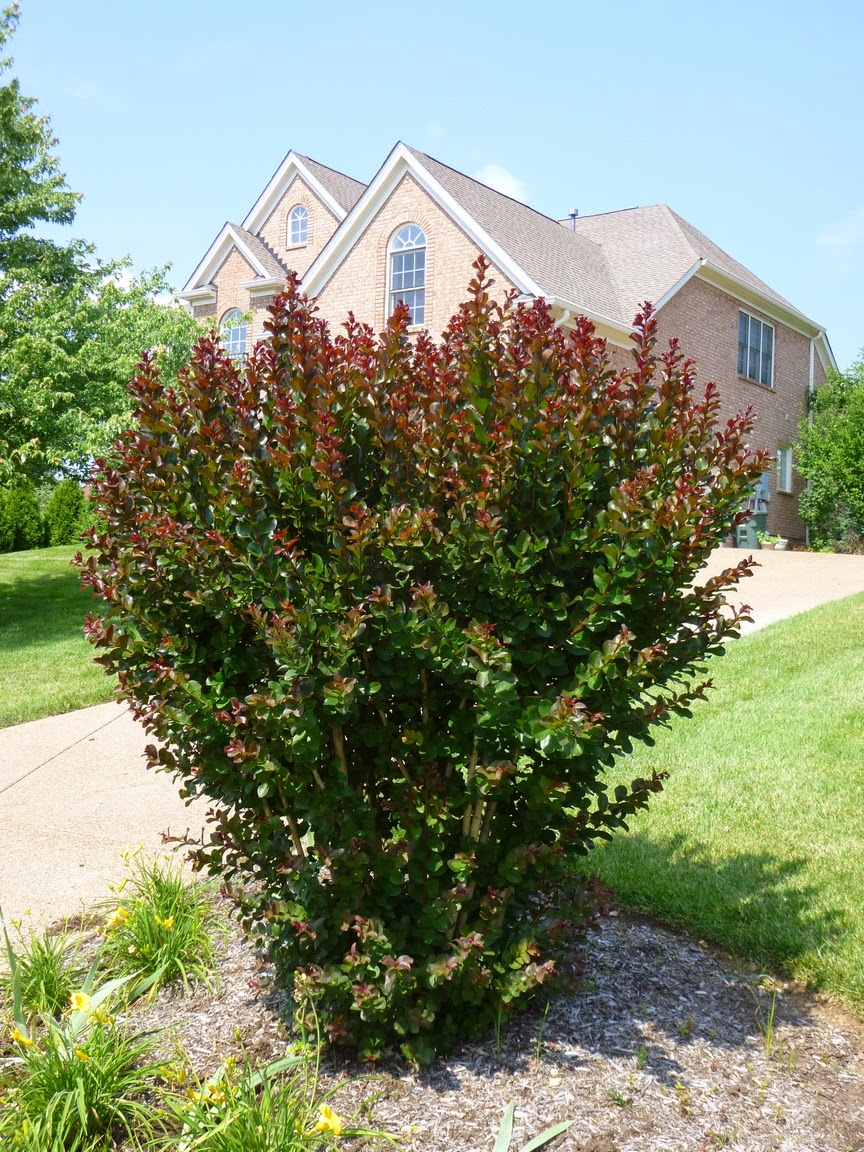
Best case crape murder scenario - pollard crape myrtle with numerous suckers behaving like a shrub

Now I'm not saying that every single crape myrtle will die in a hard winter if it's pruned back severely year after year. It might depend on how many years it's gotten the chop or on whether it's in a sheltered location or how much pampering it gets during the growing season. There are lots of variables. But chopping crapes back year after year is not only a crime against aesthetics, it's also placing the plants at a disadvantage for coping with whatever Mother Nature throws at them.

Incidentally, if you'd like a crape myrtle that stays shrub-sized, there are plenty of dwarf crapes that have been bred for compactness. You'll save the time, hassle, waste and/or cost of annual pruning and your petite crapes will look healthier and more natural year-round.

Miniature crape myrtles
This landscaping bed isn't exactly my style, but despite the excess mulch and the dearth of plants, it's still miles better than the murdered crapes. Presumably these are miniature crapes that have been chosen so that they will not require annual butchering, er, pruning.

Incidentally, even some of the "semi-dwarf" crapes could get bigger than you think. Southern Living lists Acoma as a crape that tops out around 10-feet tall, but I've seen some mature Acomas that were probably at least twice that height.

Wednesday, April 23, 2014

So What's the Damage?

Alchemilla mollis, Lady's Mantle, unhurt by a late freeze, looking bigger and better than ever this year.


The Details:

The weekend of April 12th, temperatures topped out near 80 degrees (Fahrenheit). Then a cold front came crashing through - two nights in the mid-30s and one night where temperatures dipped all the way to 28 degrees Fahrenheit in our neighborhood. (I foreshadowed this cold snap in a blog post last week.)

In true Darwinian style, I left most plants uncovered and unprotected to fend for themselves.

Remarkably and encouragingly, most pulled through without any problems. Here's a list of the ones that laughed off the cold and the few where winter got the last laugh.


Little or No Damage:

- Agastache foeniculum, Golden Jubilee
- Ajuga genevensis (leaves and flowers both unharmed)
- Alchemilla mollis
- Aronia, Chokeberry (buds, flowers and leaves all unharmed)
- Athyrium nipponicum, Japanese Painted Fern (newly planted)
- Baptisia australis (covered with an overturned pot for protection)
- Cercis canadensis, Redbud (flowers and emerging foliage both appear unharmed)
- Chrysogonum virginianum, Green and Gold

Chrysogonum virginianum, Green and Gold, undamaged by the cold, now bursting into bloom.

- Clematis "Crystal Fountain" (leaves and buds both appear unharmed)
- Cranesbill Geraniums (Biokovo, Rozanne and sanguineum)
- Dianthus gratianopolitanus "Firewitch"
- Echinacea purpurea
- Fothergilla gardenii (leaves appear unharmed, some flowers may have been damaged, others seem to be fine)
- Gaillardia x grandiflora "Arizona Apricot"
- Helianthus "Lemon Queen" perennial sunflower
- Hemerocallis, Daylilies
- Hydrangea quercifolia, Oakleaf Hydrangea

Hydrangea quercifolia, Oakleaf Hydrangea, seemed unfazed by the cold. I planted this shrub in autumn 2012 and did not see any flowers last year. Maybe this is the beginning of a flower panicle?!


- Hypericum frondosum "Sunburst"
- Juniperus virginiana, Brodie, Burkii and Grey Owl varieties
- Lavandula, Lavender, "Hidcote" (newly planted)
- Liatris spicata
- Liriope muscari (newly planted)
- Lonicera sempervirens, Coral Honeysuckle (leaves, buds and flowers)
- Malus, Crabapple, "SugarTyme" variety (leaves seem fine, flowers were pretty much finished blooming anyway, so it's hard to gauge whether they would have been damaged)
- Panicum virgatum, Switchgrass, "Northwind" (covered one clump with an overturned pot, but new growth on both protected and unprotected clumps seems equally unharmed)
- Philadelphus x virginalis, Mock Orange, "Natchez" (leaves and buds both seem unharmed)

Philadelphus x virginalis, Mock Orange, Natchez variety, leaves and buds appear totally undamaged by last week's cold snap

- Phlox paniculata
- Platycodon, Balloon Flower (covered one clump with an overturned pot, but the control clump that was not covered looks fine too)
- Polystichum acrostichoides, Christmas Fern (newly planted)
- Rhus aromatica, Fragrant Sumac, "Gro-Low" (buds seem fine, there may be a little foliar damage on some emerging leaves, but I think the majority of emerging foliage seems fine at this point)

Rhus aromatic "Gro-Low" Sumac does not seem to have been set back at all by the freeze
Rhus aromatic "Gro-Low" Sumac does not seem to have been set back at all by the freeze. Check out those beautiful lemon yellow buds and fresh multicolored foliage! I'm enraptured!!

- Stachys byzantina, Lamb's Ear, "Helene von Stein"
- Veronica umbrosa, Prostrate Speedwell, "Georgia Blue" (leaves and flowers both seem unharmed)
- Viburnum prunifolium, Blackhaw (buds and open flowers both seem unharmed)
- Viburnum x pragense, Prague (buds and open flowers both seem unharmed)

Neither the new leaves nor the flowers on the Prague Viburnums were damaged by the late freeze

- Viburnum rhytidophylloides, Alleghany variety (perhaps a little foliage damage on some plants, another seems unharmed)


Moderate damage:

- Agastache rugosa, Honey Bee Blue (perhaps 30% of foliage seems damaged/killed on newly installed plants)
- Aucuba japonica (established leaves seem fine, some of the of emerging new growth may have been damaged)
- Buxus sempervirens, Hardy Boxwood (established leaves seem fine, but new growth seems limp and damaged, I suspect I'll need to break out the pruning shears and give the Boxwoods a haircut back to healthy growth)

Wilted and whitened foliage marks frost and/or freeze damage on a Boxwood (Buxus)


- Cephalotaxus harringtonia, Japanese Plum Yew, "Prostrata" (established foliage seems fine, it looks as though the new growth may have been damaged, but I'm not familiar enough with this newly-installed plant to diagnose the degree of damage with any certainty)


Major damage:

- Ceratostigma plumbaginoides, Leadwort Blue Plumbago (newly emerging foliage seems limp, dark brown and dead)
- Hibiscus syriacus, Rose of Sharon (newly emerging foliage and young leaves on both Rose of Sharons looks limp and dead)

Newly emerging foliage got fried on this Blue Bird Rose of Sharon.  This photo was taken about a week after the cold snap.
Newly emerging foliage got fried on this Blue Bird Rose of Sharon.
This photo was taken about a week after the cold snap. 


- Lagerstroemia indica, Crape Myrtle (most newly emerging foliage looks dead and blackened, fortunately several trees had not yet started to leaf out, interestingly foliage on a few branches of one Natchez crape seems fine, even though foliage on other branches seems dead!)

Luckily not much foliage had emerged before the cold snap on the crape myrtles, which are some of the latest trees here to leaf out. The leaves on this branch that had started emerging seem to be toast. All the green leaves in the background were still dormant buds during the freeze and have just awakened and put out green foliage in the past few days.
Crape myrtle with frozen dead leaves and fresh green leaves on different branches

- Vitex agnus-castus, Chaste Tree (newly emerging foliage appears to have been totally killed)

Vitex agnus-castus foliage appears to have bitten the dust.
No sign of any new foliage yet in the week since the freeze.


So that's the story.

Overall, I was very pleased with the way most plants pulled through.

Monday, April 14, 2014

Winter Gets in One More Punch

Screenshot from NOAA

Uh oh.

Tonight's forecast low is 39 degrees Fahrenheit.

Tomorrow night we're expected to drop to 29.

Wednesday night could see a chilly 38.


It's the frosty Tuesday night forecast that's got me concerned. The warm weather over the past few days (temperatures around 80 degrees Friday, Saturday and Sunday) induced many of the plants that had stayed safely dormant through an interminable winter to unfurl new leaves and flowers.


Fothergilla in full bloom. Will these flowers withstand a brief spell at 29 degrees?

I'm worried there will be significant damage to all this tender new growth if and when temps dip below freezing tomorrow night.

Creamy nodding aquilegia flowers come have started to bloom

New leaves on the Natchez crape myrtle
New leaves on the Natchez crape myrtle, one of the last trees in our area to leaf out.

Typically, I aspire to be a Darwinian gardener, prizing plants tough enough to survive on their own. But this time, I think I might just intervene a wee bit and use overturned clay pots to cover Balloon Flower and Baptisia australis.

Fresh bright green growth on Balloon Flower (Platycodon)
Fresh bright green growth on Balloon Flower (Platycodon). I think I will try covering this plant with an overturned pot tomorrow afternoon to retain some heat overnight.


Do you have any experience with late frosts and freezes? 

If so, which of your plants have come through unscathed and which have suffered major (or minor) damage?

I took lots more photos this evening. Stay tuned for another post toward the end of this week showing which plants sailed through without a scratch and which ones took it on the chin.

Monday, August 19, 2013

Too Close for Comfort

Please step away from the wall...  Surely whoever planted this Crape Myrtle realized that it might grow more than 3-inches wide? Generally speaking, if a plant is supposed to grow say 20-feet wide, experts recommend planting it at least ~12 feet from a building, so that it can grow to its maximum width and still give you a little space to get between the building and the plant for pruning, painting, window washing, etc.

When we moved into this house a bit over 2 years ago, we noticed that a number of the foundation plants were sited too close to walls and steps.

Some of those (the Nellie Stevens hollies) we removed.

Some of them (the camellias flanking the front steps, another camellia planted alongside the front wall) have stayed. I can't bear to part with them and I'm concerned any attempt to moved them by 1-2 feet would be detrimental to their health.

But there's one plant that's planted WAY too close for comfort to a side wall - the lavender crape myrtle pictured in the photo above.

I can't be sure (since there are so many crape myrtle cultivars), but I think this could be Muskogee, one of the superior USDA introductions that is resistant to powdery mildew.

Personally, I've decided that I like the white-flowered crape myrtles (such as Natchez) best. Most of the others seem a bit too garish for my tastes. Plus the white-flowered ones seem to attract the most bees! But I do think that the light-lavender flowers of Muskogee (if that's what it is) are probably my favorite among the colored varieties.

So it's painful to think of getting rid of the tree, but we're talking about a plant that will wants to grow 25-feet tall and 20-feet wide being planted 3-inches from the wall!!


Really? Who thought it was OK to plant a full-size crape myrtle this close to a house??

(What on Earth were the builders thinking when they plopped the plant alongside the foundation originally? Did they get it mixed up with a dwarf crape -- although even that should have been planted at least a couple of feet from the wall. Or were they just being cruel and sadistic?)

This is a beautiful plant, but it's just in the wrong place. Even if it were a couple-feet away from the wall, that still wouldn't make any sense with this type of crape myrtle.

The lavender crape myrtle (Muskogee?) blooms are really beautiful. It's just a shame that the tree was planted so close to the house...

So unfortunately I think I have to commit real crape murder (not the crape murder that involves drastic annual pruning techniques).

My plan is to cut the plant down to the ground using loppers and a chainsaw.

From what I understand, crape myrtles don't die easy. Most likely, the plant will send up a thicket of suckers in an effort to survive.

Now many websites suggest drilling a hole into the trunk and pouring in concentrated herbicide, but I am reluctant to use such chemicals.

I thought I could try to dig out as many of the roots as possible and then regularly cut off any suckers that sprout. I imagine it might take a few years, but that the tree would eventually weaken and die.

What do you think? Is this a foolhardy idea? Should I bite the bullet and ask a trained landscaper to come over and remove the tree and/or inject poison into the stump?

Also...Should I be worried about a large Natchez crape (15-20 feet tall already) that is planted perhaps 4-feet away from another wall of the house -- again, that seems way too close to me.

Thoughts and advice are welcome!!

PS - I probably will also be removing 2 of the 3 crape myrtles that I planted just last year. One of those, Petite Snow, has not put on any new growth at all, nor has it bloomed this year. And the leaves do not even resemble the Petite Snow photos I've seen online, which makes me think that it might have been mislabeled.

The other crape that I'll be removing is called Geronino, from Flowerwood Nursery. There are two things that really tick me off about this plant:

New Geronimo crape myrtle leaves afflicted by powdery mildew are twisted and disfigured
New Geronimo crape myrtle leaves afflicted by powdery mildew are twisted and disfigured. Not what you want to see at the front foundation of your home .

1) I still have the tag that came with the plant where the size is given as 10-feet tall by 6-8 feet wide. Maybe that's a little big, but not too crazy for a corner foundation planting. But on Flowerwood's own website, Geronimo is now listed as growing 15-20 feet tall by 12-15 feet wide. So...basically I'm looking at another monster crape planted right against the foundation. No thanks. I'll dig it out this autumn while it should still (theoretically) be easy to do so.

Geronimo crape myrtle flower buds afflicted with powdery mildew
Geronimo crape myrtle flower buds afflicted with powdery mildew. Based on my experience with mildew on a different crape, these buds will not open.

2) If that was the only issue, I'd consider replanting the crape somewhere else on my property, but Geronimo also has major issues with powdery mildew, as you can see in the two photos above.

The thing that bugs me is that Flowerwood chose a Native American-sounding name for this crape myrtle. And it just so happens that many of the highest-rated mildew-resistant crape myrtle cultivars from the US National Arboretum (USNA) are known for having Native American names.

Texas A&M even says: "As a general rule, cultivars with name of a Native American tribe will be resistant to powdery mildew." Guess they'll have to revise that general rule now thanks to Geronimo. Caveat emptor!

Monday, August 5, 2013

All Summer Long -- The Flower Parade Continues into August


Zinnia elegans, just one of a wide variety of self-sown volunteer zinnias in my garden in a dazzling variety of colors and shapes. Gardening books suggest deadheading zinnias for more blooms, but I rarely deadhead mine (since the goldfinches like to eat the seeds) and I still tend to get blooms for months! Zinnias are heat-tolerant and somewhat drought-tolerant, in my experience.


The foliage on one of the aquilegia plants was looking very tired, so I cut it all the way back down to the ground. From my experience in prior years, fresh new foliage -- seen here -- will soon emerge and make the plant look good as new. 

One of the two Black Chokeberries (Aronia melanocarpa) that I planted in spring 2012. This one is doing great, has probably tripled in size so far this year and is still pushing new growth. It gets morning sun and afternoon shade.

This is the other Aronia melanocarpa, also doing pretty well. It's bushier with more suckers pushing up, but it has not grown as tall. And if you look closely, you'll notice light dots on many of the upper leaves. I believe those are injuries caused by lace bugs. I typically don't spray any of my plants and this is no exception (although I did wash off the undersides of some of the worst affected leaves with a garden hose). I want to see if the Aronia can fight off the lace bugs -- hopefully with the assistance of some beneficial insects drawn in by the pests themselves and flowers like Sweet Alyssum that I've planted nearby. From what I've read, lace bugs don't usually cause the plant any severe damage, so I'm hopefully the Aronia will survive this indignity and emerge even stronger next year. 

Yes, like every other homeowner south of the Mason-Dixon, I have several crape myrtles. My favorites are the ones with white flowers like Natchez. I tend to find most of the other colors a bit too jarring and garish in the landscape. Plus in my experience, the white-flowered ones seem to attract the most bees! Anyway, like several of the other crape cultivars, Natchez has gorgeous exfoliating bark. I love both the older grey bark that's sloughing off and the ultra-smooth glowing new brown bark underneath.
 
Close up on Natchez Crape Myrtle blossoms

Cucumber-leaf sunflower (grown from seed), blooming its heart out for weeks and weeks!

OK, it can't all be pretty. This is/was a Salvia nemorosa (either May Night or Blue Hill...I planted them next to each other and never could remember which was which). Both plants bloomed too early to attract many bees. I trimmed them back as suggested to stimulate a rebloom. Instead, I seem to have stimulated their early demise.

And...here's the other Salvia nemorosa. It's not totally dead yet. Just mostly dead.

Sunflower, taller than me (ergo taller than 6-feet)

Gaillardia pulchella "Arizona Apricot", attracts small bees, keeps blooming for months even without deadheading, even the spent flowerheads are attractive fuzzy balls. Technically perennial to zone 3, but it is not supposed to do well on heavy soils (like our clay), so I'm not counting on it to come back next year. But it is supposed to self sow, so hopefully I'll have some gaillardia regardless. And just in case, I'll probably try growing some from seed too. (This one was grown from a transplanted seedling purchased I believe at the Perennial Plant Society of Middle Tennessee plant sale.)

Not too many flowers here, but the foliage of this perennial geranium (x cantabrigiense "Biokovo") is looking great with barely any supplemental water all year in its first year in the ground.
 
Rozanne perennial geraniums are having their Best Year Ever. There are three Rozanne plants all mixed and rambling together. They too flower for weeks and weeks, especially when given afternoon shade. You can see that the plant is even pumping out fresh new (lighter green) foliage in August!

Yet another perennial geranium - Geranium sanguineum "New Hampshire". This one is throwing off a few flowers and lots of fresh green foliage. Beautiful!
Love the sky blue flowers on the Hardy Blue Plumbago (HBP). But why is it turning red so early in the year? That can't be a good sign... This one is in the sun and it's looking reddest (also doesn't seem to have grown at all from last year), but one of the two HBPs in partial shade is also reddening a bit. Hmmmm.... Has anyone else experienced this?

Lovely lemony flowers on the perennial sunflower Helianthus microcephalus (Small-headed Sunflower), "Lemon Queen" variety purchased just this spring at Gardens in the Wood of Grassy Creek. As with many of my other Gardens in the Wood purchases, this one has done great. This healthy, bushy plant is probably between 4-5 feet tall now. There are about a dozen flowers already open and many more buds. I'm guessing that within a week or two, this plant be covered with dozens of flowers. The bees and other beneficial insects are already happily visiting the flowers. I imagine the whole plant will be buzzing with activity very soon!


Don't be too grossed out, but what you're looking at here is a stem of the Lemon Queen perennial sunflower pictured above. You're probably wondering what the heck is that white foam at the stem junction? I was wondering too, so I looked it up and near as I can tell, it's probably the excretions of an insect called (for obvious reason) the Spittlebug or Froghopper. The insect sucks some sap from the plant and uses some of that sap to produce the foam to camouflage itself and protect it from predators. What do you think? Gross? Amazing? Clever? All of the above? Anyway, apparently spittlebugs usually don't hurt the plants on which they feed, so I've opted to pursue my usual policy of benign neglect, although I did use a hose to wash off some of the spittle one time to give predatory insects or birds a chance to do their thing.


Another sunflower? Not quite. This is a False Sunflower, Heliopsis helianthoides "Summer Sun" variety. Like many of the other flowers featured here, Heliopsis has been blooming for many weeks. Amazingly, the one slightly faded flower in the bottom left of the photo was the very first flower that opened and it's still looking pretty good! I haven't seen the Heliopsis attract as many bees or butterflies as the true sunflowers, but perhaps it's just getting overlooked right now? Although gardening guides say the plant can get up to 5-feet tall, it's probably only around 12-inches at the moment. It is a native perennial (hardy to zone 3), so perhaps it will get bigger next year? I think some Garden of Aaron readers have commented that Heliopsis self sows readily, so perhaps the bees will take more notice next year if I have a whole patch of Heliopsis plants for them to visit...

This is New York Ironweed (Vernonia noveboracensis). The foliage looks nice and I love the purple color of the flowers, but I have to admit I've been a little disappointed so far. The flowers are small, they don't seem to last that long, the spent flowers are not particularly attractive and worst of all, I don't think I've seen any bees or butterflies visiting the Ironweed yet. I've no intention of pulling the plant, but I am a little bummed that it has not attracted more pollinators yet. Again, as with the Heliopsis, maybe the problem is that I only planted a single Ironweed?

Similar issue here with the dwarf Joe-Pye Weed (Eupatorium dubium "Baby Joe"). I recently saw my first small bee on this plant, but I have not seen a single butterfly visit it yet, despite the fact that it is advertised as a butterfly magnet. I do have to admit that both the foliage and the pink flowerheads are very pretty though.

Another sunflower (Helianthus annus) bloom. I've got a lot of them in a variety of sizes and shapes. That's what happens when you plant a variety pack of sunflower seeds!
The older foliage on the Vitex agnus-castus is still looking great, but I'm excited to see the plant is having a flush of beautiful light green foliage. For some reason, I find these new leaves incredibly cute. I'm hoping the new leaves means that a second flush of flowers might be on the way. The bees - especially the bumble bees - went nuts over the earlier Vitex blooms, so I'm sure they'd appreciate a second round! 


Speaking of those earlier Vitex blooms, you can see the spent flowerheads here with their seeds forming. And camouflaged among the seeds is quite an interesting insect. Does anyone know what this? I imagine that it's predatory and is hiding among the seedheads waiting for an unsuspecting prey insect to alight?

Here's a mixed patch of Cosmos and Zinnias. As you can see, I love the casual and informal look of different colors all mixing cheerfully together.  

Let's finish up with the irrepressible purple coneflowers. Some of the petals are looking tattered, but these plants have been blooming for months, giving joy to countless bumblebees like the one on the right side of this photo. If you want to find a bumblee in my garden on a hot summer day, the best place to look would be on a sunflower or a coneflower.

I hope you enjoyed this little tour. I'll try to do another photo safari through the garden toward the end of September. Will the garden still be filled with flowers in another 6-8 weeks? Or will pathogens and pests get the upper hand? (Right after I took some of these photos, I noticed that powdery mildew is starting to run rampant through the zinnias.) 

Tune in next time - Same Bat Time, Same Bat Channel :)