Showing posts with label pruning. Show all posts

Wednesday, March 23, 2016

Poor Little Lamb


This little lamb has lost its way...


Garden blogs are filled with beautiful photos, but it's not all sunshine and roses out there.

Here's a pic of lamb's ear (Stachys byzantina) looking terribly bedraggled by the end of winter. I wish I knew the best way to prune out the dead, disfigured foliage, which is intermixed with fresh, healthy leaves.

Should I just raze the whole thing to the ground? The foliage is so thick and deceptively tough that it's not easy to prune, even with a hedge clipper.

If I leave it alone, I know that eventually the new growth will camouflage the mess beneath, but then I worry that the mass of dead foliage will impede air circulation and water penetration.


UPDATE - I ended up removing lamb's ear from the garden. It looked beautiful from spring to autumn, but just awful in the winter. The dead foliage was persistent, so that after a while, even the fresh new foliage was growing on a mound of dead and decaying gunk underneath. In addition to the cultivar, I got the straight species, which spread much faster and had lovely flowers with a long bloom season that attracted lots of bumble bees. Unfortunately, the flowers led to a plethora of seedlings in the immediate vicinity of the mother plant. If the old foliage decayed completely over the winter and/or if the plant didn't spread so quickly, I might have kept it. It's rock solid in the heat and didn't seem to have too many problems with our humidity. But I just couldn't deal with the old foliage and its spreading ways. Plus it's a non-native. Plus I didn't like the scent of the crushed foliage when I did try to clean it up at the end of the winter. Yuck. So... I had to give it the heave-ho.
There are other evergreen or semi-evergreen perennials that don't look their best in Middle Tennessee by the end of winter. Ajuga reptans (bugleweed) comes to mind. But the damaged, dead and dying foliage of the low-growing bugleweed seems to disintegrate to the point where the build-up of rotting foliage doesn't cause the same aesthetic issues as with lamb's ear.
Meanwhile, Ajuga genevensis (Geneva bugleweed) may even put start putting out a few cheerful blue flowers at the beginning of March. A hint of things to come...


Instagram

Friday, March 18, 2016

I Knew Which Way the Wind was Blowing...


Switchgrass (Panicum virgatum 'Heavy Metal') stands strong all winter long. I love the sound it makes when the wind rustles through the leaves. Switchgrass is a warm-season grass, which means most years I don't think it really gets started in Middle Tennessee until April. 

Typically, I'd probably wait until late March to cut back the switchgrass. Since March has been an unusually warm this year, I cut back the switchgrass about a week ago. 

Now I can't tell which way the wind is blowing anymore just by looking out the window to see how the grass is leaning. 

Instagram

Tuesday, June 24, 2014

Thou Shalt Not Murder (Crape Myrtles)

The horror! Murdered crapes with gnarly knuckles
Photo via woodleywonderworks


Why is crape murder such a terrible, terrible thing?

Well, for one thing, it mutilates the trees and makes them look awful in winter. And since crapes take a long time to leaf out (at least here in Tennessee), that means they're looking like death warmed over for about six months.

The other reason is that when you have a hard winter, plants that are stressed by brutal, repeated, extreme pruning will often have a harder time surviving and recovering than plants that were pruned gently or not at all.

To wit:

Here is one of our Natchez crape myrtles. Notice how it is fully leafed out and flowering in mid-June.

Natchez Crape Myrtle leafed out and flowering in mid-June in Middle Tennessee
Bird in Natchez crape myrtle foliage
Here's a bird (not sure what kind) that was sheltering in the midst of the crape myrtle foliage on a hot day.

Bee collecting pollen from Natchez crape myrtle
The Natchez crape myrtle in full flower attracts lots of bees. (Not as many bees as the Hypericum, but lots of bees nonetheless.) I'm no expert on bee identification, but it looks as though the crape myrtle attracts bumblebees, honey bees and also some smaller native bees. The bees move so fast, that it's hard to capture them in a photograph, but if you look closely, you can see a bee in the middle-right section of the flower cluster in the center of this photo.


Now let's check out the murder scenes.

These are some other crape myrtles on our street, also in mid-June. Notice that these crapes all look pitiful.

I've seen others around town that looked equally bad or worse, but I wasn't about to cause a car accident stopping the car to grab a pic of the carnage:

Murdered crape myrtle
Murdered crape myrtle #1

Murdered crape myrtle
Murdered crape myrtle #2

Murdered crape myrtle
Murdered crape myrtle #3

Pollarded crape myrtle
Murdered crape myrtle #4. These are probably the most horrifying examples of the results of crape murder. Notice that these are older crapes that had been heavily pruned (or pollarded) for many years, resulting in the knobby scarred knuckles at the ends of the lopped trunks. In previous years, this strategy resulted in ugly-enough porcupine like growth in the spring. After this last harsh winter, the tree looks to have been killed to the ground. Sadly, it wasn't quite put out of its misery and now must endure the indignity of coming back from the roots, with the new skinny stems looking terribly incongruous among the dead stems from years past. What to do here? As with many murdered crapes, I'd say either shovel prune or cut down to the ground to start over with renewal pruning.


In a best case scenario, even when a tree is not damaged or killed through annual pollarding, such pruning will probably stimulate rampant suckering so that you end up with a crape that behaves like a wild bush:

Best case crape murder scenario - pollard crape myrtle with numerous suckers behaving like a shrub

Now I'm not saying that every single crape myrtle will die in a hard winter if it's pruned back severely year after year. It might depend on how many years it's gotten the chop or on whether it's in a sheltered location or how much pampering it gets during the growing season. There are lots of variables. But chopping crapes back year after year is not only a crime against aesthetics, it's also placing the plants at a disadvantage for coping with whatever Mother Nature throws at them.

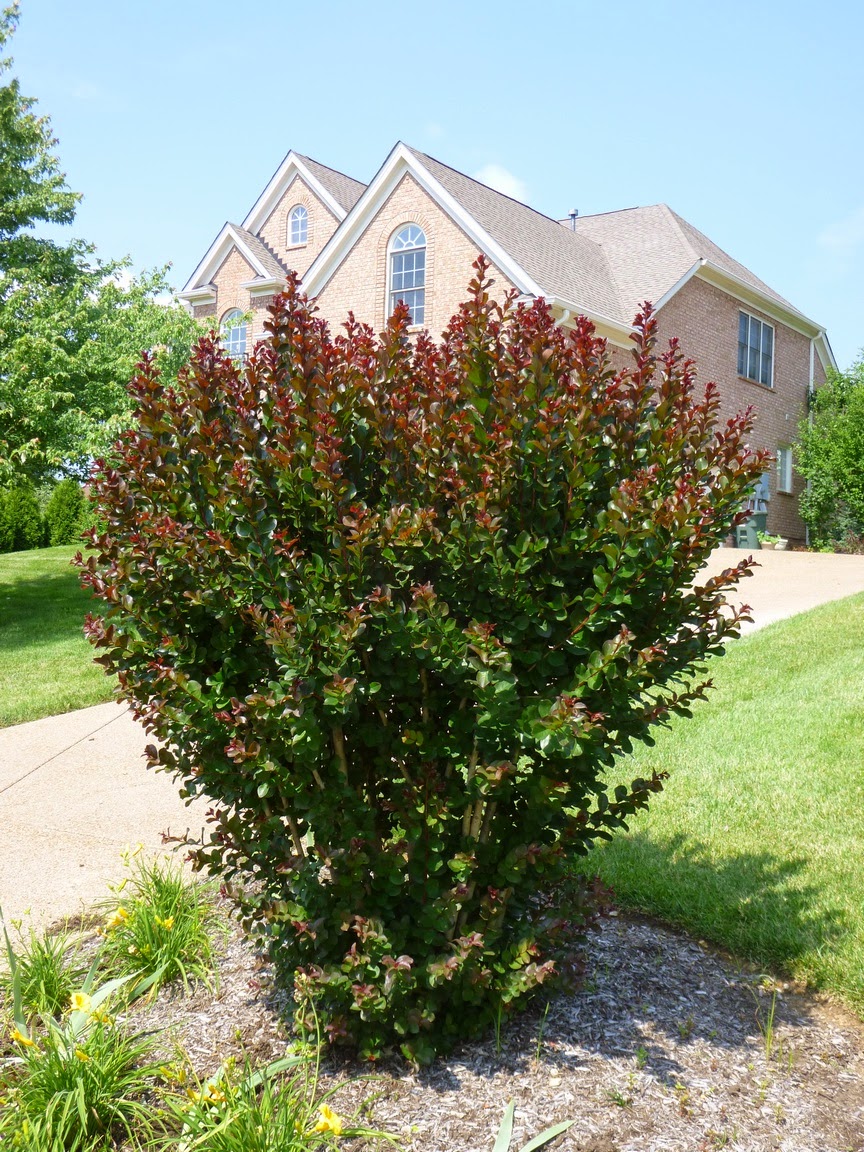
Incidentally, if you'd like a crape myrtle that stays shrub-sized, there are plenty of dwarf crapes that have been bred for compactness. You'll save the time, hassle, waste and/or cost of annual pruning and your petite crapes will look healthier and more natural year-round.

Miniature crape myrtles
This landscaping bed isn't exactly my style, but despite the excess mulch and the dearth of plants, it's still miles better than the murdered crapes. Presumably these are miniature crapes that have been chosen so that they will not require annual butchering, er, pruning.

Incidentally, even some of the "semi-dwarf" crapes could get bigger than you think. Southern Living lists Acoma as a crape that tops out around 10-feet tall, but I've seen some mature Acomas that were probably at least twice that height.

Thursday, February 20, 2014

Help Wanted: How and When to Cut Back?


My Dad likes to say, "Dates on the calendar are closer than they appear."

Spring will be here before you know it. This past week, we finally got our first real stretch of above average temperatures with highs in the 60s. I know it won't be long before lots of plants start putting on new growth.

Before that happens, I'm aware that I probably should do some trimming. But I confess that I'm not confident I know exactly how or when to trim. Thus I humbly solicit the expertise of other more experienced gardeners on the following plants. Your advice is greatly appreciated!

Muhlenbergia capillaris, Pink Muhly Grass, Sweetgrass - Some online sources suggest cutting Pink Mulhy grass to 6-inches tall in the early spring. Other sources say that Pink Muhly should never be cut shorter than 12-inches tall, or should be cut back by one-third or even left untrimmed with the old foliage just raked out if desired. You can see why I could use some guidance here from gardeners who have grown this plant.

Schizachyrium scoparium, Little Bluestem, "The Blues" - I was dubious when a landscaper suggested these plants, but I'm oh-so-glad I agreed. This tiny little 'meadow' of waving grasses has been one of the happiest sites in my garden year-round since it was installed. Color me impressed with these golden blues. My landscaper may cut the Little Bluestem for me, but I'd still like to know what y'all think. I think I've heard that Little Bluestem should be cut to around 8-inches tall in late winter or early spring. Does that sound right to you? Or should I just rake/pull out any loose leaves?

Epimedium x perralchicum "Frohnleiten" -- An evergreen perennial with groundcover habit, I've read in the AHS Encyclopedia of Garden Plants that it's often a good idea to clip back old epimedium foliage in late winter or early spring to stimulate flowering and the growth of new foliage. Does this align with your experience? And how do epimediums typically deal with transplantation of I wanted to try moving it someplace a little shadier? (It gets lots of shade in the winter where it is now, but it has to cope with the strong afternoon sun in summertime.)

Dryopteris x australis, Dixie Wood Fern - This is a native Southeast fern that did great last year. As you can see, in winter the stems all collapsed, but the fronds stayed green. I don't have much experience with ferns, but I guess I'm just wondering whether I should cut the fronds at the base where they've already fallen to make way for new fronds in the springtime, or whether I should just let them naturally decompose as they seemed to do regularly during the warmer months last year. (I'm predisposed to just let them be.) But if I were to trim away the old fronds, should I do so now or wait until a bit later in the spring? (I'm not sure when the new fronds typically emerge...)

Finally, there's the question of Aucuba japonica or Gold Dust Plant. I'm probably zone-pushing a little with this plant, but MSU does call it hardy to -5 Fahrenheit. In a sheltered spot, it seems to have come through the harsh winter of 2013-14 (official low temperature of -2) without too much damage. Some leaves have blackened, however. Should I trim those off or will they just fall away naturally and decompose?


I'm most worried about the top part of the plant. Aucuba leaves tend to droop in cold weather and then perk up again when temperatures warm. But the leaves at the top of this Aucuba are staying droopy. And I don't see any new leaves emerging here as they are elsewhere on the plant. Should I trim off this top section or will that permanently stunt the Aucuba's growth?

Just another pic to show the new leaves emerging elsewhere on the Aucuba that I don't see at the top of the plant. From what I understand, Aucubas typically respond well to pruning. Pennsylvania garden writer George Weigel says that the tips of cold-damaged stems can be snipped off in late March just before new growth begins. Does that jibe with your experience?


Thanks for any advice or suggestions you may have. It's always nice when we gardeners can benefit from one another's experiences!

Friday, March 15, 2013

To Prune or Not To Prune ... Sweet Woodruff

Sweet Woodruff in March 2013 - battered but unbowed
UPDATE - As time goes by and I see how a plant performs in the garden from year to year, my views may change and I'll update old posts accordingly. That's what happened with sweet woodruff. I started experiencing dieback on patches of this plant in both winter and summer. I suspect it's a bit difficult to grow in the hot and humid Southeast and especially the Deep South. At the same time, when I started to try to dig up patches, I found a disturbingly elaborate web of roots that seemed to occupy the entire top layer of soil. I could literally lift the plant and the soil would come with it like a piece of carpet. So I ended up evicting sweet woodruff entirely from my garden. Fortunately, unlike Ajuga or Geranium sanguineum at least it had the decency to leave politely and not try to make too many repeated comebacks. I've since shifted my gardening more toward natives, especially vis-a-vis spreading groundcovers. If you do grow this plant in the U.S., please check to make sure it's not invasive in your region, as might be the case particularly in the Pacific Northwest, Upper Midwest and parts of New York State.

So far, I'm still loving Sweet Woodruff (a.k.a. Galium odoratum). Not loving it anymore. Shovel-pruned it.

I first planted some last spring, it survived our scorching summer last year, so I split off some last fall, and both the division and a new plant that I purchased from a nursery last autumn have done well and seem to be growing and expanding.

(That's opposed to other 'groundcovers' I've purchased that have either (a) died or (b) covered very little ground so far.)

So that's why I sang Sweet Woodruff's praises a couple of months ago. At the time, the plants were welcome shades of green in an otherwise relatively brown and bare landscape.

Well, I'm still enamored with the plants, but they weren't quite as evergreen as I'd hoped, at least not in our average zone 7 winter. Our coldest temps were in the high teens this winter, but most nights were in the 20s or 30s.

Anyways, my question is this -- For anyone who grows or has grown Sweet Woodruff, do you prune off the old tattered foliage or if you don't do anything will the plant shed the old foliage on its own as the year progresses.

Lots of healthy new Sweet Woodruff foliage emerging from underneath the messy mop of foliage pictured above. Should I trim away the old growth or will it fall away on its own (and how long would that take?) as this new foliage takes center stage?

I only have the three small Sweet Woodruff patches right now (actually one small patch, two tiny patches), so I certainly wouldn't mind clipping off the old growth this year, but I have two concerns:

1) Perhaps the old growth is there to shelter and protect the new growth as it emerges? After all, no one's pruning Sweet Woodruff in the wild.

2) Alternatively, if the old foliage will persist throughout the year and it's better to give it a haircut to let the new foliage have its place in the (partial) sun, that's good to know before I let Sweet Woodruff run rampant and find myself faced with the task down the road of pruning an acre of last year's Sweet Woodruff foliage on my hands and knees.

Ergo, I welcome your opinions, suggestions and personal experiences on this edition of To Prune or Not To Prune! Thanks :)


Wednesday, July 4, 2012

104, 108, 106, 104, 99, 99

Those aren't lottery numbers, they're the high temperatures recorded in my neck of the woods over the past six days.

At Nashville airport, it actually hit 109 degrees (42.8 celsius) on June 29, setting an all-time high temperature record.

That's right, the highest temperature ever recorded in Nashville since modern record-keeping began back in 1871, over 140 years ago.

Oh and did I mention we have had basically no rain for over a month?

What does that do to a garden? It ain't pretty, folks. I'll spare you pics of the worst of the carnage today and just say that I'm fighting to keep most plants alive.

At the same time, I'm perversely interested to see what will survive. Especially in an age of scarce resources, I believe that coddle our gardens far too much. I think I want a garden that can prosper - or at least survive - with little intervention or assistance.

Is that too much to ask?

In any case, I have not been living up to that ideal, but I have taken feeble steps in that direction by refraining from watering every day and limiting my watering to every other day.

(The exception is the vegetable garden. It's not fair to ask vegetables that were bred to be edible, not drought-resistant, to survive on their own. It would be like throwing a toy poodle into the Amazon jungle. So the cucumbers, the beans and the stubbornly small okra seedlings get some daily water. The tomatoes though, which are well-established, only get a deep watering every other day.)

So how are some of the previous garden superstars doing in this infernal weather? Not so well...

Remember the Rozanne perennial geraniums covered in blooms back in early June? This is the same plant now:

Perennial geranium 'Rozanne', nary a bloom in sight

I had thought perennial geraniums like Rozanne were drought-tolerant, but as with my last post, I find that when I go back to look at the Bluestone Perennials plant description, I must have actually focused on heat tolerance rather than drought tolerance.

That's a big difference. Rozanne might do great in steamy tropical wet Florida -- or even in a normal Tennessee summer punctuated by regular downpours -- but it doesn't seem to have much tolerance when the rains fail.

In any case, I tried cutting back the dead growth on my three Rozannes. (I was guided in part by this article that suggests a big cutback can promote rebloom, though I'd be happy with just having them survive to bloom next year.) As a relatively novice gardener, I'm not sure if that was a good idea or not. Would more experienced gardeners like to chime in? Do you typically cut back drought-stressed perennials.

The trimmed Rozannes look better...for now. But we'll see how they fare through July and August...

Rozanne geranium after a major haircut

Since I was in a trimming mood, I also cut back two of the three gauras. Again, I was guided by an article that said: "If the plants are looking tired prune again in summer to encourage a further flush of flowers."

But what is the best way to trim a wild and sprawling gaura that has ceased flowering?

How do you tame a plant like a gaura? (Apologies to Sound of Music.)

I tried two methods of pruning with these two plants:

1) For the plant on the right, I grabbed bundles of the long floppy stems and cut them back close to where the leafy bottom part of the gaura begins, maybe 8-inches off the ground.

2) Cutting bundles of stems is hard work, so for the plant on the left, I tried to cut back even further. I mostly chopped this plant back to its woody stems. One cut to a woody stem severs all the floppy ones above it, so fewer total cuts are needed. But I'm a bit concerned that I may have cut back the plant too severely.

There were a lot of dead leaves at the base of both plants, particularly the one on the left. I'm not sure if this is typical (it's only my 2nd year growing gaura and I know they are supposed to be short-lived plants), but I suspect that it's at least partly the result of the heat and the drought.

Well, here is a photo showing one trimmed and one soon-to-be trimmed gaura:

Short-haired gaura vs. Long-haired guara :)

With the trimming done, I took a walk around and visited some other plants, like this heat-and-drought stressed lily. I can't remember the name of these lilies we planted last year, but all three of them did come back and they were looking pretty good until about two or three weeks ago when they started yellowing at the base. Not all the flowers have opened and the ones that did open weren't looking all that happy. So I cut some of the flowers and brought them inside where we could enjoy the beautiful fragrance. The ones that are inside in the a/c and sitting in a vase of water look much happier now!

Lily struggling in the heat.

A cool and comfortable lily blooming widely and fragrantly in the air-conditioned house

As we established in a post about 10 days ago, the zinnias are looking extremely drought-stricken. But I've been watering them faithfully every couple of days and most of them seem to be (barely) hanging in there. The ones that are left are visited regularly by gold finches and butterflies. Many of the butterflies are little brown skippers, but there are other beautiful visitors including this one:

Black and blue butterfly (swallowtail?) on zinnia

Same butterfly, same plant, different flower, different angle

Finally, let's take a walk around to the North side of the house. It's a bit cooler and shadier over here, which means that while several of the Natchez crape myrtles sitting in direct sun on the west side of the house have stopped flowering and are sulking with drooping leaves, the ones on the North side of the house are looking much fresher and just starting to cover themselves with flowers. It's a welcome sight from an aesthetic standpoint, and I'm guessing that the bees are happy as well.

Lavender crape myrtle blossoms

Smaller reddish-pink crape myrtle has grown a lot and has many more flowers this year compared to last year. I'm not sure if it will stay shrub-sized or grow into a small tree. This one is more susceptible to powdery mildew than either the Natchez or lavender crape myrtles, but so far it has fought off the mildew on its own to produce a multitude of flowers

Close up on reddish-pink crape myrtle flowers that harmonize nicely with the brick wall background


That's all for now. Weather.com is calling for a 95% chance of rain in the next six hours. Accuweather says 90% probability of rain. I hope they are right!

Conversation starter --- Do you pamper your garden with life-sustaining water in times of drought or do you practice tough love and create your own little Darwinian survival-of-the-toughest situation?