Wednesday, February 5, 2014

Breaking Up 2014 Edition - 31 Failed Plant Relationships in my Garden

Some garden relationships just don't work out.

Here is a rogue's gallery of past loves that have since fallen into disfavor:

(PS - It probably should go without saying, but just because these plants flopped in my garden doesn't mean that they're doomed to do the same in yours. Every garden is different. Every gardener is different. Feel free to catch some of these rejects on the rebound. YMMV - Your Mileage May Vary...)

Callirhoe bushii, Bush's Poppy Mallow, blooming June 2013
1) Callirhoe bushii, Bush's Poppy Mallow - Supposed to have a long bloom season and attract lots of bees and other pollinators. Instead it had a short bloom season and I never saw a single pollinator on a C. bushii flower.

Callirhoe involucrata, Winecup, photo by peganum

2) Callirhoe involucrata, Wine Cups, Poppy Mallow - Tried growing this from seed by sowing directly in the garden. Failed.

3) Calycanthus floridus, Carolina Allspice, Sweetshrub - Planted in spring 2012 in partial shade. This plant struggled through the dreadful drought and heat of the 2012 summer. Somehow when picking this plant, I missed the fact that it prefers moist soils. When it had not shown any signs of life by early April 2013, I gave it the heave-ho. The photo I was going to share of this plant is so hideous that to post it would be to dishonor the dead. But if you must see the train wreck, you can check it out in this late 2012 post.

Caryopteris, Blue Mist Spiraea. You can find other caryopteris photos online that make the plant seem bigger and bushier, but this is sort of what mine looked like - rather unassuming, almost see-through, not a bold presence in the garden. I can't say that I dislike it. The blue color is lovely and it does attract bees when in bloom, but the bloom season was not long for me and the plant was not attractive out of flower. Maybe a plant for an unobtrusive, out-of-the-way corner of your garden? Photo by mwms1916

4) Caryopteris, Blue Mist Spiraea - Chosen for its reported drought tolerance and ability to attract bees and butterflies over a long bloom season (supposedly July to September). In reality, Caryopteris did not leaf out until mid April and did not start blooming until mid-August. The sparse blooms did attract some bees, but I never saw a butterfly on the plant. I've since read that Caryopteris performs best with a hard pruning in the spring, so I'll give that a shot this year and see if it makes any difference. I may also try transplanting it to a slightly sunnier location to see if that induces more flowers.

Ceratostigma plumbaginoides, Leadwort, Hardy Blue Plumbago finally emerging from a long winter nap, mid-April 2013

5) Ceratostigma plumbaginoides, Leadwort, Hardy Blue Plumbago - In 2012, several of these plants performed admirably through the record heat. 2013? Not so good. The plumbago in full sun looked sickly all year and pretty much pooped out early. Maybe it was negatively impacted by the roots of a large sunflower growing nearby? I won't be surprised if it doesn't return next year. The leadworts growing in partial shade (morning sun, afternoon shade) performed better, but they didn't start putting on new growth until mid-April. Since the plants drop their leaves by late-November, we're looking at nearly five months of bare stems, which isn't appealing on a specimen plant, and certainly is not desirable on a large-scale groundcover. The blue flowers are pretty in late summer and early autumn, but they don't seem to draw many pollinators. Under the right circumstances, the leaves can attain a rich red coloring before they fall. I don't think I'll rip out my plumbago, at least not quite yet, but neither am I eager to add any more to garden.


6) Ceratostigma griffithii, Griffith's Plumbago - A total flop. It was supposed to be a drought-tolerant evergreen shrub or sub-shrub (depending on which catalog description you chose to believe). Purchased via mail order, the plant looked feeble to start and saved  me the trouble of shovel-pruning by disappearing sometime during the 2013 growing season. (Sorry I've got no photo for this one. What can I say? It's a rare plant and I couldn't find any Creative Commons-licensed photos of it on Flickr. Nor could I showcase any photos from my own garden, since it did its disappearing act before I could take any.)
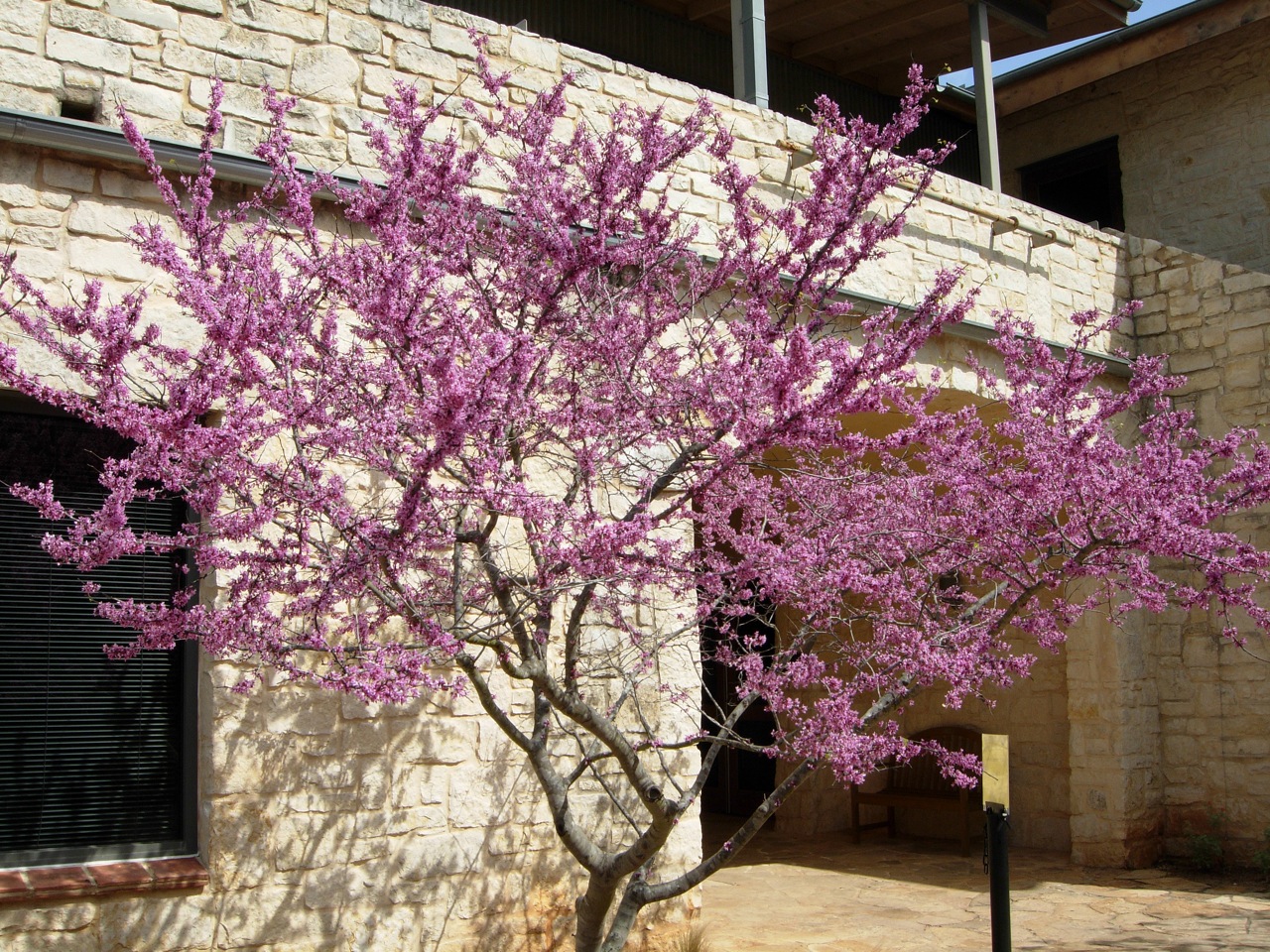
Redbud in bloom. Enjoy it while it lasts...Photo by Jeff Stvan
7) Cercis canadensis, Redbud - I'm going to go out on a limb here and criticize the Redbud (not to be confused with Citizen Kane's beloved Rosebud). Yes, it's native to Tennessee (and much of the Southeast, Mid-Atlantic and Midwest). Yes, it looks lovely for about one week in the springtime when it is covered with flowers. Yes, the bees go crazy for it - although just over a few days. But it is reportedly short-lived (typically 20-25 years acording to various sources), reportedly weak-wooded and susceptible to damage from snow, ice and wind. In sheltered understories, the leaves probably look quite nice.

Clematis integrifolia, May 2013

8) Clematis integrifolia - I admire this plant, but I wouldn't necessarily recommend planting it or add any more of it to my garden. It is tough and reblooms throughout the summer, but I'm not a fan of the lax, sprawling growth habit or the downturned flowers. Nor have I ever seen any pollinators visiting those flowers. I can appreciate its strong points, but Clematis integrifolia and I just aren't meant for each other.

Dianthus gratianopolitanus "Firewitch", May 2013

9) Dianthus gratianopolitanus "Firewitch" - Hardy to zone 3, but tough enough to make a full sun perennial / groundcover in Middle Tennessee. So what's the problem here? I admit I'm probably being persnickety, but I find the persistent stems terribly unappealing and I don't know how to remove them. Also, despite the fact that Firewitch is supposed to be appealing to bees, I've never yet seen a bee on a dianthus flower. Some sources say that Firewitch flower petals are edible. I've tried them occasionally and lived to tell about it. While they may make an attractive garnish, they have zero appeal for my palate.

Eupatorium dubium, Dwarf Joe Pye Weed, August 2013

10) Eupatorium dubium, Dwarf Joe Pye Weed - Purchased for its reported ability to attract butterflies. I did not see any butterflies on the plant all summer, although a few small bees did visit the flowers. It didn't seem all that happy in full sun even though the summer was neither particularly hot nor dry by Tennessee standards. Not impressed from an aesthetic standpoint.

Galium odoratum, Sweet Woodruff, February 2014

11) Galium odoratum, Sweet Woodruff - How the mighty have fallen. After a torrid love affair with this plant, the romance cooled toward the end of last summer. One patch that got morning sun and afternoon shade petered away to nothing. The main patch (in a morning sun, afternoon shade setting) suffered some ugly dieback that I believe could have been fungal. Despite the fact that it's rated as hardy to zone 4, this winter has given Sweet Woodruff severe freezer burn. I can accept a plant that doesn't look its best in winter (such as Ajuga or Creeping Raspberry), but I can't see the logic in keeping a plant that looks dreadful year-round. I will say that the tiny white flowers have a pleasant vanilla fragrance when dried, but that's not enough for me to keep or recommend Sweet Woodruff as a groundcover any longer.

Gardenia jasminoides "Jubilation", February 2014


12) Gardenia jasminoides - I was hooked when I caught a whiff of gardenia on a garden tour. I don't know what secrets that gardener had for keeping his or her bushes lush and healthy, because my "Jubilation" gardenia has struggled pretty much ever since I planted it in late 2012. It made it through 2013 and even produced a few sweetly-scented blooms, but it's been downhill ever since. The near-zero temperatures this winter have blackened many of the remaining leaves. Missouri Botanical Garden calls gardenias high maintenance and warns they are susceptible to numerous diseases and pests. There is a very funny, very long archived thread on the Gardenweb forum that reveals how gardenias drive many gardeners bonkers. I still love the scent of gardenia -- I'll just be seeking it out in someone else's garden. (Incidentally, while some gardeners report their gardenias surviving negative Fahrenheit temperatures, it's also the case that gardenias seems susceptible to major damage from late spring freezes.) In any case, I like tough and trouble-free plants, and gardenias don't exactly seem to fit that bill.

Geranium maculatum, April 2013, shortly after planting, not long for this world

13) Geranium maculatum - Native to the Southeast, reported to have great fall color and to be somewhat evergreen, my G. maculatum gave up the ghost within months of being planted. I have good luck with other geraniums, but maculatum and I clearly were not meant for each other.

Unknown daylily, May 2012

14) Hemerocallis, Daylily - OK, if the gardening community isn't coming for me yet with pitchforks over my criticism of the Redbud, this may soon have them storming the parapets. But I'll say it anyway -- I'm just not a fan of daylilies. The plants look awful in winter. The flowers are pretty, but they typically only last a single day, and the dead flowers and persistent scapes are a pain to remove. Daylilies don't seem to attract bees, butterflies or other beneficials, but they do attract plenty of aphids. (The only good thing about that is that the aphids in turn attract ladybugs and other predators.) I'll admit that they're fairly tough and even drought tolerant, although my personal experience indicates that daylilies will stop flowering and suffer serious foliage damage unless given supplemental water in drought conditions. Daylilies aren't dreadful. I'm not planning on shovel-pruning the ones in my garden, but I do think they are far over-used and over-hyped. There, I said it.

Hexastylis arifolia, Heartleaf Ginger, photo by BlueRidgeKitties

15) Hexastylis arifolia, Heartleaf Ginger - I really wanted this to work out. An ornamental (non-edible) ginger native to Tennessee and throughout the Southeast, I thought this might make a nice evergreen groundcover. The plant I received via mail order was pathetically small and it struggled from the get-go. (My mail order experiences last year have really pushed me toward buying local in 2014.) The plant never had more than one leaf throughout the growing season and it ultimately disappeared sometime in the autumn. I'm keeping my finger's crossed that it could make a reappearance this spring, but I'm not holding my breath.

Hibiscus moscheutos, Hardy Hibiscus "Lady Baltimore", July 2013

16) Hibiscus moscheutos, Hardy Hibiscus - The flowers are beautiful, and the plant is tough enough to survive Tennessee droughts (with a bit of supplemental water). So what's the problem? The flowers are very short-lived. The plant is slow to emerge from dormancy in spring (late April in 2013). Hardy Hibiscus flowers are supposed to attract hummingbirds and butterflies, but I've never seen either one visiting the flowers. Hibiscus moscheutos is also very susceptible to the hibiscus sawfly, which tatters the foliage and frequently leads to frustrating levels of bud drop before the flowers even open. So what's a zone 6/7 hibiscus lover to do? Hibiscus coccineus (a.k.a. Swamp Hibiscus or Texas Star) is supposed to be at least moderately resistant to the sawfly, so that's a plant that I'll probably try to trial in my garden in the near future.

Kolkwitzia amabilis, Beauty Bush "Dream Catcher", April 2013

17) Kolkwitzia amabilis, Beauty Bush "Dream Catcher" - Looks nice in the online photos. In reality? Ugly foliage. Zero flowers. I guess no one would buy it if they called it "Ugly Bush"? And that, my friends, is why there will rarely be truth in advertising.

Lagurus ovatus, Bunny Tails, photo by Jon Sullivan

18) Lagurus ovatus, Bunny Tails - Mea culpa. I did a lousy job raising this from seed and transplanting it. It's also true that my heavy clay soil is the diametric opposite of the sandy soil that L. ovatus reportedly prefers. That said, I was underwhelmed with the size and vigor of this plant. Sigh.

Lobularia maritima, Sweet Alyssum, October 2012

19) Lobularia maritima, Sweet Alyssum - Well, here's another 2-3 year love affair that has crashed on the rocks of reality. In 2011, I was pleased with the smattering of sweet alyssum I grew from seed. In 2012, I tried working with starter plants, but most of them croaked, so I decided that starting my own plants from seed was the way to go. So I ordered a gazillion seeds (I exaggerate slightly) from American Meadows and scattered them liberally along the borders of my garden beds. Many sprouted, but did not thrive. Those that sprouted and thrived (especially in morning sun, afternoon shade settings) quickly grew leggy and ugly, swamping nearby plants. Yes, the flowers are fragrant when massed. Yes, this is a fairly easy annual plant to grow in the right conditions, but the dead flower stems are ugly, persistent and a huge pain to remove. As I struggled to grub out Sweet Alyssum from the beds, I found myself wondering - "Why did I create all this work for myself?" I still don't have a good answer to that question. Well...except for the fact that Sweet Alyssum does attract hoverflies and parasitic wasps. That's a good thing, but not good enough to grow it again next year. And if I do have another fling with Sweet Alyssum, I can promise that it will be a single, small seed packet, sparsely scattered into a discrete corner, not flung about with wild abandon. I've learned my lesson. Really.

Lonicera periclymenum, European Honeysuckle, Woodbine, April 2013

20) Lonicera periclymenum, European Honeysuckle, Woodbine - A variegated vine died in 2012 just months after it was planted. A variety called Serotina did survive and returned more strongly in 2013, but it did not perform to expectations. This deciduous woody plant sprawled perhaps 7-feet wide and produced pretty but very short-lived flowers. These were followed by a few red berries. It's not an awful plant, and it might get better in subsequent years. (I've pruned it way back, but haven't decided yet whether or not to shovel prune it.) But I much prefer the native climbing Lonicera sempervirens (Coral Honeysuckle) over the European Woodbine.

Monarda didyma, Bee Balm, "Jacob Cline", July 2013

21) Monarda didyma, Bee Balm, "Jacob Cline" - Just a bit too vigorous for my tastes. After only a few months, I saw Jacob Cline was spreading through underground stems and popping up throughout the bed. Well, I might have simply tried to control its spread if the flowers had been attractive, or if they had lived up to their reputation to attract bees, butterflies and hummingbirds. As it was, I never saw bees or butterflies on Jacob Cline and the hummers seemed far more interested in the Coral Honeysuckle (not to mention the Zinnias). So I went for a clean break (not that easy since the M. didyma stems tend to snap when you try to pull up the roots. I'm still keeping my eye on a Monarda (M. fistulosa, a.k.a. Wild Bergamot), but I don't see any more M. didyma in my future.

Salvia elegans, Pineapple Sage, June 2012

22) Salvia elegans, Pineapple Sage - Didn't live up to the hype. Officially only hardy to zone 8, Pineapple Sage survived the long (though not especially cold) winter of 2012-13. I doubt it will return after the below-zero cold temperatures during this 2013-14 winter. But I won't mourn its passing. Despite a reputation for attracting bees and hummingbirds, I never saw a single bee visit the late autumn flowers, and the hummingbirds didn't visit much either. (Perhaps because it bloomed so late in the season that most hummers had already begun migrating further South?) Leaves and flowers are both supposed to be edible, but I couldn't discern any pineapple flavor (or any flavor at all really) when I sampled one of the leaves. In drought conditions, S. elegans is one of the first plants in my garden to show distress, curling its leaves and generally looking miserable. It can survive a drought with some supplemental water, but it won't win any beauty contests in the process.
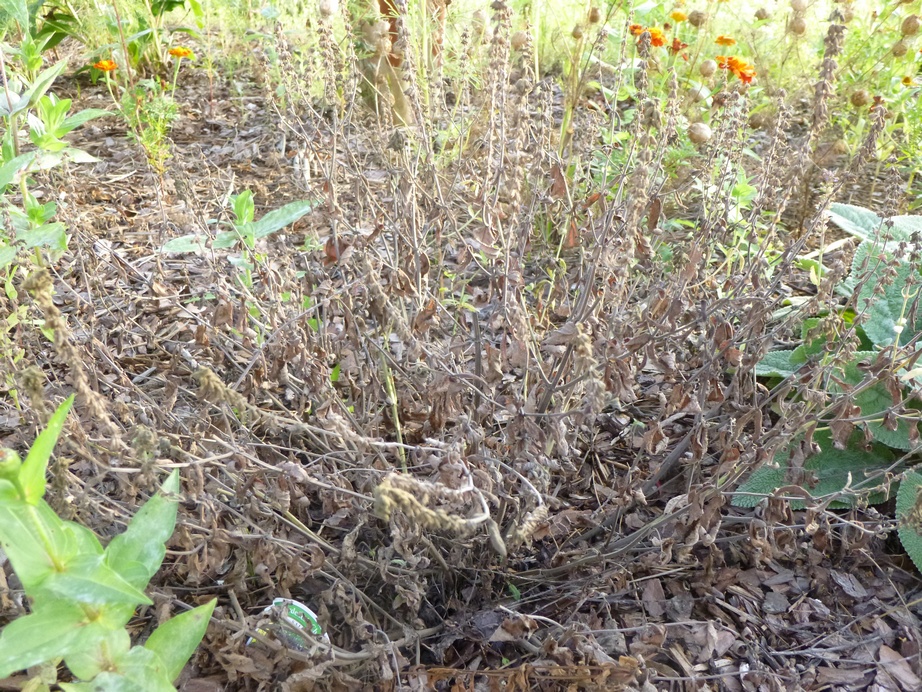

Salvia nemorosa, August 2013

23) Salvia nemorosa, Woodland Sage -- I added two kinds of woodland sage to the garden in September 2012 - May Night and Blue Hill. Both plants performed tolerably in the first half of 2013. In June, I was able to post a picture of May Night in the midst of a mild rebloom. They both drew a couple of bees, but neither became the bee magnet I had envisioned. These plants are not what you would call "self-cleaning". They need deadheading and trimming to look their best, but deadheading can be a chore when S. nemorosa's tough, wiry stems that fought back against the bypass pruner. After the bloom is done, these plants are not particularly attractive and they look more and more ragged as the calendar turns toward autumn and winter. I haven't yet given up on the whole Salvia genus yet, but I think I've crossed S. nemorosa and S.elegans off my list.

Sarcococca confusa, Sweet Box, February 2014

24) Sarcococca confusa, Sweet Box - On paper, this looked like a winner. Evergreen? Check. Drought-tolerant once established? Check. Fragrant winter flowers that reportedly attract bees? Double-check. And yet...the two plants that arrived via mail order in the spring of 2012 were tiny. One died due to the punishing double-whammy of summer drought and heat wave. The other struggled onward and put on a promising growth spurt in early 2013. I was sure that this year would be the year that S. confusa came into its own. But the plant looks to have sustained serious foliage damage from the arctic blasts of the winter of 2013-14. It's a little strange, since Sweet Box is rated as hardy at least to zone 5, but I'm thinking that rating probably applies to a sheltered forest setting rather than an exposed foundation planting. I guess I should have paid more attention to the warning to shelter S. confusa from winter winds (which would have meant not buying it at all, since I don't really have any significant shelter to offer at this point in my hilltop garden). With snow cover or a properly wooded setting, I think S. confusa might be a nice, modest plant for most of the year with the added of bonus of winter fragrance (provided it's nice enough to outdoors and do a little sniffing). But I can't see adding it to any garden of mine in the near future. It also grew very slowly - which has advantages in terms of not needing much pruning, but disadvantages if starting with a small plant and hoping to have any sort of near-term significant impact.

Autumn Joy, Sedum spectabile, January 2013

25) Sedums - I hope that I won't have to surrender my gardening license, but I have to admit that I don't really like sedums much. And in the interest of reciprocity, I have to admit that they don't seem to like me much either! I've tried a few different types - Sedum spectabile (e.g., Autumn Joy, Autumn Fire and Vera Jameson), as well as Sedum tectractinum (Chinese Stonecrop) and Sedum ternatum (Whorled Stonecrop, a Tennessee native). None of them have wowed me. The spectabile sedums have proven particularly disappointing this year - weak, spindly, beset by aphids, hardly attracting any beneficial insects even when they deigned to flower. I'm sure I'm doing something wrong here, because I've seen flourishing stands of Autumn Joy sedum on a garden tour. I will say that Autumn Joy sedum is very easy to propagate simply by breaking off a stem, removing the bottom leaves and sticking the stem in the ground. But what's the point of propagating something you don't like very much? No point at all.

Sempervivum "Red Rubin" April 2013

26) Sempervivum, Hens and Chicks, "Red Rubin" -- Simply failed to thrive. As a plant native to Northern Africa, Southern Europe and SW Asia, I'm guessing it did not appreciate our humidity or the heavy clay soil. It hasn't died a dramatic death, but rather seems to be subtly and quietly sinking into the background and being absorbed into the surrounding soil.

Tiarella cordifolia, Foamflower, May 2013 (the Tiarella is at the top of the photo, the bottom plant is Stachys officinalis, a.k.a. Betony or Hummelo

27) Tiarella cordifolia, Foamflower -- Somehow I overlooked the fact that these plants have low drought tolerance. Oops. Tennessee has frequent periods of drought, often coupled with high heat. I'm trying to grow a self-sufficient garden. Ergo, drought intolerant plants are doomed.
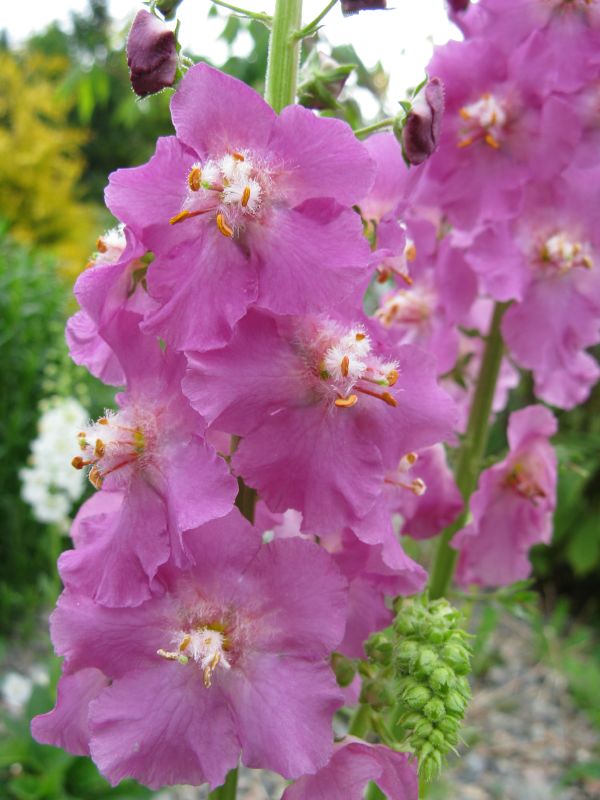
Verbascum phoeniceum, Mullein, photo by Kingsbrae Garden

28) Verbascum phoeniceum, Mullein -- This was a funny one. I know I read somewhere that these plants will rebloom if the flower stalks are cut back. So I cut it back. Did it rebloom? It did not. Argh! In addition, while the flowers were supposed to attract bees, hoverflies and moths, I never saw any visiting pollinators. I do recall reading that these pollinators are supposed to visit early in the day. Maybe I needed to check the Mullein at the crack of dawn? If it returns this year, I'll try to remember to set my alarm to go out and scout the flowers for any early-rising pollinators.

Vernonia noveboracensis, Ironweed, August 2013
29) Vernonia noveboracensis, Ironweed - Native plant enthusiasts tend to sing Ironweed's praises to the heavens, so perhaps my expectations were overinflated when it came to this plant. Regardless, I thought the sprays of little purple flowers were pretty, but short-lived. And I never saw those flowers attract a single bee or butterfly. Now it's possible that Ironweed might attract such pollinators if I planted a whole patch of it, but I'm not about to do the experiment when I have other plants I'd rather trial instead.

Veronica spicata, Spike Speedwell "Giles van Hees", June 2013

30) Veronica spicata, Spike Speedwell, Giles van Hees variety -- Once again, this was a case of flowers that were reputed to attract bees and butterflies not living up to that claim. Lest you think that I live in bee or butterfly free zone, there were plenty of both in the garden last year working plants such as Hypericum, Vitex, Crape Myrtle, Zinnia, Cosmos and several varieties of Sunflower. But they bypassed the Spike Speedwell completely. In addition, the middle part of the plant seemed to die out by late summer, although sections of the plant at the edges were still throwing up long-lasting flower spikes into autumn. This is somewhat of a mixed verdict. I'd like to see how the plant performs in the year ahead -- or even if it comes back at all -- but at this point I greatly prefer the Creeping Speedwell (V. peduncularis) over the spike variety.

Zinnia haageana "Persian Carpet" July 2013


31) Zinnia haageana "Persian Carpet" -- Here's the backstory: I grow Zinnia elegans partly for its beautiful flowers and partly for its potent ability to attract butterflies to the garden. Powdery mildew is the scourge of my Z. elegans, often killing the plants mid-summer and rendering them fairly hideous-looking in the process. Z. haageana promised mildew resistance and it certainly seemed at least somewhat resistant, but it didn't really matter. The petite yellow flowers held little interest for the butterflies and the plants themselves were diminutive and not particularly attractive. So it's back to the drawing board. I'm taking a break from sowing Zinnia seeds in 2014 (although I may allow some self-sown zinnias to grow if any seeds survive this harsh winter), but I'll be trialing one or more of the supposedly mildew-resistant Zinnia elegans varieties - such as Benary's Giant Purple - in 2015.


Thus ends a long and somewhat embarrassing role call. And yet, I am not (too) discouraged. This is a challenging environment for plants in many ways - the heat, cold, droughts, wind, heavy clay soil - not to mention a cold-hearted gardener who insists they get by on their own without too much coddling, fertilizing, watering, spraying or other interventions.

Well, I do whisper sweet nothings at them...

And I know that sooner or later, I'll winnow down the possibilities to find plants that were meant for me, plants with which I can build a long and fruitful relationship.

Saturday, January 25, 2014

In Memory of a Gardener: Cecile Kaplan Dalton, 1936-2014


On January 8, 2014, my mother passed away.

As far as we know, she died peacefully and quickly in her sleep.

I guess it's not a bad way to go, but we were shocked at her sudden and unexpected death.

Naturally I'm grateful to my mother in many ways, but for the purposes of this blog, I'd like to pay homage to her for getting me started on the garden path.

Both my parents gardened when I was a little boy. We had a large garden - or what seemed large to me at the time - on the one flat patch of land what is otherwise a vertiginous piece of suburban Pennsylvania land. The garden was enclosed by a fence, chicken wire perhaps, but rabbits would still tunnel underneath and groundhogs would clamber over. My father's job (as he tells it) was to dig and remove the countless rocks that made their way to the surface each year. No matter how many he dug, new ones seemed to migrate upward. I gather my mother did more of the sowing and watering. My brother, my sister and I were sometimes given the task of harvesting. I seem to remember in particular snapping off ripe corn cobs and then husking them outdoors so my mother could make sweet corn on the cob in the summertime.

When I was perhaps four or five years old, as I recall, my mother gave me own little garden patch by the back door. It could not have been more than 10-20 square feet, but it seemed plenty big to me at the time. I don't recall whether she let me choose my garden seeds or suggested what crops I should plant, but I do remember cultivating crunchy crisp radishes and sweet strawberries. (Well, the chipmunks and slugs got plenty of the strawberries, but I think I managed to snag a few too.)

And that was that. The garden later fell into disrepair when my parents tired of battling the challenging soil and the countless varmints who lived in the woods behind the house. In the 1980s, we installed a pool in the backyard where the garden had once stood. The pool is still there and has been the scene of many happy memories.

Through the intervening years, my inner gardener slumbered. When my mother asked my teenage self to come help her push a cart at the garden center so she could buy bulbs, ferns, perennials and her beloved azaleas, I complied but only with much grumbling. I was more interested in baseball, girls, movies, books and computer games (not necessarily in that order).

I took for granted the cool wild woods behind our property, the towering oaks and conifers that grew on the uphill slope, all the daffodils and tulips that poked their heads up each spring thanks to my mother's annual bulb-planting sprees. (I did help with the bulb-planting, but the exercise of trying to insert the bulb planter into ground that seemed to have more rocks than dirt did little to increase my enthusiasm for gardening! To this day, I've mostly steered clear of bulbs.)

Oh I always loved Nature. Some of my fondest memories from my college years in New England involve hikes with my girlfriend or other friends through autumnal or wintery woods, but I spent a much greater percentage of my time holed up in vast libraries trying to decipher the wisdom supposedly set down by Great Thinkers.

After graduating from college, I spent some months at home. The leaves that autumn were glorious - fiery reds, brilliant oranges, glowing golds. I decided to collect a box full of them. Rather than scoffing, my mother helped with the project. I remember her hunting among the leaves with me to find the finest specimens. (I also learned some valuable lessons on the transience of things. Unpressed, even the best of the fallen autumn leaves soon curl, dry and transmogrify into something more subtle and more fragile.)

Then came a decade in The City, where nature was pushed to the edges like an afterthought. The years passed quickly, hurried along by the rushing pace of the ceaseless crowds. But I think the door back to the garden cracked open just a little there when I found myself irrationally fixated on a houseplant. I lived in a Brooklyn apartment that looked out on a concrete courtyard and the back wall of a municipal building. Outside of a narrow slice of sky, the view was entirely unnatural. But there in a corner of the apartment thrived a tough and forgiving plant, the only green living thing in sight. I can't remember the name now, but I think it was a type of Sansevieria.

I met my wife in The City and together we finally left in late 2009, journeying down to Tennessee (taking the houseplant with us naturally). We got an apartment at first, but at least this one had views of some woods. The apartment also had two balconies and on one of these, we installed a few pots - a bucket of hyacinths that my sister had sent as a housewarming gift, and then my first foray into edible gardening in nearly 30 years: a pot of basil and a pot of mint.

I was hooked.

With just water and sunshine, we could harvest herbs to enliven our meals.

And yet even then, as we made the decision to put down roots here in Tennessee and look for a house, the garden was still somewhat of an afterthought. I was so ignorant that I gave little thought to the landscape around the houses we toured. We knew we wanted a patch of land for space and privacy, but the content of that land - the topography, the plants, the soil, the wind, the light - these were things that I mostly overlooked.

We picked a place, moved in March 2011 and I remember going shopping with my wife for seeds. She chose Cosmos and Zinnias. The first brave seedlings popped out of the ground a little while later and I was in love.

That was just a few years ago, but I'm glad I had those few years to reconnect with my mother on the subject of gardening.

We had wildly different gardening styles and tastes. She loved azaleas, crocuses, tulips, daffodils, daylilies, roses, rhododendrons and hostas. She could not understand my enthusiasm for sunflowers. She lamented the fact that the mature trees on the property she and my father shared in Pennsylvania -- the same land where I had grown up 30-plus years earlier -- cast too much shade on the roses and blueberries. I sympathized, even if I was stuck at the other extreme with a sun-baked backyard in a much newer development practically devoid of shade.

For years, my siblings and I tried to encourage my parents to sell the old homestead and move to something smaller, less hilly and more sensible, but she refused to countenance such a step. The driveway may have been steep and treacherous, but she loved the hillside perch with the backyard forest with all the birds who came to visit the porch feeders in the winter. (She did not love the grey squirrels forever trying to figure out a way to knock down the feeders and devour the seed therein, but she got her exercise jumping up from the table to chase the squirrel away whenever it made its appearance.) When the leaves fell, they revealed a valley vista that stretched for miles.

Recently she had begun spending winters down in Longboat Key, Florida. My older brother generously rented and then ultimately purchased a condo for her overlooking the Gulf. She loved to watch the dolphins who would swim offshore and the pelicans smoothly gliding by and then suddenly plunging into the surf in search of their aquatic prey.

When my wife and I visited her there, we would go to Marie Selby Botanical Gardens to admire the orchids or stroll the Ringling Bayfront Gardens. On our last trip in the winter of 2013, she booked a garden tour for us at the Ringling where we marveled at massive banyan trees and admired the brilliant amaryllis.

This past summer, the last time I saw her, my siblings and I all gathered for the first time in perhaps 25 years or more at our old Pennsylvania home. The humidity was enervating and the mosquitoes were more vicious than I'd ever remembered, but I prevailed upon everyone to take a daytrip to a nearby pleasure garden called Chanticleer that none of us had ever visited before.

My sister's son was there too - not yet two years old at the time - and I think my mother really enjoyed seeing him explore the garden. I remember him being especially fascinated by the sleek koi who came to the edges of their pond to gaze up at us curiously, beseechingly.

Even at Chanticleer we had our differences. I think she found it hard to understand why I hoped (and still hope) to add Rattlesnake Master, Eryngium yuccifolium to my garden, but even as others rushed ahead to complete the tour and escape the sauna-like combination of heat and humidity, we took our time to examine a rampant, lush Dutchman's Pipe vine or marvel at a hedge of hydrangeas in dazzling full bloom.

I wish my mother could see my garden this year. I wish she could be there at the end of this long, cold winter when the frozen ground softens, when the daffodils raise their cheery heads, when the bees return to work the coneflowers, the crape myrtles, the sunflowers, the cosmos and the vitex.

I am still such an inexperienced and foolish gardener, still fumbling my way along, making myriad mistakes to accompany my few successes. How I wish she would have lived to see my garden flourish, that she could have walked along the paths I dream of making under shade trees not yet planted, along vegetable garden beds I have not yet sowed. How I wish I could show her the garden of my dreams that I hope to bring to fruition someday.

And yet I am grateful -- grateful that we had some years to talk about gardens, to reminisce about the vegetables she used to grow, to hear her explain why peas taste best straight from the vine (because the sugars turn rapidly to starch once the pods are picked), to share news about which birds we'd spotted frolicking in our backyards.

I'm thankful that she introduced me to gardening those many years ago. As the obituary below indicates, my mother was a teacher both by profession and temperament. She taught me a great deal about gardening and about life.

I know whatever I manage to grow now and in the future will spring from a seed she planted in me long ago.

And I hope that her heaven is a seaside garden, redolent with roses, ablaze with azaleas, with a shaded bench to watch the dolphins and pelicans just offshore. I hope I can visit her there someday.


Obituary for Cecile Kaplan Dalton


Accomplished college professor, beloved mother and grandmother, Cecile Kaplan Dalton passed away January 8, 2014 at the age of 77. 

The only child of Yetta and Nathan Kaplan, Dr. Dalton was born on November 29, 1936 in Chicago, Illinois. She graduated Phi Beta Kappa from Northwestern University with a bachelor’s degree in chemistry. 

Although they grew up blocks apart on Chicago’s West Side, she and her husband Dr. David R. Dalton first met in college at Northwestern’s Chemistry Club. They went on to earn PhD degrees in chemistry from UCLA in the early 1960s and then moved to Columbus, Ohio for post-doctoral work at Ohio State University before eventually settling in the Philadelphia suburbs. 

Cecile and David Dalton were married 56 years and had three children together: Nathaniel, Rachel Bailey and Aaron. 

Dr. Dalton had a successful career in both industry and academia. For many years, Dr. Dalton taught organic chemistry at Swarthmore College, Bryn Mawr College and Temple University. She had a passion for teaching post-baccalaureate students who had returned to college to complete their prerequisites for medical school. 

Dr. Dalton loved opera and classical music. After she retired from academia, Dr. Dalton applied her considerable organizational talents to serving as an Officer on the Board of Directors for the Philadelphia Opera Guild. 

An enthusiastic traveler and bon vivant, Dr. Dalton enjoyed trips to Japan, the Caribbean, Israel and especially to her beloved Florence, Italy where she would rent an apartment for months at a time and immerse herself in the language and culture. 

In recent years, Dr. Dalton had begun spending the winters in Longboat Key, Florida, where she made new valued friendships, volunteered in the library at Temple Beth Israel and supported the educational and conservation activities of the Mote Aquarium. 

She is survived by her husband, her children and four grandchildren. Graveside service and burial took place Sunday, January 12th at Chicago’s Westlawn cemetery, Eastview section, 7801 West Montrose Avenue, Norridge, IL 60706. 

In lieu of flowers, contributions in Dr. Dalton’s memory are requested for American Friends of Magen David Adom (PO Box 52158, Philadelphia PA 19115) or Mote Marine Laboratory & Aquarium (Attn: Development Office, 1600 Ken Thompson Parkway, Sarasota, FL 34236). 

(Another obituary for my mother appeared in The Philadelphia Inquirer on January 19th.)

Thursday, December 19, 2013

New Resource: Botanical Garden List


You never know who you'll see at a botanical garden!
Here a cute frog crashes the party at Powell Gardens' Festival of Butterflies.
Photo by Greg Boege


Dear Garden of Aaron readers,

Thanks for all your support and valuable feedback over the past year!

I would like to draw your attention to a new resource - a list of U.S. botanical gardens that I have added to the right sidebar. 

I'm sure this list is not comprehensive, but I hope that I've included most of the biggest and best botanic gardens in the country.

If I've missed any notable names, please contact me or use the comments section below to let me know.

(In the future, I hope to add a list of major U.S. arboretums. Since some botanic gardens - like the one in Dallas - seem to define themselves primarily or equally as arboretums, they'll end up on that other list.)

Hopefully these links to botanic gardens around the country will help you to discover gardens in your region or give you ideas of gardens you can visit when you travel.

What are your favorite U.S. botanical gardens? I've got to give some hometown love to Cheekwood, but I also was incredibly impressed with a visit a couple of years ago to Powell Gardens outside Kansas City, particularly the 12-acre Heartland Harvest Garden. Well-played, Powell!

Which garden would you most like to visit? I have to say that I'm hoping to visit some of the famous nearby gardens in upcoming years, including the botanical gardens in Memphis, Atlanta and St. Louis, plus the University of Tennessee Gardens in Knoxville!

Thursday, December 12, 2013

Eight Top Performers from 2013: Creeping Raspberry, Aucuba, Camellias and More!


Apologies for the recent silence.

I was traveling for a while and then sank into a curmudgeonly funk due to November's extraordinarily cold weather.

Having shaken off that funk, this feels like a good time to look back on some of the lessons learned from 2013. I'll start by looking at the best performers - either new discoveries or proven favorites.

Creeping Raspberry

Rubus calycinoides, Creeping Raspberry - Winner, especially in sunny situations. As you can see from the photo above, Creeping Raspberry blankets the ground, preventing weeds, but so far it has not displayed any tendency to spread out of control. (Everything I've read about this plant is that it spreads through above-ground runners, not below-ground roots, so it seems unlikely that the plant would travel underground and pop up feet away, as can happen with other sneaky groundcovers like Blue Star Creeper.) Note that this photo, like the others below, was taken a few weeks ago. Since then, cold temperatures have added much more reddish tones to the plant's leaves. I'm looking forward to seeing the changeover from old to new leaves in the spring and also to seeing what this plant is capable of doing in 2014. Indeed, I'm happy enough with this plant that I plan to add several more specimens in the spring. After that, I imagine I'll be able to separate rooted runners and propagate it within the garden and should not need to buy any more for the foreseeable future. I'm also keeping my fingers crossed for flowers and berries next year, but maybe my hopes are too high in that department.

UPDATE 4/2017 - I ended up removing creeping raspberry from the garden in 2015. See this post to read why it got the heave-ho. (I should say that even though it was a royal pain to dig up and remove creeping raspberry, at least removal was just a one-time job. It didn't try to return from any rootlets like Ajuga, hardy blue plumbago and bloody geranium tend to do.)


Ajuga genevensis

Ajuga reptans "Burgundy Glow"

Ajuga - Winner (mostly), Ajuga is an unpredictable plant. In one place, it seems to have petered out. Perhaps it got too much shade? But most of the others I've scattered around the garden are thriving, especially in partial sun settings, with one doing well even in full sun. My favorite may be Ajuga genevensis, it's not variegated or flashy, but it does produce a dense, low carpet of pleasant green leaves. Ajuga genevensis also seems to hold up to cold temperatures better Ajuga reptans. So why is the genevensis variety so much harder to find in nurseries and catalogs??

The purplish ajugas like Burgundy Glow are beautiful, but they do seem to have a tendency to revert to a darker-leaved plant, so you may have to keep a sharp eye out for those reverts and remove or transplant them if you want to keep a patch consistently purple. I like that ajuga is evergreen in zone 6-7, although it does get tattered over winter. I like the springtime flowers. I like that it seems relatively tough and spreads at a moderate, but not ridiculous pace. I like that it seems relatively easy to uproot and keep in bounds if necessary. My goal in the future is to have mostly plants as groundcover and not much mulch. I see groundcovers like ajuga and creeping raspberry being a big part of that plan. In 2014, I'm eager to try the Chocolate Chip variety, which I hear is an outstanding ajuga.

UPDATE 4/2017 - Way too aggressive in my garden. It wants to create a monoculture (at least at ground level), it's unattractive for a good bit of the year and seems to offer very few ecosystem benefits. In my garden, Ajuga reptans does suffer random dieback sometimes, but the other species (A. genevensis and A. tenorii) seemed to thrive and spread, usually by rhizome, but occasionally also by seed. I wish I could say that I'd evicted this from the garden, but it's an ongoing effort and in some places - especially where it has insinuated itself among the roots of shrubs or other perennials - I'm not sure what to do. I can't really dig deeply in those places to remove the roots completely and spraying seems to run the risk of damaging the other plants, so I'll probably just keep pulling and pulling until the Ajuga (hopefully) gives up the ghost.


Aucuba japonica, Gold Dust Plant - Winner, planted in autumn 2012, so far my Aucuba shrub has thrived. The variegated leaves really light up a dark corner. I hope to add more Aucuba to the landscape - particularly as having multiple male and female plants would give me the hope of getting large ornamental red berries. Warning -- those berries are apparently inedible and slightly poisonous for humans, but hopefully birds would enjoy them. Note that the leaves in this photo are a bit droopy. That's just because I took the photo on a cold day. When temperatures are below freezing, Aucuba droops. Think of it as your own biological thermometer. As temps warm, the leaves perk back up. Loving this plant so far.

UPDATE 4/2017 - Still loving Aucuba. I should say that while it has done well in partial shade in my front foundation, it struggled when I tried a green-leafed variety in a more sunny, exposed setting. It also got chomped to pieces by deer when placed out in the landscape. But it's been a fantastic evergreen through heat, drought, cold, snow, ice, etc. in my east-facing foundation bed. I should really post an update photo to show what it looks like now.

Sorry I don't have a beautiful Camellia flower to show you. Many of the early-blooming ones have finished or got zapped by freezes. This Camellia japonica has not started flowering yet, but it has many fat buds that hold the promise of a beautiful show in the spring!

Camellias - Winners, with reservations. All the camellias in my garden so far have done fairly well with minimal supplemental water and just a bit of acidic fertilizer. This November, I swapped out a mildew-stricken crape myrtle and added yet another camellia - Winter's Joy. Supposedly hardy to zone 6 and with an upright, narrow growth pattern (10-12 feet high by 4-feet wide), I hope this camellia will perform as well as the others have.

But that's not to say everything is perfect with the camellias. (Has there ever been perfection in a garden since the time of Adam and Eve?)

One of the camellias I added last year dropped a lot of buds this winter in our November cold snap (lows in the teens) and barely flowered at all.  Apparently, camellias (some more than others) are susceptible to this sort of bud drop when temperatures fluctuate wildly, as they have done so far in Middle Tennessee this winter, from a low of 12 degrees Fahrenheit in November to a high of 76 degrees Fahrenheit last week.

And then there's the whole issue of zone pushing. Many camellias are only listed as being hardy to zone 8 or the warmer parts of zone 7. But there are more and more camellias - such as those in the Ice Angels(R) series - that are advertised as being hardy down to zone 6, which technically should mean that they are able to survive temperatures as low as -10 Fahrenheit. Fortunately, I have not encountered anything like those temps since I started gardening Middle TN. We're officially listed as being on the colder side of zone 7 these days (0-5 Fahrenheit maximum low temperature in an average winter), so there should be plenty of camellias that survive here.

But I have to recognize that I'm pushing zones here a bit. I'm thinking that I should look for camellias that flower either early or late - or ones that are known for having especially hardy flowerbuds. After all, I'd like to have camellias not just for their evergreen leaves (which are attractive on their own), but also for their flowers. But many of those flowers and flowerbuds will be killed by sub-freezing temperatures - certainly by temperatures in the teens or low 20s, so then I just have the sad spectacle of fallen buds or melted flowers on the stem. (As this source says, "Most blooms freeze, brown and turn to mush at about 32F.") I guess this is why I don't see many other camellias planted in my neighborhood or other Nashville area gardens. I imagine that Camellias are probably best suited for climates reliably warmer than Middle Tennessee - such as parts of the Deep South where it doesn't get to be 12 degrees in November!

That said, I still like the camellias a whole lot. If I pick the right varieties, I should be able to have a nice flower show in late autumn (October to November) and spring (March and April) even in harsh winters. And in mild winters, like the ones we had the last two years, I might even get to see flowers all winter long.

UPDATE 4/2017 - I still love the two camellias that were already planted right next to the porch steps when we bought the house. I mean, they're clearly too close to the foundation, but maybe that's why they have survived and done pretty well over the years while other camellias that I bought and tried to use in more exposed locations got blasted by cold winter winds? I like that we have both a Camellia sasanqua (blooms in late autumn, attracts honeybees) and C. japonica (does not seem as attractive to pollinators, but it does bloom for months in late winter to spring. In fact, it's just finishing up now in late April and I can see on my Instagram feed that it started blooming in February, so that's at least 8 weeks of blooms!!)


Dixie Wood Fern

Dryopteris x australis, Dixie wood fern - Winner, the books call this native fast-growing and drought-tolerant. The books would be correct (so far). This is my only fern and I'm loving it. I'd like to add more ferns, but I don't have many of the shady spots that ferns like. I planted Dixie in the spring, so this is my first winter with the plant, but since it's hardy to zone 5, I presume it will overwinter here just fine (although sadly, I don't believe it's evergreen). It's worth noting that the fronds which fell over were presumably felled by a cold snap. I imagine those fronds are dead and will eventually decay, but for now they are still green and adding a beautiful ferny presence to the garden even splayed on the ground.

UPDATE 4/2017 - Still a nice, solid performer, although the persistent old fronds are pretty messy. I guess they do decay, but slooooooowly. Honestly, I'm not that big into ferns in the garden at the moment, but I still have a few, and this is probably my least favorite at the moment. Ouch. Sorry about that, Dixie wood fern.

Coneflower seedheads
Echinacea purpurea, Purple Coneflowers - Still Winners. The coneflowers bloomed all summer and into autumn, with the clumps getting larger and more beautiful as they mature. Since I leave the seedheads for the birds, I'm starting to see more and more self-sown seedlings pop up here and there, so hopefully I'll have many more coneflowers next year. I love them for their natural beauty, plus of course for the way they attract bees and birds. This year, I also tried a trick I read on the Internet -- I cut off entire mature seedheads and buried them in various places throughout the garden beds - including in some partial shade spots. (So far, all my coneflowers are growing in very sunny settings - I'm curious to see how they'd do in a morning sun / afternoon shade situation). I'll post an update next spring as to whether this was a successful propagation technique.

UPDATE 4/2017 - Purple coneflowers perform fine in the garden. The straight species ones are dependable and come back year after year. The flowers are pretty and attract pollinators (especially bumblebees), while birds do eat the seeds from the seedheads. That said, purple coneflowers can look pretty awful in a drought, especially when growing in full sun. They seem most robust and floriferous when growing with morning sun and afternoon shade. They can seed around quite a bit (especially if you leave the seedheads standing over the winter for the the birds), but seedlings (or even established plants) are easy to pull and remove if you find yourself with too much E. purpurea.

Gaura lindheimeri 'Siskiyou Pink'

Gaura lindheimeri - Still Winners. Love, love, love the gauras. Since it didn't get too hot this year, they bloomed pretty much from late spring all the way through to autumn. The big, billowy plants attracted lots of bees, ladybugs and other beneficial insects like green lacewings, who came to feast on the many aphids this plant attracted. (If you're grossed out by aphids in the garden, Gaura might not be the best plant for you. I cut a couple sprays of flowers to take inside before I realized the stems and especially stem tips were covered in aphids camouflaged as flower buds. Yech.) I didn't treat the gauras with any insecticide or even try to wash off the aphids with water, I just let the predator bugs do their thing and they soon had the problem under control, but I think there always a few aphids on the plants throughout the summer, which actually probably was a good thing as it kept up the predator insect population enough to protect the other garden plants.

In early winter, the stems turn red and then tan. As I recall from last year, they may be a bit of a frizzled mess by spring, but for now, they still have some nice billowy presence to them - and a bit of green at the base. At a time when many other perennials have died back and annuals have plain died, it's nice to have the gaura's presence in the garden. I hope to add more, particularly full-size ones like Siskiyou Pink. Gaura has been very tough and drought-tolerant for me, plus it's survived several typically wet winters despite my heavy clay soil. Other gardeners have not been as lucky with overwintering gaura outside of its native SW climate, but I'm keeping my fingers crossed that these gaura will survive for many more years. And meanwhile, a couple of the gauras have self-sowed to give me a few new seedlings, so I do have a few young next-generation plants in the garden in case the parents shuffle off this mortal coil.

UPDATE 4/2017 - My gauras proved to be short-lived perennials (typically 2-3 years?). I suspect they were killed by a combination of cold temperatures and heavy, wet clay soil. Still, I missed the pretty flowers and long bloom season and just bought a quart-size plant this year. I've tried installing it on a slope where hopefully the drainage will be a little better. We'll see if that helps.

Geranium x cantabrigiense "Biokovo"

Geranium, Cranesbills - All Winners. The Rozanne hybrids sprawled and bloomed from summer through November, while x cantabrigiense 'Biokovo' and sanguineum 'New Hampshire' were much more compact with shorter bloom periods, but beautiful foliage and generally trouble-free plants in morning sun, afternoon shade settings. I know that Rozanne will be completely herbaceous, but I'm curious to see the extent to which the others die back. So far, Biokovo is looking mostly green and beautiful as we head into mid-December! Even if all the geraniums are fully herbaceous, I still think they are wonderful perennials from spring to late autumn in zones 6-7, and I hope to add a couple more Geranium x cantabrigienses in 2014.

UPDATE 4/2017 - I did add more 'Biokovo' geraniums. They're fantastic. Truly one of my favorite, most dependable plants. I think they'd be happier in a cooler and/or shadier setting (most of them get full sun all morning and into early afternoon in the east-facing front foundation). They get a bit wilted, but hang tough through the summer. And they really shine in autumn, winter and spring. They're true evergreens, with some red leaves for bonus color. They form a relatively thick groundcover that excludes weeds, but they spread at a measured pace and are easy to remove if they stray beyond their boundaries. 'Rozanne' is also a nice plant - loooong blooming season. It's probably an amazing garden plant further north. Here, it wilts awfully bad during the summer and seems to be a little short-lived. Maybe 3-4 years? Plus it involves a little more work - benefiting from being trimmed back once or twice a year, and all the dead stems need to be pulled out in late winter (since it dies back to the ground and then comes back from the roots - or not). I do wish to retract my recommendation on G. sanguineum. This plant has turned into a bit of a nightmare. I thought it was spreading too aggressively and overwhelming other nearby plants, so I decided to rip it out. Ha. Geranium sanguineum - or bloody cranesbill - has deep, thick, red roots. They hang on touch and snap easily (at least in heavy clay soil). And the plant regrows from even small root fragments. The upshot - I've dug up certain areas oh, half-a-dozen times trying to get rid of G. sanguineum and probably will be digging all this year trying to eradicate the last remnants. Meanwhile, I've got quite a few holes and blank spaces in my garden where I can't plant anything lest I need to excavate again in a search for G. sanguineum root pieces. Ugh. Don't plant it. (Unless you're in its native range - Europe, far western parts of Asia. In that case, I guess you could plant it if you wanted a really tough, aggressive native romping through your garden.)


Stay tuned throughout the winter for more reflections on how plants performed in 2013. Here's a hint - they weren't all winners! ;-)

Monday, November 11, 2013

This is Why I Grow Zinnias


Gulf Fritillary butterfly (Agraulis vanillae) on a Zinnia elegans
The zinnias are dead now having succumbed to the twin hazards of powdery mildew and cold weather.

But when I look at the blackened stalks standing in the garden, I think back to the warm days of July when the zinnia patch was alive with ethereal butterflies skipping from one blossom to another.

Still, I'll be taking a break from Zinnias next year and trying to weed out the volunteers. My plan is to sow seeds again in 2015 -- but using Z. marylandica (specifically the Pinwheel variety) which are supposed to be more resistant to drought and mildew than the typical Z. elegans.

Monday, November 4, 2013

Feeling Guilty about Coral Honeysuckle


Alas, Poor Honeysuckle, it's only crime was to grow too well and too bushy...

I had a dream in days gone by of native coral honeysuckles twining their way up the metal railings on either side of my porch stems, blooming with their orange-and-yellow trumpets all summer long, attracting hummingbirds and softening the hard lines of the metal and brick.

Amazingly, my dream came to fruition.

And yet, once I saw the coral honeysuckle in place, I realized I had made a mistake.

The honeysuckle was so happy and so exuberant that it practically hid the railing entirely and sent up bushy tendrils in every which direction from the top railing.

It was out of control.

And I was worried. Worried that I had created a potential hazard for anyone using the front porch. After all, the railings are there for a reason - to help people go up and down without tripping or slipping.

But if they can't find or grasp the railing, then the railing is pretty well useless.

I didn't want anyone to get hurt and I didn't want to worry about the liability issues either.

So one day in August, I went out with scissors and started trying to snip the honeysuckle vine off the railings.

The vine broke my scissors! (The tendrils get woody and tough after a while.)

So I went to get my loppers. Overkill? Sure, but it did the trick.

I toyed with the idea of ripping out the whole plant, but I felt guilty curtailing the growth of a couple of vines that were only being all-too-successful at fulfilling the goals I had set for them.

So I left the stubs with a couple of flowers and some maturing berries.

Here you can see the pruned remnants of the formerly mighty vine - now transformed into a truncated bush - encamped at the foot of the stairs.


Provided the vines survive, I'm still undecided as to whether I should leave them to ramble through the front foundation beds or take them out entirely. I'm not at all sure that they'd be willing to play nice with other perennials, at least not without a lot of watchful pruning and shaping.

But I do like the fact that the vine frequently attracted a visiting hummingbird -- who seems to have become accustomed to our property and now drinks from other flowers like the zinnias and even has sampled the Russian Sage.

What would you do with these Coral Honeysuckle vines?

And have you ever had to remove or relocate any overperformers in your garden?