Monday, June 15, 2015

June Blooms Galore! Agastache, Geraniums, Blue Wild Indigo, 'Zagreb' Coreopsis, Johnny Jump-Up, Lantana, Mexican Hats and more!

Agastache rugosa 'Honey Bee Blue', an expert told me not to get my hopes up about this Agastache behaving as a perennial here in Middle Tennessee, but it came through our unusually cold winter and very wet spring without any complaints.

Welcome to June in the Garden of Aaron!

As I prepared this post, I took a look back at some previous June posts to see how things have changed in the garden over the past few years:

- There was the June 2012 post that I made in the midst of an awful drought and heat wave that stressed almost every plant in my garden (except for the crape myrtles, the French marigolds. I will say that it's interesting to see that the coneflowers were attracting lots of little skipper butterflies by late June 2012. So far, despite seeing lots and lots of bees, I've seen very few butterflies in the garden. Perhaps more will arrive in the next week or two?

- In June 2013, Gaura lindheimeri, love-in-a-mist and Penstemon digitalis 'Husker's Red' were rocking the house. Zinnias and sunflowers were just getting ready to burst.

- Later in June 2013, I posted photos of additional flowers - zinnias, coral honeysuckle, Monarda didyma 'Jacob Cline', cranesbill geranium, Agastache 'Golden Jubilee', Salvia 'May Night', Hypericum frondosum 'Sunburst', crape myrtles, Stachys officinalis, French marigolds (again), Alchemilla mollis, Bush's poppy mallow, lambs ear, gardenia, love-in-a-mist (again), Malva sylvestris 'Zebrina', Veronica spicata 'Giles van Hees' and purple coneflowers (again)


So before I dive into the June flowers (and some foliage) from this year, I thought it might be useful to give a quick recap on which of these plants I'm still growing in my garden and which have fallen by the wayside.

I've nothing against growing flash-in-the-pan shooting stars that have a moment of glory one year and are gone the next, but lots of gardeners (myself included) also prize durable and dependable favorites that will come back and even grow stronger and more beautiful from one year to the next. So, which of the June bloomers are still around in the 2015 edition of Garden of Aaron?

- Lagerstroemia indica, crape myrtle - Oh yeah. Bigger, better, stronger. Just starting to bloom now (no photos below), but should be glorious in a couple of weeks. No damage at all on my big, mature crapes over the last couple of winters with lows near zero, ice storms, etc. My secret? I don't murder them.

- Tagetes patula, French marigold - Yes, still persists in my garden as a self-sowing annual. I intentionally pluck and scatter the seed pods to help it spread. Despite sowing many seeds, I don't get many seedlings, but enough to help the plant persist in my garden. As long as it gets decent rainfall, it typically blooms for months. Last year, it was spectacular throughout the entire summer. This year, it is just getting started.

 - Echinacea purpurea, purple coneflowers - Yes, they continue to thrive and spread here. I love the fact that they attract bees, butterflies and birds. I had some issues last year with either a disease or a pest (aster yellows?) distorting some of the flowers, but I pulled the affected plants and so far I haven't seen any issues yet this year (knock on drywall). I've included a couple of photos below.

- Gaura lindheimeri, gaura has basically died out in my garden. It's a pity, because it was very drought tolerant and bloomed for a long time, attracting bees (and aphids, ladybugs and green lacewings). I think the soil was too heavy and/or the winters too cold and wet. I may try again with the all-white variety, which seems to have survived last winter just fine at my neighbor's property, even as she also lost her pink gauras.

- Penstemon digitalis 'Husker's Red', I feel a bit guilty, but I have to admit that I shovel-pruned this plant. I was not digging the short bloom period, and while it was semi-evergreen, I thought the foliage didn't look all that good in the winter. I have some regrets about this, but I've added some new penstemons to the garden (Penstemon x mexicali 'Red Rocks', which I'm liking much more and which has a much longer bloom season)

- Nigella damascena, love-in-a-mist, I'm actively trying to get rid of this. Yes, the flowers are beautiful. Yes, the seedpods are mysterious and exciting. BUT, it self-sows everywhere. The seeds germinate in summer or autumn. The feathery seedlings survived our cold winters without any issues and then it shoots up and blooms dramatically in the summer. The seedlings easy to pull, but when there are hundreds or thousands of them, it gets tedious. 

- Zinnia elegans, I still have a few zinnias growing in my garden, but I have not sowed any seeds recently, and they have sort of petered out. I think the last two cold winters in a row have prevented some self-sowing. I have mixed feelings on zinnias. In dry years (like 2012), they look awful without supplemental water, which I'm reluctant to provide (since I want to have a relatively self-sufficient garden). In wet years (2013 and 2014), they get powdery mildew and still look awful. (I tried a supposedly mildew-resistant zinnia species - Z. haageana (last photo in this blog post) - and was not impressed with the flowers or the disease resistance. It did not self-sow.) Still, maybe I'll sow some zinnia seeds next spring. I miss the butterflies they attract.

- Cranesbill geraniums, still grow them, still love them, they get better each year, I have one photo below

Geranium sanguineum, bloody cranesbill geranium, beautiful flowers, gorgeous foliage, trouble-free and attracts small pollinators (as you may be able to decipher from the blurry visitor in the flower on the left).

- Agastache 'Golden Jubilee', still thriving, self-sowing politely (well, perhaps a bit more than 'politely', but I wouldn't call it 'aggressive' or 'rampant' by any means)


Agastache 'Golden Jubilee' just coming into bloom in early June 2015

- Monarda didyma 'Jacob Cline', shovel-pruned it. It was spreading too fast, too far. And I didn't like the flowers. And I never saw it attract any pollinators. I think it might have gotten some mildew too. So there.

Salvia 'May Night', it's still hanging on, even giving a bit of rebloom this year. Hasn't really thrived, but has not croaked either. We tolerate each other.

- Stachys byzantina, lamb's ear, still have it, still love it, one of my 'Helene von Stein' cultivars even flowered this year (although it's not supposed to).


Stachys byzantina, lamb's ear, this 'Helene von Stein' cultivar is not supposed to flower. Apparently this one didn't get the memo.

Lamb's ear flowers are supposed to be attractive to bees, but I haven't seen any pollinators on these two flower stalks. Guess they didn't get the memo either. (One commenter on a previous post said that lamb's ear flower stalks reminded her of Medusa. That seems a bit harsh to me...)

- Stachys officinalis, betony, doing just fine, still have it, it's never really "wowed" me, but it's nice.

- Alchemilla mollis, lady's mantle, also doing fine, the clumps have gotten a little bigger, despite its reputation as a rampant self-sower, I've never seen a seedling.

- Gardenia jasminoides 'Jubilation', long gone, I think it was just too cold and windy for gardenia in my garden. (Gardenias have a reputation for being 'difficult' plants, so I may have killed it with gardening incompetence, but I'm going to blame the cold and wind.)

- Callirhoe bushii, Bush's poppy mallow, the rabbits did their best to kill this one, nibbling it down to the ground repeatedly, but it's come back every time and this year has some protection from other perennials that have grown up around it. It's a tough survivor that has won my respect and admiration. 

- Malva sylvestris 'Zebrina', this one the rabbits successfully killed. It's a shame, because the flowers were beautiful.

- Veronica 'Giles van Hees', this one sometimes melts out a bit in the summer, but it always seems to recover and come back just a little stronger and wider. It's growing on me...slowly.

- Lonicera sempervirens, coral honeysuckle, I had two vines growing on my front porch railings, they got very bushy and wild, one of them started suckering and/or layering, so I removed it. I kept the other one for now, but it had a bad case of aphids this year and even though ladybugs and other predators eventually showed up, a lot of the leaves and flowers still seem damaged. It's limping along. In years past, the coral honeysuckle vines attract hummingbirds, but I've barely seen any hummers this year (even though I have other flowers like Salvia greggii, autumn sage, that are supposed to attract them).

- Hypericum frondosum 'Sunburst', I had a landscaper install about a dozen of these shrubs on my front hillside. They seem to be a little short-lived. A couple have kicked the bucket and one of the others has some dieback. I don't find the plant all that attractive most of the year, but it's marvelous in bloom - covered with yellow puffball flowers that the bees go crazy over. Still, when I remove the ones that have died this autumn, I think I'll try to diversify the planting by replacing them with something else.


So I think that's a recap of where things stand with many of the plants featured in previous June blooms posts. Now here's what's blooming (or otherwise eye-catching) this year:

 
Baptisia australis, blue wild indigo (year 3 in the garden), seed pods

Coreopsis verticillata 'Zagreb' (year 2 in the garden)

Close up on 'Zagreb' with a small pollinator visiting one of the flowers.

Achillea millefolium 'Paprika, yarrow (year 1 in the garden), the rabbits did a number on it for a couple of months, but they seemed to have moved on, which has allowed the yarrow to resprout, spread out and put up flower stalks.

I'm 99% sure this is Agastache foeniculum, anise hyssop, I sowed some in spring of 2014 and got zero germination last year. This year, I've seen some pop up here and there, so I guess it needed a cold treatment to germinate? If you look closely in this photo, you can see a small pollinator has landed about 2/3 of the way up the flower.

Sisyrinchium angustifolium 'Lucerne', blue-eyed grass, this may not look flashy, but I think it could be one of my best additions to the garden this year. It looks like a grass (and of course it has 'grass' in its common name), but it's actually a member of the lily family, and it has bloomed non-stop since I planted it about two months ago. (The blooms do stay closed on cloudy days.) I wouldn't call it a pollinator magnet, but I have seen pollinators (especially small pollinators) visiting the flowers.

Here's another perspective on blue-eyed grass. It's native to Tennessee and throughout the Southeast, Mid-Atlantic, Midwest and New England. Charming!


Here's a purple coneflower (Echinacea purpurea) and a small spider hanging out on one of the flower petals.

Echinacea purpurea, purple coneflower, at many different stages of bud and bloom

This Fothergilla (center) is being engulfed by a patch of Melissa officinalis (lemon balm, left). I think the Fothergilla is getting a little stressed out by the competition, so I plan to cut the lemon balm way back and/or pull some out, but I'd like to wait until it blooms first. It's just starting to come into bloom with tiny white flowers, but when this photo was taken (about a week ago) it had not yet started flowering. The flowers are supposed to be very attractive to bees. We shall see...


Viola tricolor, Johnny jump-up, heartsease, apparently these are prolific self-sowers in some gardens, but mine have sort of petered out after a few years. This is the only remaining patch. Perhaps I accidentally mistook some of the other seedlings for weeds and dispatched them mercilessly? It's possible. It's a charming, cheerful little perennial. I may try to sow it again in the garden someday.


Lantana camara 'Miss Huff', I'm trying lantana for the first time this year. Most sources say it's only hardy to zone 7, so I'm probably on the borderline, but 'Miss Huff' is supposed to be one of the more cold-tolerant varieties, so I'll keep my fingers crossed. I'm growing it both because it's floriferous and cheerful, as well as for its reported ability to attract butterflies, but I have not seen any butterflies (or any other pollinators for that matter) visiting it yet. Perhaps as the plants get bigger, they'll become more noticeable to the pollinating crowd?

I've got a lot of Mexican hats (Ratibida columnifera) growing in the garden this year. It's a perennial that also self-sows quite a bit. So far, the seedlings don't seem rampant, but it's spread around quite a bit. I feel a little trepidation about what happens next year... It's growing here next to some Gaillardia x grandiflora.

Not one perfect rose, but instead of one perfect Cosmos bipinnatus! Cosmos are annual flowers that volunteer from year to year, but never (for me) in overwhelming numbers. I often end up pulling some that volunteer in the 'wrong' place, but I let most of them grow wherever they sprout.

The flowers are not terribly showy on this species Viburnum dentatum (arrowwood viburnum). I'm growing two cultivars ('Chicago Lustre' and 'Pearl Bleu') in partial shade, and they both seem happier than this plant, but I can't tell if that's because the others are cultivars or because V. dentatum would really prefer partial shade in Middle Tennessee. Honestly, I suspect a bit of both.


So that's what is going on right now here. 

What are some of the standout bloomers in your June garden?

And how do this year's June bloomers in your garden differ from years past (i.e., which plants have joined the dearly departed and which ones have joined the show)?

Tuesday, June 9, 2015

Lovely Lavender is a Bee Magnet!

Lavandula angustifolia (syn. L. officinalis) 'Hidcote', English lavender

One of my favorite plants in the June garden this year, 'Hidcote' English lavender seems to be thriving in its second year in the garden.

I picked 'Hidcote' because it is supposed to have some of the greatest cold tolerance of any lavender. It was basically evergreen last winter, although there was a bit of foliar discoloration (purpling) and wilting toward the end of the winter.

I followed the pruning instructions kindly provided in this excellent YouTube video by Sarah Bader from Lavender at Stonegate, which seems to have promoted a nice dense habit on the plant. I plan to do another major pruning this year right after the lavender has finished blooming in order to promote dense regrowth for next year.

As regular readers of the blog know, I have pretty heavy clay soil and I rarely do serious amending, so I was worried as to whether lavender could survive here. For instance, one Dave's Garden reviewer from Idaho who praised the plant said that lavenders require "hot, dry, rocky, sandy soil" and another in Kentucky described growing lavender on "sandy, lean and very well-drained soil with pea gravel on top."

Well, I didn't do any of that. I just plopped three lavender plants into my regular clay soil, that I may have amended (can't recall) with some soil conditioner. So far, they all seem to be fine, having survived an unusually cold winter and a very wet spring. Oh and despite the fact that NCSU says they "require" perfectly well-drained soil and full sun, my lavender plants are also getting a considerable amount of shade (morning shade from the shadow of the house, afternoon shade from a couple of big crape myrtles).

I'm not saying any of this to brag. For all I know, my lavenders are at Death's door and just putting on a brave show of it. But for now, they seem to be thriving, despite the fact that I've placed them in less-than-ideal circumstances. I'm sharing this fact so you all can know that if I haven't killed lavender (yet) then it may be tougher and more versatile than some books and other gardening sources suggest.

OSU hints at this adaptability, indicating that L. angustifolia may actually be able to tolerate partial sun, as well as "various soils and soil pHs."

One of my favorite things about lavender is just how popular it is with bees - especially bumblebees. All day long and well into evening, I usually can count on spying around 6 to 8 bees busily harvesting nectar and pollen from the flowers.

A study at the University of Sussex confirmed that bees are highly attracted to lavender flowers.

My camera isn't all that great at capturing the speedy bees as they bumble their way through the lavender flowers, but I tried my best to snap some shots that would give you an idea of lavender's appeal to our fuzzy, buzzy friends:

'Hidcote' English lavender and bumblebee


Lavandula angustifolia 'Hidcote' with bumblebee (Bombus spp.)

Bumblebee (Bombus species) on English lavender
PS - If anyone has advice on harvesting lavender for use in potpourris or cooking, I'm all ears!

Saturday, June 6, 2015

Hail to the (Snow) Queen!


Oakleaf hydrangea (Hydrangea quercifolia) flowers fade from white to pink


'Snow Queen' oakleaf hydrangea (Hydrangea quercifolia) that is...

Well, I think this is 'Snow Queen'. I had been laboring under the false impression for a couple of years that I had planted H. quercifolia 'Snowflake', but I recently learned (thanks Deb!) that 'Snowflake' is double-flowered, whereas mine is clearly single-flowered.

Whether this is 'Snow Queen' or a pretender to the throne, she's surely a beauty. Love the way those white flowers are growing all pinky as they fade!

Saturday, May 30, 2015

Groundcover Review - Epimedium x perralchicum 'Frohnleiten' (Thumbs Up!)

Epimedium x perralchicum 'Frohnleiten' in mid-May 2015 with another rosy flush of new foliage emerging.


It's been a while since I've posted any groundcover reviews, but I'd like to dive back into that genre with a quick snapshot of Epimedium x perralchicum 'Frohnleiten'.

I believe I added a small (3.5-inch?) pot of 'Frohnleiten' to my garden a couple of years ago, in the spring of 2013. By autumn of that year, I was ready to declare failure and put 'Frohnleiten' on my list of "Groundcovers that have not worked at all".

That first year, the plant sulked, the foliage crisped, I was unimpressed.

I nearly gave up too soon.

By April of last year, I had changed my tune. I included 'Frohnleiten' in a post on beautiful spring flowers -- except that I wasn't highlighting the Epimedium's little yellow flowers (it didn't really bloom until this spring) but rather its dazzling new pink foliage that's as pretty as many flowers.

In May of the same year, I spotlighted 'Frohnleiten' again for its beautiful foliage.

Finally, in October of last year, my eyes were opened to the full potential of Epimedium as a groundcover when I saw E. x. versicolor 'Sulphureum' used to marvelous effect as a groundcover at the Berlin Botanical Garden.

Today, as the photo above shows, my own little patch of Epimedium x perralchicum 'Frohnleiten' has spread to form a nice dense little groundcover perhaps 18 to 24 inches long by 12 inches wide. Following the format I established last year, here are some thoughts on the pros and cons of 'Frohnleiten' specifically (since it's the only Epimedium I've personally grown) as a groundcover:

Pros

1)  Evergreen: I tend to prefer evergreen groundcovers for several reasons. First, they provide winter interest. Second, they shade out the soil year-round to prevent weed seeds from germinating and gaining a foothold. Third, they make it easier to plan a garden bed. With deciduous groundcovers (e.g., hardy blue plumbago), I'm never quite sure where it will pop up next spring or how fall it will spread. With an evergreen groundcover, I have an easier time figuring out where to place new plants so they will complement each other.

2) Non-aggressive: Perhaps I'm speaking too soon (it's only been in the garden a couple of years and could perhaps become more pushy as it matures), but so far 'Frohnleiten' has been well-behaved. This can be frustrating in the first year or two when you want the plant to spread faster, but as I've learned from other ill-fated encounters with more aggressive groundcovers (e.g., creeping raspberry), having a groundcover that spreads at a measured pace can be a blessing later on if you want it to play nice with other perennials and don't want to constantly have to be fighting to keep it in place.

3) Beautiful: OK, this is subjective, but then much of this whole blog is subjective! Still, I like most everything about this Epimedium - the shape of its leaves, the hue of the mature green foliage, the cute sprays of little yellow flowers (which unfortunately I neglected to photograph for this post) and especially the rosy new foliage that at least this year seems to emerge over a period of months. It's true that (at least in Tennessee zone 6/7), the old foliage will get pretty crispy by the end of the winter, but I'd say it stays looking good almost all the way up until the new foliage is ready to emerge.

4) Good job of suppressing weeds: Not every groundcover is equally good in this regard, but 'Frohnleiten' seems to be an effective weed suppressor, which is one of the major roles I want a groundcover to perform in the garden.

5) Thrives in dry shade: I don't have all that much shade in my garden, so usually I'm more preoccupied with finding plants that can handle the hot Tennessee sunshine, but from what I understand, it's hard to find plants that can cope with dry shade. Epimediums are supposed to be champs in that regard and mine certainly seems unfazed by droughts now that it has gotten established. I think it's also happier now that other shrubs and perennials have grown up around it, giving it a shadier setting in which to do its thing. At least in Tennessee, it seems like 'Frohnleiten' in particular (and I'd guess Epimediums in general) prefer shady spots. Perhaps further north it can handle a bit more sunshine?

6) Low maintenance: There's no need to deadhead the flowers or even cut off the flower stalks - they just seem to disappear once the flowering season is done. Similarly, the previous year's foliage becomes so brittle that it simply crumbles and disintegrates around the same time that the new foliage emerges. (I cut off or break apart the old foliage with my hands in early spring to make way for the new leaves, but I'm not sure that's really necessary. I may try skipping that step next year just to see what happens.) So overall, it has a really clean, fresh look. This is in contrast to another groundcover I like - lamb's ear (Stachys byzantina), whose old dead foliage looks rather the worse for wear through the winter and then persists for quite a long time beneath the new foliage. And while creeping raspberry's long creeping stolons were a maintenance headache, 'Frohnleiten' seems to stay quite compact, sending up new shoots only in the immediate vicinity of the established clump.

7) Deer and rabbit resistant: I have at least one bunny rabbit living in my front foundation bed. It runs past the Epimedium everyday. Fortunately, 'Frohnleiten' has been spared the rabbit's nibbles. Rabbit-resistance is a key consideration around here.

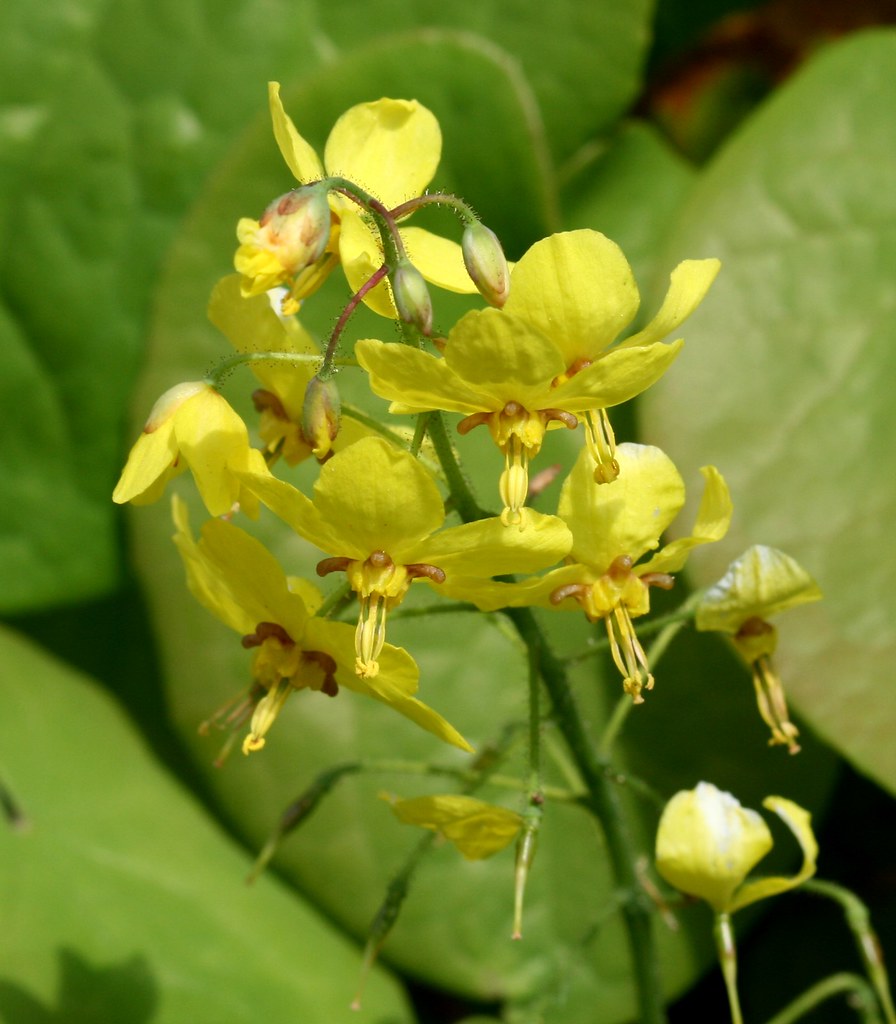
According to the Pacific Bulb Society, the charming sprays of yellow flowers on Epimedium x perralchicum 'Frohnleiten' produce nectar that attracts pollinators (photo by S. Rae)


8) Wildlife value: The Pacific Bulb Society says that Epimedium flowers produce nectar to attract pollinators (although I must confess that I don't think I saw any pollinators visiting the flowers on my little patch of 'Frohnleiten' this year). Seeds are attached to an elaiosome - a packet of lipids and proteins - which may induce ants to gather the seeds and take them back to their nests to feed their larvae, thus distributing the seeds and propagating the plant in the process.

9) Troublefree: Missouri Botanical Garden says that 'Frohnleiten' has "no serious insect or disease problems." Yep, that about sums it up for me. Something (slug? leafcutter bee?) may occasionally slice off part of a leaf, but generally 'Frohnleiten' seems tough, vigorous and resilient.


Con:

1) Exotic: I tend to prefer to garden with native plants. According to Missouri Botanical Garden, 'Frohnleiten' is a hybrid between E. perralderianum (native to Algeria) and E. pinnatum subsp. colchicum (native to northern Iran). Still, I've never read about Epimedium acting invasively. In fact, the Chicago Botanic Garden recommends Epimedium species as good alternatives to invasive goutweed (Aegopodium podagraria).


Conclusion:

I'm a big fan.  

Epimediums are not exactly flashy, but 'Frohnleiten' at least seems to be a solid, reliable, dependable performer that performs admirably as a groundcover and just keeps getting better every year.

I think I'll try experimenting by adding some more Epimediums to the garden next spring. I've heard good things about E. x versicolor 'Sulphureum', which may spread a bit faster than some of the other Epimedium groundcovers. It sure looked good in Berlin. Maybe it's time to see, how it will do in Tennessee...

Thursday, May 21, 2015

What a Difference Two Years Makes - The Front Foundation Now and in 2012


Here's a look at the front foundation planting today:

Fully stocked - three evergreen Aucuba japonica shrubs, one Hydrangea quercifolia 'Snowflake, a camellia, lots of aquilegia, geraniums, balloon flowers, bugleweed, prostrate Japanese plum yew (Cephalotaxus harringtonia) and a few other odds and ends.


And here's what it looked like two years ago (after I ripped out all the boring boxwoods and liriopes, plus the Nellie R. Stevens holly that was planted about 1 foot from the foundation):

Just a bed of hopes and dreams back in November 2012. The only constants here are the camellia, a bit of ajuga and some columbine.


And here's one more photo showing the Hydrangea quercifolia (oakleaf hydrangea) when I installed it a couple of years ago. Scroll back up to the top of the page to look at that first photo. The oakleaf hydrangea is just as tall as the adjacent camellia now and has filled in its entire space and then some.


What's the moral of showing these three photos side-by-side?

In a nutshell -- Don't give up!

If you ever feel discouraged about the state of your garden, just remember that a lot can change in a couple of years.

If you're dissatisfied with some of the plants in your landscape - if they don't bring joy to you and/or don't bring any benefits to the birds, bees, butterflies and other wildlife - don't be afraid to rip them out and start over. You might not get instant satisfaction, but with a little patience, your new vision could take shape sooner than you expected.

Something else to remember (and I'm guilty of this myself) is that plants often will grow larger than you anticipate. When you're planting a knee-high 3-gallon shrub, it's hard to imagine the plant growing 10 or 15 feet tall and wide. Sure, you can prune some plants to keep them in bounds. Certain plants even accept annual pruning gracefully as long as you perform it at the right time and in the right way, but you can save yourself a lot of hassle in the long run by trying to either (a) pick relatively slow-growing plants that won't need to be pruned so often or (b) choosing plants or cultivars whose mature size should be relatively compatible with the space available.

Like I said, I don't always (ever?) practice what I preach in this regard. That oakleaf hydrangea probably wants to grow about 10 to 12 feet tall and wide, which means I should have planted it at least 6 feet away from the house. Instead, I planted it about 2-3 feet from the foundation, so I'll probably be doing some annual pruning and/or enjoying the flowers poking into the porch. Hm...maybe I'd be OK with that latter scenario :-)

Saturday, May 16, 2015

Rolling out the Welcome Mat - Aquilegia, Fothergilla, Geraniums, Indian Pink, Salvia and More!

Thanks to my friendly camera-lending neighbor, Christian, I'm able to show you a few more photos from my early May garden - focusing primarily on the flowers you'd see in the front (and side) of the house if you stopped by to visit. This stunning dark purple columbine just showed up this year on the side of my house. I believe it is an interspecies hybrid between Aquilegia canadensis (the red-flowered native, seen in the background here) and one of the Aquilegia vulgaris cultivars that I purchased. Whatever the case, I love it!


The native Aquilegia canadensis went nuts this year - spreading, growing at least 3 feet tall and blooming exuberantly! I thought columbine would need at least partial shade in the Southeast, but these endure afternoon sunshine without any complaints in their northwest exposure. (They do get morning shade.) My only wish - that they would attract hummingbirds. They're supposed to - but I haven't seen any hummers visiting these flowers. (Of course, I've barely seen any hummers at all this year so far.)


Fothergilla gardenii, just looking amazing and acting troublefree - as usual. (That's part of a big patch of Melissa officinalis, lemon balm, crowding the fothergilla from the left side of the photo.)


This Geranium x cantabrigiense 'Biokovo' is only 2-3 years old and it has grown nearly as large as the azalea shrub behind it. After this photo was taken, the center of the geranium splayed open. I'm not sure what happened. I think there's a rabbit living under the azalea bush, so bunny may be to blame. (Perhaps the rabbit excavated a nest and disturbed the geranium roots?) I'll probably try a drastic cutback (which has worked to rejuvenate other geraniums in my garden), but I'm planning to wait until the blooms are done, because (a) they look beautiful and (b) they attract bumblebees!


That same rabbit has been wreaking havoc on the three Indian pink (Spigelia marilandica) plants in the front border. You can see a few stems have been nibbled here.


...and an entire Indian pink has been chomped back here. Darn you, rascally rabbit!


What amazing fuzzy purple-and-white flowers on the Salvia leucantha (Mexican bush sage), a new addition to the Garden of Aaron. Again, these are supposed to attract hummingbirds and butterflies, but I haven't seen either one visiting the flowers yet. Although it's only rated as hardy to zone 8 (and I'm in zone 6b/7a), I found an inexpensive source so I figured I'd take a chance on the plants. Plus, how could you resist these Seussical blooms?


The 'Natchez' mock orange (Philadelphus x virginalis 'Natchez') seems to be doing pretty well during its second full year in the garden. It's sent up some new vigorous, healthy-looking foliage from the base and has some pretty new flowers. The flowers are fragrant, but the scent is quite faint. Perhaps that's why it doesn't seem to attract many pollinators, except for ants like the one shown here in the leftmost flower. (Incidentally, I believe Natchez is a complex hybrid, but it may have 1/4 native ancestry from P. pubescens, which is listed as native to Tennessee, Arkansas and Illinois.)


Close-up pic of the flowers on Penstemon x mexicali 'Red Rocks', another new addition to the garden this year. Red Rocks reportedly has a nice, long bloom season and is supposed to be better than many other penstemons at tolerating humidity and heavy soils.


Lastly, here's a look at the front corner of the house where I planted Panicum virgatum (switchgrass) last spring. I think this is the 'Northwind' cultivar. This is quite a windy, exposed corner on the hilltop and many of the other plants (including a crape myrtle) that I tried here struggled with that wind. Fortunately, the switchgrass does not seem to mind the wind one bit and it's nice watching the leaf blades sway and bend in the breeze. Near the switchgrass, you can see some columbine, self-sown sunflowers, a pink-flowered Salvia greggii and some volunteer Mexican hat plants (Ratibida columnifera).

Thanks for visiting! The garden continues grow and change and bloom and grow more beautiful day by day, week by week. Stay tuned for photographic proof coming soon~! :)

Tuesday, May 5, 2015

In Full Swing - Clematis, Penstemon, Sumac, Sage, False Indigo and More!


Things are in full swing in the garden - bees are buzzing, flowers are blooming, leaves are expanding, plants are growing, everything there is life (except where there is death).

I apologize for the lull in posting photos. My camera is currently traveling overseas (along with my wife), but my kindly neighbor Christian generously lent me his camera so that I could capture some scenes from the early May garden.

(There are a lot of photos, so I'll split them into two posts. This post will focus on the back garden, the next one on the front and side gardens.)

Abelia x grandiflora, dwarf cultivar. I'd thought it was 'Rose Creek', but I think it was mislabeled, so I'm not sure of the cultivar. Whatever it is, it seems to be settling in nicely during its first year in the garden. I don't usually like bright yellow plants, but I like the contrast here against surrounding greenery.

My favorite plant in the garden these days is Baptisia australis (blue wild indigo). In its third full year in the garden, it has sent up multiple stalks of pretty blue flowers that (as you can see here) attract bees!

The Burkii eastern red cedars (Juniperus virginiana) are loaded with berries/cones. The branches were coated with rust fungus earlier during our wet spring, but that issue seems to have abated (at least for now) as the weather has turned drier and warmer.

Clematis 'Crystal Fountain'. We had this clematis tied up into the crape myrtle tree with biodegradable twine. The twine degraded in some rain storms this spring and the vine fell to the ground, but it doesn't seem too much worse for the wear and actually makes a rather nice groundcover. Make lemonade from lemons and all that...

Nothing too exciting here - Forsythia x intermedia 'Lynwood Gold'. But I must admit that the shrub looks very healthy. The foliage was a lovely shade of green earlier in the spring. I'm not over-the-moon on Forsythia. It's totally overplanted and the flowers seem relatively useless in terms of supporting wildlife, but I have to give it props for toughness.

What happened here!? 'Lemon Queen' perennial sunflower is not looking her best.  I need to investigate further, but my initial suspicion is some sort of fungal rot. It's not a pretty picture, but I believe gardening blogs should honestly show the good, the bad and the ugly.

Lantana camara 'Miss Huff', first year in the garden, first blooms.

Panicum virgatum (switchgrass) 'Northwind' -- This is my second year with switchgrass in the garden. I cut back the old stems myself in March. It seems to me that in a normal-to-harsh winter here, I could easily wait until the end of March or even the beginning of April to make such a cutback. The old stems look good all winter and into spring, so the cutback is only needed to make way for new growth. But that new growth doesn't start in earnest until mid-April. Cut back your grasses too early, and you have relatively unattractive stubble mocking you for a month.

Penstemon x mexicali 'Red Rocks', first year in the garden

Acer rubrum (red maple), not sure which cultivar, but whatever the name, it's turning into quite a nice little tree. As long as the deer don't try ripping up the bark again (like they did a couple of winters back), I hope it will be OK.

Fuzzy berries forming on fragrant sumac (Rhus aromatica) 'Gro-Low'. The small yellow flowers that preceded the berries seemed to be a big hit with all sorts of small pollinators (probably a motley crew of bees, wasps and flies).

Salvia greggii (autumn sage), not sure whether this is 'Flame' or 'Rose Pink', but in either case both survived the winter (I was holding my breath since they're rated marginally hardy in Mid-Tennessee) and have started blooming. Last year, the autumn sage flowers attracted hummingbirds.

As with the azaleas I inherited at the front and side of the house, I feel like this ornamental sage ('May Night'?) looks good for a couple of weeks and then looks like Death warmed over the rest of the year. Still those brief bursts of beauty - especially in the Spring - have won it a place in the garden for now. The lamb's ear 'Helene von Stein' in the background looks good most of the year, including now.

Looks like there should be lots of crabapples this year on the 'Sugar Tyme' crab.

This is not too impressive, but I'm just happy that my wax myrtles (Morella cerifera) survived the winter. Although evergreen further South, they pretty much defoliated here. Then again, I probably shouldn't have planted marginally hardy plants in November. Both plants almost made it through the winter intact, but one got chomped by a deer (I presume) right before Spring arrived. This is the one that didn't get chomped. (The other is still alive, but only barely.)

Purple coneflower (Echinacea purpurea) wilting in early May. Not a good sign of drought tolerance when we're still 5-6 weeks away from the official start of summer.

As with the 'Lemon Queen' sunflower, I'm not sure what happened here, but a portion of the Hyssopus officinalis (hyssop) seems to have wilted out practically overnight. Hyssop is a fast grower, so I'll try just trimming out the damaged section and hoping for a recovery.

Stay tuned, more photos coming soon from the front garden!