Sunday, November 4, 2012

The Late October Tennessee Garden

Dear Readers,

Apologies for my long absence.

I was traveling for three weeks in September-October and then needed to take care of some business (the kind that pays the bills) before I get back to blogging. Mea culpa. 

As for the travels, I look forward to sharing photos and thoughts on Spanish and French gardens in upcoming posts.

But for now, I thought it might be fun to share some photos of the garden in October:

Sweet Alyssum never really got established in the hot spring or early summer, but it has done better in the cooler fall weather - though not as well as last year. I am thinking about trying a heavy winter overseeding to see what happens.

Autumn Joy sedum. Since it's my first time growing this kind of sedum, I'm not sure why some leaves are yellowing and whether it's a real problem or just a cosmetic issue.

A reblooming azalea. It was here when we bought the house, so I don't know the variety. This one has Eastern exposure.

Another reblooming azalea. I like this one better! Unfortunately, since I didn't plant it, I don't know the name of this one either. There are about five identical azaleas on this (North) side of the house.

Western exposure - French marigolds, zinnias and a recently planted Vitex agnus-castus (a.k.a. Chaste Tree or Monk's Pepper)
A close-up on the leaves, flowers and seeds of the Vitex. The plant is supposed to be a fast-grower to 15-25 fee tall and wide. I have high hopes, but am trying to temper my expectations. The tree is reportedly deciduous, but still has mostly green leaves even now in early November (a couple of weeks after this photo was taken)

Blue Star Creeper (strangely the plant seems to have about five Latin names). I planted Blue Star Creeper in a Western-facing landscaped bed last year. It blooms prettily in the spring, but gets baked into oblivion in the summer, returning in the autumn. I thought I'd see how it might do on the East side of the house, so I transplanted this patch in September. It seems to be settling in nicely, but I'm concerned as to whether low winter temps will damage the plant. I'll post updates to let you know.

It doesn't look like much, but this part of the buffalo grass patch that I planted back in August. It might be hard to tell from this photo, but I think all the plugs have survived and some have started to spread nicely, but unfortunately they didn't really get a good enough toehold before the weather turned cool, which I believe slows their growth and quickly makes them go dormant. If I were ever to plant buffalo grass again, I would try to plant it in June I think to give the plants a whole summer of robust growth. But I will try to keep the patch weeded this winter in the hopes that next spring when it warms up the buffalo grass will form a thick enough groundcover to exclude most weeds.

In late October, the backyard still was full of zinnia and French marigold blooms. Pretty much all day long, especially on sunny days, the flowers were alive with bees and butterflies skipping from bloom to bloom. It was a beautiful sight!

Heavily-blooming camellia, Eastern exposure. We didn't get any blooms at all on this plant last year. I scattered some acid fertilizer beneath it in late summer / early fall. Perhaps that helped? I really like these flowers. Unlike the one red camellia bush that bloomed last year (but so far just has buds this year), the white petals gently fall off and decorate the ground so that it looks as though there is a patch of snow beneath the plant. And as you can see, the 'flowers' have a sort of pinkish tinge. Just lovely! Sadly, since it was here when we bought the house, I can't identify the variety. Maybe Winter's Snowman or Snow Flurry?

Another shot of some of the blooms on the (pinkish-)white camellia.

A nearby pink camellia has been blooming as well. Not as many flowers, but these are still beautiful! Again, this was here when we bought the house, so not sure of the variety. Perhaps Pink-a-Boo or Kanjiro?

The cherry tomato vines (Riesentraube and Sungold) were still covered with fruit in late October. (Of course the ground below them was also littered with fallen fruit.) Since our HOA requires a lawn with few weeds and since we have not been able to achieve that without hiring someone to spray chemicals and since I don't feel comfortable growing food alongside those chemicals, this will probably be the last tomato plant we grow for a while.... :(

I think the cosmos plants bloomed better in October than they did in the spring or summer!

This is the Eastern side of the house, where I had a bed of English marigolds (Calendula officinalis) during the summer. They have, ahem, reseeded rather heavily and sprouted prodigiously in the fall weather. I wasn't a huge fan of the English marigolds, so I'm not so thrilled about the heavy reseeding. But I imagine that many of these plants will die from the cold before they have a chance to create a third-generation of English marigolds! I have uprooted some, but I am leaving others just to see how much cold weather they can withstand.

This was one of the few English marigold plants that I left in the ground. I had uprooted most in August/September when they stopped blooming and became infested with leafhoppers. Clearly, the plant has bounced back and begun blooming in the cooler weather. 

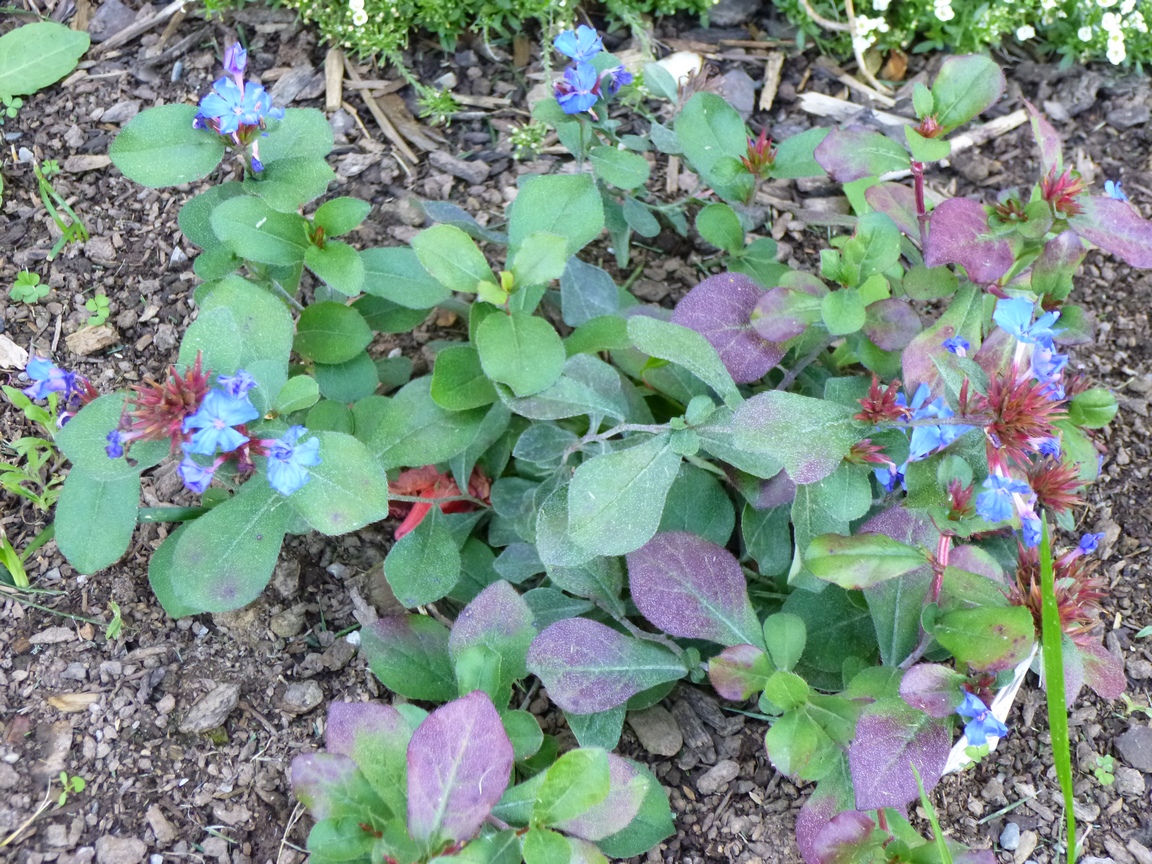
Hardy Blue Plumbago apparently turns a beautiful shade of purple in the autumn. Just another bonus to one of my favorite perennials!

I was worried that everything would be dead in the garden after three-plus weeks of neglect, so it was uplifting and heart-warming to see this gold-and-orange patch of French Marigolds (Tagetes patula). Just gorgeous! The butterflies and bees were all over these flowers. And I think that there were quite a few moths as well, including perhaps a hummingbird moth - the first one I've ever seen in Tennessee! A wonderful autumn sight. Definitely a plant that I would recommend - if the seedlings could survive in the drought and 100+ temps we had this past summer and mature into these types of flowering plants, then I'm pretty sure they can almost anything the Southeast can throw at them. Highly recommended!

The okra plant that I transplanted in September and highlighted in a blog post is still alive. I don't think it was warm enough while I was gone for the plant to produce any mature pods, but it was still nice to see it standing.

Pineapple Sage (Salvia elegans) looked miserable all summer - leaves curled in the drought, I thought it would die despite the supplemental water I gave it. By September, with cooler temps, the planted looked healthier, but I didn't expect it would double or triple in size while I was gone and throw up these sprays of red flowers. What a nice surprise! I think these flowers are supposed to attract hummingbirds, but sadly I saw only a single hummingbird make a brief visit. Maybe you need a whole patch of these plants to catch a hummingbird's attention?

Just another perspective showing the size and shape of the Pineapple Sage.

One more shot of a butterfly visiting some zinnia flowers. (Notice the smaller dun-colored skipper butterfly in the upper right hand corner of the photo. I didn't intentionally try to capture both butterflies in the frame, but there were so many butterflies flitting about that I just happened to get lucky.) I love butterflies and I love zinnias. Fortunately, they also seem to love each other.

Follow the garden from one season to another with a free email subscription.

Thursday, September 20, 2012

Zinnias and Butterflies


Why plant zinnias?

1. You can plant them from seed. For a couple of dollars, you can have flowers all year

2. They're pretty tough. Most of my zinnias survived drought and 100+ degree weather.

3. They attract butterflies!! Lots and lots of butterflies.

4. They also attract goldfinches eager to eat the seed.

Butterflies, flowers, vegetables and more in your inbox? It's easy with a free email subscription.

Sunday, September 16, 2012

Autumn Joy Sedum


Tough? Yep.

Succulent? You betcha.

Frothy pink flowers? Don't mind if I do.

Attracts butterflies and other insects? Sure does.

It's Autumn Joy sedum!!

(I've been so happy with the sedum thus far that I'm thinking about adding some more to the garden next year. Maybe Matrona or Brilliant or even the Dragon's Blood groundcover...)

Do you grow sedums? If so, which ones work best for you? If you have photos of sedum in your garden, please post links in the Comments field!

See the sedum and the rest of the garden change through the season with free email updates.

Tuesday, September 11, 2012

Perseverance

An okra plant will survive.
A few weeks ago, we ripped up our raised vegetable bed to install a test plot of buffalo grass.

None of the summer vegetables had done very well in the raised bed this year. I'm not sure why. Maybe the soil (purchased from a nursery last year) was too heavy. Maybe I didn't fertilize enough. Maybe the dirt in the raised bed just cooked to an unfavorable temperature in the 100+ degree heat we had earlier in the summer.

(The only thing that did do well in the raised beds were cosmos plants! Although even they got big and bushy, but hardly produced any flowers...)

Meanwhile, the tomato plants growing right in the clay soil next to the raised beds were thriving.

So I decided to try to transplant the two biggest okra plants from the raised bed to the clay soil.

I had not gotten any okra at all from the raised bed this year. Most of the plants refused to grow. But these were the best of the bunch. They even had managed to create a couple of flowers by transplanting time.

Well, okra hates to be transplanted.

The transplants immediately dropped all their leaves and flowers and I felt sure they were dead.

But they weren't

The smaller plant never did regrow any leaves, but its flower must have been fertilized, because soon a small pod started to grow right at the top of the plant. It as though the plant knew it didn't have enough energy to regrow leaves and so it decided to pump all its reproductive hopes into the single pod.

The larger plant meanwhile has regrown some nice healthy-looking leaves, but has not yet put out any pods.

Love these fresh green leaves on this transplanted okra plant!

I was just impressed by the spirit and the perseverance of these okra plants, particularly the smaller one.

And I will celebrate that perseverance by savoring the one okra pod when I eat it tonight.

I'm hoping I'll do better with okra in 2013. See whether that hope pans out with free email updates.

Thursday, August 23, 2012

Buffalo Grass Trial - Day #2

Buffalo grass plugs newly installed, Day #2, August 23, 2012

Yesterday, my mail order of Prestige buffalograss arrived from Todd Valley Farms.

(Yes, this is the same Todd Valley Farms referenced in my interview with Wayne Thorson about the virtues of buffalograss. In case you're wondering, I did not get any perks or discounts from Wayne or Todd Valley Farms in exchange for the interview. You can read the Trust section of this website if you'd like to learn more about my policies and promises on editorial integrity. I bought my buffalo grass fair and square in a 95-plug tray for $48 plus $14 shipping and handling. I looked around and investigated buying the buffalo grass through other mail order outlets, but the ones I investigated seemed to basically just be distributors for Todd Valley Farms, so I just decided to buy from the source.)

I have to admit that I was very excited to open the box and see the thick carpet of Prestige buffalograss therein. Despite three days in transit in mid-80s to low-90s weather, the plugs looked healthy, strong and green. Yes, the grass is a softer, greyer color than fescue or bluegrass, but it was incredibly soft and all the blades were nicely interconnected in a way that seemed like it would do a good job of excluding weeds.

In fact, the stolens on the buffalograss were so interwoven that it was impossible to pull the plugs apart without cutting them. My wife graciously volunteered for this task while I set to work trying to dig holes in the rock-hard clay that we call soil.

(I'm sorry I didn't take a photo of the buffalograss looking so pretty in its tray. I was eager to get the plugs untangled and planted. As it was, the job took us ~3 hours and we only finished around sunset. It would have taken far longer without the help of my generous and kind wife!) 

Incidentally, this buffalograss test patch was installed where we previously had our raised garden bed. I disassembled the bed a few days ago, distributing some of the soil therein throughout the landscaped beds and raking the remaining soil to the point where it looked relatively smooth with a nice slight grade away from the house and patio.

Anyway, back to the digging. It was hard work, chopping at the soil with a small shovel. If I were planting more than one tray (and even if I were doing one tray again), I'd certainly consider buying some sort of auger attachment for my drill to make the work go faster and easier. Or I might try the approach my wife suggested, which would be to use a big shovel to chop up the top layer of dirt throughout the whole planting area and then plant all the plugs into that loosened soil. Or maybe it would have been better to use a tiller? I'm not sure yet and confess that I still have a lot to learn about soil!

Prestige buffalograss plugs close up after installation

In any case, we watered down the area, watered down the plugs themselves and chopped out holes in the soil. I didn't worry too much about placing the plugs at exact distances from each other, but I did try to stagger the rows as recommended in the planting instructions. (By 'stagger the rows', I mean that I wanted the post-planting area to have a checkerboard pattern.)

The planting and care instructions sent by Todd Valley Farms are rather chemical dependent. They recommend soaking the plugs with Miracle Gro®or a similar sod/seed starter fertilizer and using chemical herbicides to suppress weeds.

As an organic gardener, I basically ignored those instructions. Instead I scattered some chicken manure and earthworm castings into each of the holes and plan to spray some organic liquid fertilizer in a few weeks. As far as I can tell, the fertilizers that are recommended (every 30 days according to the planting instructions) are not absolutely essential - after all, no one was spraying buffalograss with fertilizer when it was the dominant grass on the Great Plains! - but rather just to encourage the buffalograss to fill in its area before weeds pop up to compete. Since I'm not using an herbicide - some of which like 2-4D can apparently harm the buffalograss itself - I'll need to just be vigilant about weeds and try to pull them before they get established. Since this is a compact area (probably not more than 50-60 square feet), I'm hoping I can deter the weeds until the buffalograss fills in and gets strong enough to screen them out on its own.

Update - Just called Todd Valley Farms and was told that using organic fertilizer is fine, just to try to use one that supports root growth - i.e. one that has more P and K, versus N that would encourage top growth, which would be counterproductive without the roots to support that growth.

An overhead shot of the buffalograss plugs. The slightly darker patch of soil in the middle of the photo is where I emptied out the last of the earthworm castings. I wish all my soil was that dark and rich. Yes, I have Soil Envy!

So that's where things stand for now. The instructions emphasize keeping the plugs wet for two weeks, so I soaked the area thoroughly right after planting and again this morning. I spoke with Todd Farms to ask exactly what this meant in terms of how often to water the plugs, but was told that it was impossible to give a hard answer since the watering frequency would depend on temperature, soil, etc. Basically I was told that I should keep the area 'wet' for two weeks (wet meaning you wouldn't want to walk on it) and then 'moist' for another two weeks (moist meaning you could potentially walk there). I was also given the reassuring news that the plugs are a bit less sensitive to drying out than the sod.

And while some buffalograss buyers have reported problems with their grass turning brown, again as I understand it that is more of a problem with buffalograss sod and/or with spring plantings where the grass is taken out of a warm greenhouse and plopped into a colder environment. Since it's going to be in the low 90s today and for the next couple of days, I don't think I have to worry about cold temperature shocks with the buffalograss!

Prestige buffalograss plugs and one zinnia, one of a couple plants that I didn't have the heart to remove when I was preparing the buffalograss bed


So, I'm very excited to be giving this a try! Hopefully temps will cool off in a week or so (that's the long range forecast) and we'll get some rain which will cut down on the amount of watering I need to do, but for now I'm willing to do some intensive short-term watering for the future promise of less watering down the road. As the "General Care Guidelines After Establishment" in the planting instructions state:
"You should not need to water your buffalograss except in times of drought. If this occurs, deep water (1 to 2 inches) once per month. This will keep your lawn looking lush. Adjustments to this may need to be made due to soil conditions and/or local climates. If you choose not to water, this will not harm the grass (my emphasis) but you may notice a slight browning of the blade tips. Buffalograss will go into dormancy in extreme droughts."
All of this sounds awesome to me. The promise of a lawn - or at least a patch of a lawn - that needs hardly any supplemental water and grows slowly to a maximum height of 4-6 inches tall? That is the dream I am pursuing with this buffalograss trial.

Will the buffalo grass ever knit together into a green carpet? Or will it remain as a patchwork of isolated clumps? Find out (eventually) with free email updates.

Monday, August 20, 2012

Expert Interview #2 - Kirk Shillinglaw, Prairie Nursery


Monarch butterfly and bee on Prairie Blazingstar, photo by Rachel Ford James
As I mentioned when interviewing Ira Wallace of Southern Exposure Seed Exchange, my hope with GardenofAaron.com is to share not only my own limited knowledge and experience with gardening, but also to bring you the views, opinions and wisdom from authorities in the field.

For that reason, I’m honored to be able to present an interview with Kirk Shillinglaw, VP of Sales and Marketing at Prairie Nursery. Although Kirk carries a businessperson’s title, he assured me that he was formerly seed division manager at Prairie Nursery, which means that he is well acquainted with the virtues of various prairie and native plants.

GardenofAaron.com:  Tell me what makes Prairie Nursery different from other plant nurseries and seed catalogs.

Kirk Shillinglaw: We were one of the first nurseries to use native perennials in landscaping. In fact, we just celebrated our 40th anniversary in business, which makes us one of the oldest – if not the oldest – native plant nurseries.

In addition, we have very high quality seed and plants. All the seed we sell is lab-tested for quality and viability, and we hand-grade all our plants. 

And we have something for  just about any soil type or condition. Our annual sales reports show that we have customers in all 48 contiguous states. In the Southeast, many of our customers are located in North Carolina and Tennessee.

GardenofAaron.com: Why should gardeners consider using native plants in their landscapes?

Shillinglaw: If you choose the right plants that fit your soil and sunlight conditions, then native plants will be naturally adapted to the local conditions. Natives are generally hardy and disease-resistant plants. They often attract birds and butterflies by serving as a natural source of seed and food for pollinators. They are typically low-maintenance and many of them have good drought tolerance. While some natives do naturally experience a certain degree of insect predation, they’re generally less likely than exotic plants to get absolutely mauled by insects, which means that usually gardeners do not need to resort to insecticides to keep a plant alive and healthy.

GardenofAaron.com: Where I garden in Tennessee, the soil is mostly clay. Many other gardeners in the Southeast and elsewhere in the U.S. garden on clay soils. What sort of plants would you recommend for them?

Shillinglaw: We actually have a strong line of clay plants that we call Clay Busters. The great thing about using these plants is that you don’t have to amend the soil.

GardenofAaron.com: Really? You don’t have to amend your clay soil at all before planting these Clay Busters?

Shillinglaw: Well, we suggest removing competing vegetation to reduce some competition at the start. If you plant a native plant into a patch of quack grass, it will have a tough time getting established. So give the plants an even playing field, dig a hole, loosen the roots of the potted plant, ensure that you have some loose soil at the bottom of the hole and then tuck the plant in. You do need to give the plant some water in its first few weeks until it gets established so that it can get its roots into the soil.

GardenofAaron.com: So which of the Clay Busters would you specifically suggest for someone like myself gardening in a sunny patch of Tennessee clay?

Shillinglaw: One of the most commonly and frequently used clay plants is the Purple Coneflower (Echinacea purpurea). Another popular one is Prairie Blazingstar (Liatris pycnostachya). Those are two of the most well-known native prairie plants.

Another plant that can work well in clay is Rattlesnake Master (Eryngium yuccifolium), which has a really unusual and unique appearance.

And one of my favorites is the New England Aster (Aster novae-angliae), which in Tennessee might bloom through November.

In moist clay, Ironweed (Vernonia fasciculate) can be a good choice if you’re looking for a tall plant [4-6 feet].

Butterfly on Rattlesnake Master, photo by sfgamchick

GardenofAaron.com: You said Ironweed is good for moist clay. What if you have clay soil like mine that is moist after one of our strong rainstorms and slow to dry, but then bakes like concrete in hot, dry weather? And what if you want a plant that can take drought without a lot (if any) of supplemental water?

Shillinglaw: In that case, you want to look for plants like Yellow Coneflower (Ratibida pinnata) and Black Eyed Susan (Rudbeckia hirta) that are listed in our catalog or on our website as doing well in any kind of soil – Dry, Medium or Moist. The plants that have that description will generally be more cosmopolitan and adaptable with regards to soil moisture. Note that Black Eyed Susan is a biennial, but does self-sow on bare ground, and the vast majority of our plants are perennials that you can plant once and that will come back year after year.

GardenofAaron.com: Changing topics a little, do you grow your own plants?

Shillinglaw: We do grow approximately 95% of the potted plants we sell in our own greenhouse. Much of our seed is also produced on site.  

GardenofAaron.com: I am trying to do some of my planting in autumn this year (as opposed to this year and last year when I planted in springtime). How do you feel about autumn planting in Tennessee or elsewhere in the Southeast?

Shillinglaw: Planting in fall can be a good idea to help plants get established and put down roots so that they grow a bit more strongly next spring. While most spring transplants will still bloom their first year in the ground, you’re more likely to get blooms the following year on a fall transplant. Our autumn shipping season runs from mid-September to mid-October, although we will ship a little later to Southern areas on request. For large orders, we can sometimes make exceptions and ship outside of this time frame.

GardenofAaron.com: What are your recommendations when it comes to fertilizing native plants?

Shillinglaw: Generally, there is no need to fertilize native plants. In fact, we find that adding fertilizers may actually tip the balance in favor of competitive weeds. Of course, like anything that is green and growing, if you have a plant that is looking really poor, you might want to add a balanced fertilizer, but generally there is no need to fertilize with native plants.

GardenofAaron.com: So in the Southeast, where we have a lot of rainfall, but we alternate between periods of heavy rain and drought, would you suggest looking mainly at plants listed as tolerating dry to moist conditions?

Shillinglaw: Well, it depends on soil type. I know quite a few people garden on clay in the Southeast, but if you have a sandy soil, you’re more likely to lose moisture quickly even after a heavy rain. In that situation, plants that we have categorized as suitable for Dry, Sandy & Rocky Soils would be most suitable.

GardenofAaron.com: What plants would you recommend for shade or partial shade on clay soil?

Shillinglaw: Well, Trillium (Trillium grandiflorum) is one good option. Another good choice might be Sweet Joe Pye Weed (Eupatorium purpureum). Wild Ginger (Asarum canadense) is a tremendous groundcover for shady or partially shady areas on clay soil. Even a few of the woodland asters, like the Heart Leaved Aster (Aster cordifolious) and the Big Leaf Aster (Aster macrophyllus), can do well in clay and partial shade.
Wild Ginger (Asarum canadense), photo by gardentrek

GardenofAaron.com: Speaking of groundcovers, any suggestions in that area?

Shillinglaw: We don’t really carry any vines that would rapidly cover an area, but almost any of our ferns has the potential to spread and attain good coverage. Stiff Coreopsis (Coreopsis palmata) can also spread and function as a groundcover. And then there’s Wild Stonecrop (Sedum ternatum), which can function as a groundcover. Another good option might be Palm Sedge (Carex mukingumensis), which has unique foliage that looks like the leaves of a palm tree.

GardenofAaron.com: Would you say that interest is growing in the U.S. in native, prairie plants?

Shillinglaw: I’d say that the market for purists or traditionalists looking to restore native prairie lands has stayed about the same size in recent years, but we do have more and more customers and potential customers who realize that native plants don’t have to look wild and weedy. A lot of native, prairie plants make excellent garden plants. Very few of these natives are aggressive, which means that they will mostly play well with others.

Also, pretty much everyone likes birds and butterflies, and so the fact that these plants often do a good job of attracting that sort of wildlife is a strong point in favor of the native prairie plants. Generally, I’d say they are becoming more mainstream and more accepted by landscape designers and customers.

GardenofAaron.com: Presumably a lot of the native plants are also attractive to bees and hummingbirds?

Shillinglaw: Absolutely, bees love plants like Bergamot (Monarda fistulosa), which is commonly known as Bee Balm. And Columbine (Aquilegia Canadensis) is an excellent hummingbird plant. Our catalog and website has icons showing which plants are best for attracting birds, hummingbirds and butterflies. And next year, we’re planning to add a bee icon to highlight plants that attract pollinators. We are working on that project with the Xerxes Society, which aims to protect pollinators.

GardenofAaron.com: Anything new that we can expect from Prairie Nursery down the road?

Shillinglaw: We have been building up the woodland species that we offer, for instance by increasing our selection of woodland ferns. And we are starting to look at offering a few native shrubs, for instance plants like Elderberry. So that’s something to keep an eye on for next year.

Thanks to Kirk at Prairie Nursery for these insights!

It’s almost fall planting season at GardenofAaron.com. So stay tuned for photos and play-by-play on some of the big changes coming to the garden!

Have you ever ordered from Prairie Nursery? 

Do you have any native and/or prairie plants in your garden and, if so, how have they fared? 

Please share your experiences in the Comments field below.

Friday, August 10, 2012

Buffalo Grass, Won't You Come Out Tonight?

A cat named Ella on a buffalo grass lawn, photo by mandymooo
Apologies for the pun in the title!

I've become really interested in buffalo grass lately - and blue grama grass for that matter.

I won't go into too much detail here on the problems with traditional lawns. Books have already been written on the topic. Suffice to say that bluegrass and fescue are both resource intensive. They require lots of water, lots of fertilizer and lots of mowing. (I'm not as familiar with bermuda or zoysia grass, but I understand they each have their own issues, particularly with invasiveness.)

So I've been looking for alternate options for groundcover and lawns. Some people recommend lawns made of creeping thyme, but I don't think that's supposed to do well in the humidity of the Southeast.

And my experiments with clover early this year turned out to be a disaster. I won't say that clover isn't suited for any lawn, just that the height and the flowers are not compatible with HOA communities that like lawns to be unobtrusive. But the worst part for me was clover's aggressiveness. I can't imagine how people with clover lawns keep clover out of their landscaped beds and gardens, for instance.

And on the flip side, since clover disappears in extended heat or drought, it's not really a reasonable option for year-round groundcover.

So I've settled on two native grasses as my Great Hope - buffalo grass and blue grama grass.

To find out more about these two options, I spoke on the phone with Wayne Thorson of Nebraska's Todd Valley Farms, a grower with a 20+ year history of cultivating and selling buffalo and blue grama grasses. Here's some of the main information that I gleaned from my call with Wayne:

- Buffalo grass is very drought tolerant and requires much less water than typical mid-South alternatives like bluegrass or fescue. According to Wayne, bluegrass often needs 1 to 1.5 inches of water per week to look its best. In hot weather, that can mean watering once or twice per day. By contrast, buffalo grass needs only 1/4-inch of water per week. In many parts of the country, Wayne says that buffalo grass will not require any supplemental water once it gets established.

Buffalo grass lawn, photo by lindkathi


- Buffalo grass is low-growing. None of the varieties sold by Todd Valley Farms grow more than 8 inches tall, and one of them, Legacy buffalo grass, typically grows only 5 inches tall maximum. Because all buffalo grasses are slow-growing, they can be mowed as little as once per month, or even less frequently, depending on how manicured a look you want for your lawn.

- It is important to pick a bluegrass variety that is adapted or bred for the climate where you live. For the hot and humid Southeast, that means going with Prestige buffalo grass. According to Wayne, Prestige has been grown successfully even in the hottest and most humid regions of southern Texas and Florida.

- Buffalo grass is the only native North American turf grass.

Buffalo grass closeup, photo courtesy of Todd Valley Farms

- Buffalo grass does spread horizontally -- but above-ground using stolons. It does not have below-ground rhizomes like zoysia or bermuda grass. That means (according to Wayne) that it's relatively easy to prevent buffalo grass from invading your flower beds through the occasional use of an edge trimmer.

- Blue Grama grass also has low water use and it's a native North American grass, but Wayne says that it would make a poor choice for a lawn grass because it is not traffic tolerant at all. It also grows about 15-20 inches tall and does not spread. These latter two characteristics, plus it's attractive seed heads, could make it an appealing ornamental border grass. In late winter or early spring, you can rejuvenate blue grama by cutting it down to the ground, though I must confess I have some concerns about damaging the grass during the cutting stage if it is really as traffic intolerant as Wayne suggests.

'Hachita' variety Blue Grama grass, photo by AgriLife Today


- How do these grasses fare in heavy clay soil? Wayne says that buffalo grass thrives in clay soil. High Country Gardens, another native grass supplier, states that blue grama also does well in clay soil.
  
- How about dormancy? Blue grama and buffalo grass are both warm-season grasses. That means they'll go dormant when the days get shorter and the temperatures get cooler. For Middle Tennessee, Wayne said that I could expect buffalo grass to green up in early April and go dormant around the beginning of November. Blue grama would follow roughly the same schedule, he said, with perhaps a slightly shorter dormant period, but blue grama's seedheads can persist in the colder months, forming a nice addition to the winter landscape.

- Wayne says that both buffalo grass and blue grama grass need relatively little supplemental fertilization. He recommends an annual application of just 1-2 lbs. of nitrogen fertilizer per 1000 square feet of grass. (Applying a heavier dose of fertilizer could actually give an advantage to weeds that would compete against the buffalo grass.) By comparison, Iowa State University recommends 3-5 lbs. of nitrogen fertilizer per 1000 square feet for a bluegrass lawn.

Buffalo grass plugs ready for planting, photo courtesy of Todd Valley Farms

If you want to read more about the pros and cons of buffalo grass, there are a number of good Internet resources like this overview from Colorado State University. Do note that according to CSU, buffalo grass is not well-suited for sites that get more than 1/2-day of complete shade.

So...Does buffalo grass (or blue grama) sound like an interesting/worthwhile option to you? I have to confess I'm intrigued with the idea of a low-maintenance, drought-tolerant, native lawn and I will probably try planting a small trial patch of buffalo grass this autumn.

How will buffalo grass fare in Middle Tennessee in the long run? Find out with a free email subscription?

Wednesday, August 8, 2012

Botanical Garden Review - Cheekwood, Nashville, Tennessee, USA

I'm a big fan of botanical gardens in general, and since Cheekwood is my hometown garden, naturally I have warm and fuzzy feelings toward it.

And yet, I don't get to Cheekwood as often as I would like. I used to live just around the corner, but since we moved further away, it's become a special occasion sort of trip.

But just to be masochistic, we decided to visit Cheekwood on a typically hot and muggy August day (~95 degrees). The good part is that the garden wasn't that crowded. The bad part is that it was 95 degrees! We carried LOTS of water, sought out shade and hydrated constantly.

I wanted to see which plants were thriving in Middle TN despite the heat. Here's some of what we saw:

Big bee on unidentified purple flowers. Anyone know what these flowers are?

Beautiful goldfinch snacking on cone flower seeds, I believe

Two more goldfinches munching on coneflower seeds. I like goldfinches and I like coneflowers. They go together like Rice Krispies and milk.

I was so focused on getting a photo of this handsome grasshopper before he hopped off that I didn't even notice this white flower until I uploaded the photo. What do you think? Could it be a balloon flower?

These green and gold bushes were really dazzling and looked simply luminous and healthy despite the baking heat. They were pared (as you can see) with hostas that had a similar color scheme. I'm not a huge fan of hostas (is that sacrilegious to admit?) but I did like this big bush. Anyone know what it's called? I'm pretty sure I've seen it in a catalog, but I can't remember the name and it looks like it would be a great shrub for Middle TN if it can handle this summer's heat, humidity and drought and still look this good. PS - Could it be Aucuba japonica??

Beautiful groundcover, dotted with charming pink flowers. I'm thinking that the leaves and buds look a lot like zinnias, but these were really short and the flowers seemed pretty different from zinnias that I've grown. What do you think? Are they zinnias? And if so, what variety?  Maybe one of the Profusion series?


Praise:

1) Art + Gardens -- Cheekwood has both an (air-conditioned) art museum housed in an historic mansion and numerous gardens. It's a nice mix. When you get hot and tired (or, in the winter, cold and tired) there's a climate-controlled space to cool down or warm up. And if you're a history buff or a coffee drinker, you might be interested in visiting Cheekwood just for the Maxwell House connection...

2) New Literary, Rain and Wildflower Gardens -- Like other parts of Middle Tennessee, Cheekwood has suffered its share of severe weather lately. As I recall, one particularly severe storm wreaked havoc in what had been a shade garden, necessitating a complete rethinking and replanting of that space. The newly renovated Howe Garden is not only a beautiful space in its own right, but also does a good job explaining some of the concepts and importance of rain gardens. And I simply adored the Hobbit-esque house stone house with the thatched roof in the Howe Garden. Plus there's a new Sigourney Cheek Literary Garden too where readings are held on a monthly basis. I haven't been to any of the readings yet, but it looks like there is a small rock amphitheater that has been built to foster intimate storytelling sessions and I can easily imagine that the result is charming. Paths throughout the new gardens are well-constructed and comfortable for strolling.

3) The People -- As elsewhere in Nashville, my experience is that Cheekwood staffers, particularly the gardeners and the museum docents, tend to be kind, cheerful and polite, which makes any botanical garden visit more enjoyable.


Constructive Criticism:

1) Variety, or Lack Thereof: I believe that a botanical garden should serve both aesthetic and educational purposes. Cheekwood has loads of dogwood trees and an impressive alley of crape myrtles. Both certainly fit into the local horticultural vernacular and deserve a place in the garden, but I would have very much liked to see more variety and more unusual specimens among the plants on display.

2) Give Me a Sign: I don't mean to be harsh, but I thought signage was simply dreadful through the gardens we visited. Seeing an interesting plant and finding a identifying tag was the exception to the rule. And sometimes in the rare occasions where ID tags did exist they were illegible due to their location literally 20-feet from the path in the middle of a landscaped bed sporting a sign pleading with visitors to stay on the path. It would have been more helpful in that scenario to have a large illustrated sign near the path explaining what plants were in the bed and offering photos of each one. There are one or two signs in the Howe Garden that take this approach, but again, they are the exception rather than the rule. Thus my confusion and pleas for assistance in identifying some of the beautiful plants in the photos above...

3) A Feast for the Senses: Gardening is about beauty, but taste is also one of the five senses. How about adding a demonstration vegetable garden that might inspire visitors to grow some of their own food and even show them that a potager can be aesthetically pleasing? I guess it would be a lot of work to maintain, but I think it would be a valuable addition to what Cheekwood has to offer (and probably would help make the garden more historically accurate, since I would imagine the Cheek family grew some crops on site back in the day...)

PS - If you have children or you are a child-at-heart, this month is a great time to visit Cheekwood to see some incredible giant treehouses based on famous works of literature!

Sweepstakes #1 - We have a winner for the Southern Exposure Seed Exchange sweepstakes!


Thank you to everyone who participated in the Southern Exposure Seed Exchange sweepstakes!

This morning, I used the random number generator at Random.org to randomly choose a winner from among the valid entry comments left on the blog.

In this case, as you can see, the winner was #16: emchelly77, who hopes to grow sunflowers or tomatoes. (I heartily endorse both crops, but I'm not sure that there's still time to plant either this fall, unless emchelly77 lives someplace where frost comes awfully late...)


Thank you again to all who entered, subscribed and commented. I hope to have many more gardening-related sweepstakes on GardenofAaron.com in the future.

If you have ideas for future sweepstakes -- or ways to improve the blog, topics you want me to cover, etc. -- please don't hesitate to leave a comment below or to contact me.

Thanks!

Tuesday, August 7, 2012

Good Read - Seeking Tougher Roses


Rose in the Brooklyn Botanical Garden, photo by David Gardiner Garcia

I came across the interesting story in the New York Times the other day about a curator (fancy title!) at the New York Botanical Garden trying to identify and promote tough roses that can grow without herbicides, pesticides and even without much fertilizer or supplemental water!

Here's a link to the story: Leading the Search for a Self-Reliant Bloom

What do you think of the article?

Personally, I don't have any roses in my garden now, but I do aspire to someday plant some and hope to install just these kind of tough-as-nails roses.

But I have noticed that some of the tough (and IMHO overplanted) roses in our neighborhood - the Knockout Roses - don't seem to attract many bees, and I would want a rose I plant to be a pollinator-magnet in addition to being tough and beautiful.

Is it asking too much to want it all? ;-)

When I do buy, I'm thinking of ordering from the High Country Roses catalog, probably one or more of the Species Roses.

ps - Today is the last day to enter the Southern Exposure Seed Exchange sweepstakes. I'll choose and contact a winner tomorrow!